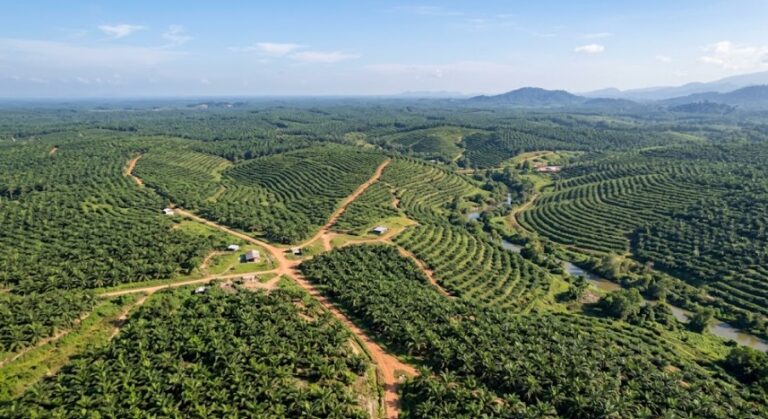
JAKARTA – The palm oil industry players are confident that the prolonged dry season caused by the ongoing El Nino phenomenon in Indonesia will not significantly affect the production of palm oil. They even believe that the crude palm oil (CPO) production this year will increase by around 5%.

The Indonesian Palm Oil Association (GAPKI) Chairman Eddy Martono said that the possibly worst impact of dry season this year is the possibility of late harvest. “Regarding the prolonged dry season, it won’t affect production this year. It may just cause late harvest,” Eddy told a press conference on GAPKI’s plan to organize the Indonesian Palm Oil Conference (IPOC) 2023 and Price Outlook that will be held in Bali on 1 – 3 November 2023.
According to Eddy, the prolonged dry season this year will only impact the production of palm oil next year. “Next year will see a decrease of production if the oil palm plantations are not well-maintained,” he said.
Eddy Martono said that if the oil palm plantations are well maintained, there will be no problem with production. “But even if production in trouble, it won’t be as bad as that in 2015 and in 2019,” he said.
He cited as an example the case of Kalimantan, which had been hit by dry season for the last three months, while Sumatera had only seen it during the last two months. “There were still scanty rainfalls. It won’t affect production. But without good maintenance, the prolonged dry season will cause production decrease in the following year and possibly in the next two years,” he said.
During the same occasion, GAPKI Secretary General Hadi Sugeng said that the long dry season will affect production if growers failed to implement best practices in their respective plantations. In that case, the impact to production can be seen until the next two years.
“GAPKI member companies have been given guidelines on how to deal with the El Nino phenomenon as part of the best agriculture practices already socialized among the growers. The best practices include reducing chemical activities, optimizing fertilizing with organic materials, and preventing maintenance activities that could trigger fires,” said Hadi Sugeng.
According to him, a number of plantations owned by GAPKI members had been hit by the dry season during the last two months, causing a delay of production. But production this year is projected to grow by around 5%.
Hadi Sugeng said that as of July 2023 the production of CPO and PKO rose by 17% equivalent to 32 million tons. For domestic consumption for foods, oleochemicals and biodiesel, there was a growth of around 11% or almost 13 million tons.
At the same period, the export volume of palm oil rose significantly by 33% or around 19.8 million tons. “But export value saw a decrease of 18% to Rp260 trillion, compared to that of the same period last year,” said Hadi Sugeng.
GAPKI predicted that the production of CPO and PKO until the end of this year will reach around 54 million tons. There will be also an increase of domestic consumption at around 23 million tons due to the increase of biodiesel 35 percent (B35) production and consumption. “We’ll keep the stock over 3.2 – 3.3 million tons until the end of 2023,” he said. (*)
Source: sawitkita.id