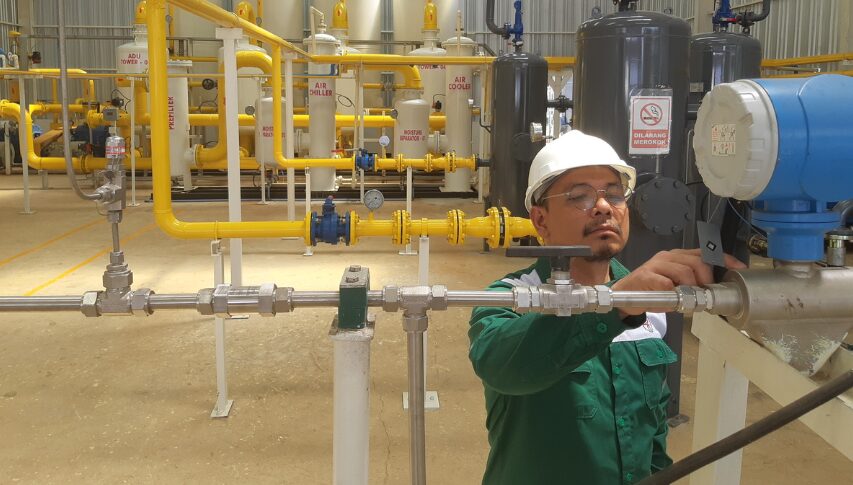
STABAT — The biggest plant of compressed biogas in Asia has started its commercial production in Langkat regency of North Sumatera (Sumut) province, which is one of major palm oil producing regions in Indonesia. The plant, which produces the biogas from palm oil waste, has a production capacity of 300 MMBTU per day.
As the world’s largest producer of palm oil from its total oil palm plantations of 16.8 million hectares, the plant will have enough supply of palm oil waste as raw material to produce the compressed biogas, which is expected to reduce the country’s import of liquefied petroleum gas (LPG).
”The compressed biogas will increase the contribution of renewable energy in our national energy mix. This is also part of the government’s commitment to reduce the greenhouse gas emission,” the ministry of energy and mineral resources’ (MEMR) Bioenergy Director Edi Wibowo said during the inauguration ceremony of the plant in Langkat on Monday (22/1/2024).
The compressed biogas plant is developed by the Knowledge Integration Services (KIS) Group with a brand name of Biomethane Compressed Natural Gas (BioCNG). The compressed biogas is also known as compressed biomethane (CBG).
KIS develops the first commercial biogas plant on the location of palm oil mill owned by PT United Kingdom Indonesia Plantations in Langkat regency. It is the first of the planned 25 biogas plants in Sumut and Riau provinces.
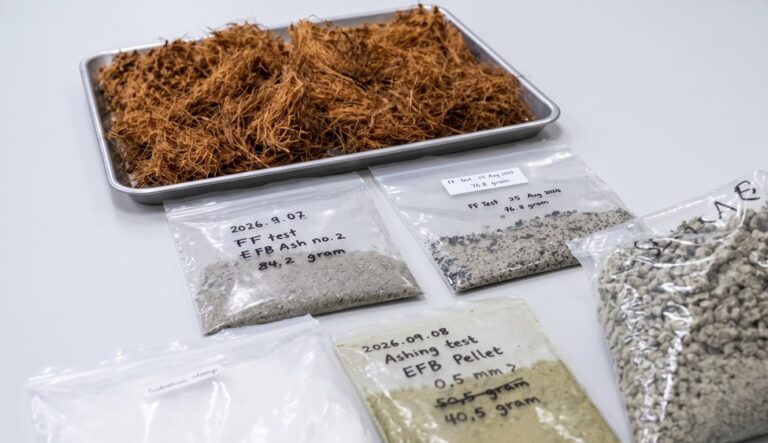
Edi said that as the world’s largest producer of palm oil, Indonesia has a very big potential to expand the biogas industry. “Around 60% of fresh fruit bunches (FFB) become waste, which can be used as raw material to produce green energy. The total bioenergy potential from the palm waste is equivalent to 57,000 megawatt (MW) of electricity. As a comparison, PLN (state-owned power company) now has an installed generation capacity of around 73,000 MW,” he said.
Actually, palm oil companies have long seen the opportunity. Many of them tried to process their waste into biogas. The waste is fermented within the anaerobic tank to produce methane gas of 40-60%. With low concentration of methane gas and not compressed, such type of biogas can only be used for power generation to meet own power need. The biogas is not efficient to be sent to other places due to its big volume.
But the technology of compressed biogas can increase the concentration of the methane gas up to 96% and its volume can be compressed significantly. The technology of compressed biogas makes the transportation of biogas in truck tubes economic.
Edi said that in the near future, the compressed biogas can also replace or mixed into the non-subsidized LPG for industrial and commercial sectors, which is sold within 12-kg LPG canisters and 50-kg LPG canisters. Currently, 74% of LPG consumed in Indonesia is produced from natural gas with dominant elements of propane and butane, which is imported.
The compressed biogas is also the important part of the national production target of 490 million cubic meters of biogas in 2025. Currently, Indonesia’s total production of biogas has reached around 100 million cubic meters.
KIS Group CEO KR Raghunath said that their BioCNG production, which is the largest in Asia, will be transported with trucks to supply the oleochemical plant owned by PT Unilever Oleochemical Indonesia in the special industrial zone of Sei Mangkei in Simalungun regency, Sumut.
“We’re optimistic that we can develop all of the planned 25 compressed biogas plants. We’ll invest US$110 million for the development. The BioCNG plants will reduce carbon emissions by 3.7 million tons of CO2 per year, create green job opportunities, and create multiplier effect for sustainable economic development,” he said.
Managing Director of PT Unilever Oleochemical Indonesia, Sai Krishna said that Unilever uses the BioCNG as part of their commitment to stop carbon emissions from the use of fossil fuels in 2030.
”Everyone knows that oleochemical industry needs huge energy. The use of BioCNG for our plants is part of our commitment to implement the circular economy,” said Krishna. (*)
Source: kompas.id