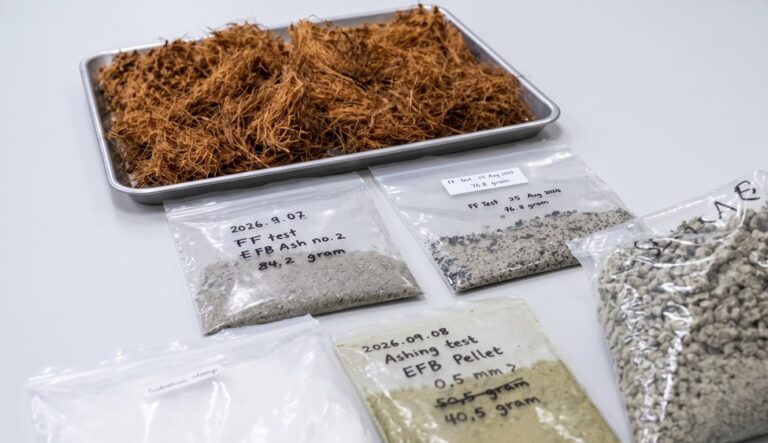
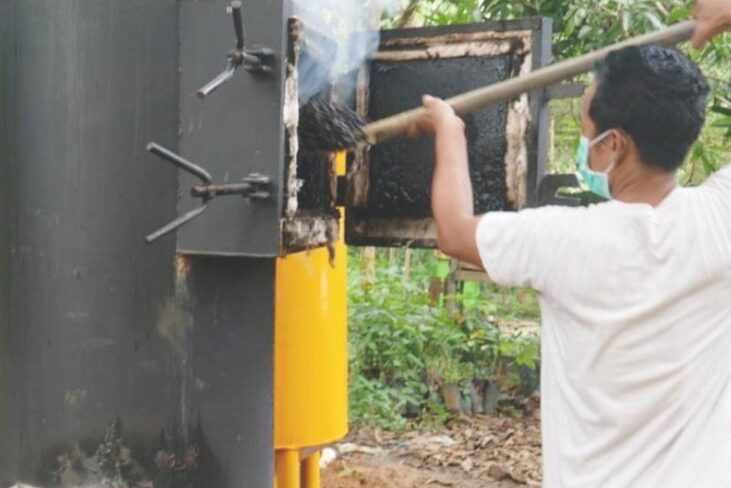
JAKARTA – Solid wastes of empty palm fruit bunches, palm shells, and palm fiber can be still processed into useful product. Through pyrolysis method, the mixed wastes can produce liquid smoke as the main product and charcoal as side product.
The liquid smoke contains compounds of phenolic, carbonyl and acid, which can be used as chemical raw material for organic insecticide in controlling pests such as fire caterpillars.
The organic insecticide was discovered by Dudi Haryadi and the research team from the Langlangbuana University in Bandung, West Java, which is supported by the oil palm plantation fund management board (BPDPKS). The use of the liquid smoke from the solid wastes is applied with the technology of distillation.
The research result is published in a book titled “Grant Riset Sawit 2023” (Palm Oil Research Grant 2023) under the headline “Studi Efektivitas Destilasi Asap Limbah Padat Kelapa Sawit Menggunakan Teknologi Distillation Cyclone Sebagai Insektisida Alami Ulat Api (Study of Effective Distillation of Liquid Smoke from Solid Wastes of Oil Palm, Using Technology of Cyclone Distillation, as Organic Insecticide to control fire caterpillars). The distillation with the cyclone technology is an innovation to produce liquid smoke of grade C and grade A with better quality.
The cyclone technology applies the principle of the smoke centrifugal rotation derived from the pyrolysis of the solid palm wastes to be separated from the ashes that carried away. The solid wastes used are from palm shells and empty fruit bunches.
Apparently, the liquid smoke derived from the pyrolysis with the use of cyclone distillation equipment is clearer compared to the liquid smoke derived from distillation equipment without the application of cyclone technology.
During the research, the liquid smoke derived from the cyclone technology will be reanalyzed to find out whether there is a difference of compound concentration in the smoke.
The challenge is not easy to tackle as the making of cyclone-based distillation technology at the scale of industry to produce liquid smoke at the required quality and expectation needs a big support.
Besides, further improvement of the distillation equipment being currently developed is needed to increase the quality of resulted liquid smoke. Usually, the liquid smoke from palm shells and empty fruit bunches contain phenol, acetic acid, 2,6-dimethoxyphenol (Syringol), acetic acid, oxalic acid, dihydrocyclobenzene, 2-mitoxiphenol, and 2-mitoxi-metil phenol.
These componds have the potential to control the main pests of oil palm trees, such as the fire caterpillars. During the research, the team also conducted an experiment of fire caterpillar rearing for test samples in the test of using the liquid smoke as insecticide. A Toxicology testing was still conducted to find out the potential of several liquid smokes derived from a number of solid palm wastes. (*)
Source: sawitkita.id