JAKARTA – President Joko Widodo (Jokowi) received a visit from Norwegian Climate and Environment Minister Andreas Bjelland Eriksen in Jakarta on Sunday (02/06.2024) to discuss bilateral cooperation and the issue of palm oil discrimination.
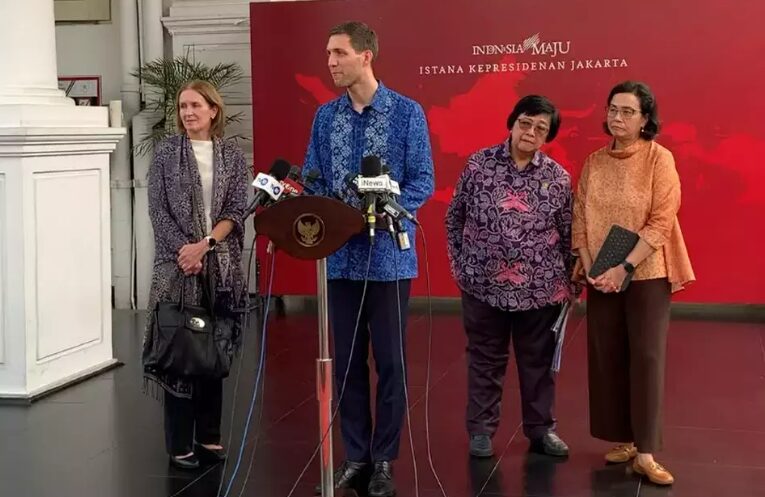
Environment and Forestry Minister Siti Nurbaya Bakar and Finance Minister Sri Mulyani accompanied President Jokowi during the meeting at the Merdeka Palace in Jakarta. Minister Siti Nurbaya emphasized that achieving the Forest and Other Land Uses (FOLU) Net Sink 2030 targets is among Indonesia’s top priorities.
Norway recognized Indonesia’s efforts in reducing carbon emissions and rewarded the country with US$156 million, she added. This financial incentive reflects Indonesia’s success in curbing 30.2 million tons of carbon emissions.
During the meeting, President also urged the Norwegian government to avoid discriminatory practices against Indonesian palm oil. “In the meeting, the President requested that Norway ensure accurate understanding and perceptions to prevent discrimination against palm oil,” said Siti Nurbaya during a press conference at the Presidential Palace complex in Jakarta.
Indonesia is currently protesting the EU Deforestation-Free Regulation, which is seen as discriminatory towards palm oil. “Indonesia is also scrutinizing the land inventory method, and we are continuously working on this,” she added.
The discussion also covered the Memorandum of Understanding (MoU) between the Indonesian and Norwegian governments to achieve Indonesia’s Forestry and Other Land Uses (FOLU) Net-Sink 2030 target.
“We discussed the MoU cooperation between Indonesia and Norway, with the main goal being the Indonesia Forestry and Other Land Uses. Concrete support or contributions were mentioned, such as a climate action achievement worth US$ 156 million, equivalent to 30.2 million tons of carbon,” Siti Nurbaya continued.
Andreas Bjelland Erikson praised the Indonesian government’s efforts to reduce deforestation by 90 percent in his response. This achievement has prompted Norway to rekindle its environmental cooperation with Indonesia.
“We proudly present our cooperation and collaboration with Indonesia due to its significant achievements in reducing deforestation over the past few years,” said Erikson.
Erikson also emphasized the importance of Indonesia’s programs aimed at achieving the Net Zero Emission target by 2023, which he believes should gain global attention.
“Indonesia’s ambitious goal towards Net Zero Emission by 2023 is something the world truly needs to know about. It proves that with good cooperation, strong leadership, and supportive institutions, we can achieve great things for the climate and nature,” he continued.
The EU’s deforestation-free regulation, also known as the EUDR, mandates that operators or traders prove their products do not come from deforested land. They must include precise geolocation coordinates in their due diligence statements before the goods can enter the EU market. Commodities subject to the EUDR include palm oil, timber, cocoa, soy, rubber, coffee, and their derived products.
The rules, which will apply on December 30, have ruffled the feathers of the world’s largest palm oil producers, Indonesia and Malaysia. The close neighbors sent a joint mission to the European bloc’s capital, Brussels, last May. The mission ended with the establishment of an ad hoc task force between Indonesia, Malaysia, and the EU to identify practical solutions to the policy.
Brazil, along with Indonesia and 15 other countries, sent a joint letter to the EU’s leadership, arguing that the EUDR has created “an inherently discriminatory and punitive unilateral benchmarking system that is potentially inconsistent with WTO obligations.” The letter was also signed by countries such as Thailand, Argentina, and Ghana, among others. (*)
Source: jakartaglobe.id