SURABAYA – Traffic accidents are often caused by over-slippery road due to its asphalt pavement being too smooth and lacking in roughness. To solve such road problem, a team of researchers from the faculty of civil engineering at Surabaya-based Sepuluh November Institute of Technology (ITS) has initiated a pavement modification by mixing asphalt with palm fiber waste and mudflow to increase the road structure’s strength and surface roughness.

Called Reswara 64 Team, the Research Team Head Bahrul Ilmi Mubarak said that the modification idea was also driven by the asphalt content that can cause significant emission. “We came up with an innovation to use the palm fiber waste and mudflow from Sidoarjo as materials for the asphalt pavement,” said Bahrul, the native of Paser regency in East Kalimantan province as reported by the website of ITS on Thursday (30/5/2024).
According to Bahrul, the carbon emission from the asphalt road can be resulted from a number of occurences on the asphalt road. For example, when exposed to sunlight it can emit three times the amount of carbon dioxide (CO2). “The maintaining process and pavement of the road also contribute to the carbon emission,” he said.
The pavement modification is implemented by adding a number of materials that can improve the road quality and reduce emission. The materials include airgel, iron oxide (Fe2O3) and split mastic.
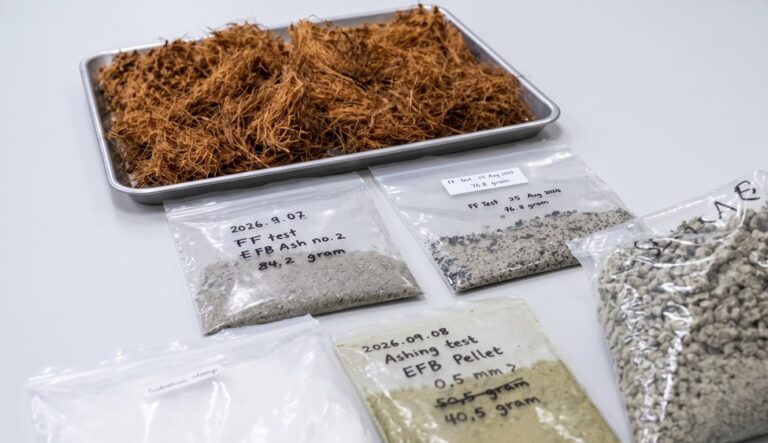
The airgel, which is derived from synthesis of silicon dioxide (SiO2) as extraction from Sidoarjo mudflow, has the capacity to absorb CO2. The iron oxide, which is extracted from mudflow as modified asphalt pigment, can reduce the temperature of the asphalt road. The split mastic with palm fiber additives from oil palm biomass functions to increase the road roughness and ability to absorb water. “With such modification, we can increase the technical life cycle of the asphalt roads,” said Bahrul.
He said that his team will establish partnerships with a number of companies to apply the road innovation. “We plan to partner with Lapindo Brantas Inc for the use of mudflow, with the National Research and Innovation Board (BRIN) for further research of the asphalt road modification, and with PT Sinar Mas Agro for the use of palm fiber wastes,” he said.
Procuring the palm fiber waste for the asphalt modification will be an easy task as it is abundant in Indonesia as the world’s largest producer of palm oil. The Reswara 64 Team, under the guidance of ITS Lecturer Cahya Buana ST MT, published the result of their asphalt research in a scientific report titled “Inovasi Laston Lapis Aus Berbasis Split Mastic-Aerogel dengan Aditif Limbah Serat Kelapa Sawit Termodifikasi Pigmen Fe2O3 dari Limbah Lumpur Sidoarjo”. With the scientific report, the Reswara 64 Team won the third award during the event of ADHI Innovation for Construction 2024, which was organized by state-owned PT Adhi Karya Tbk in February 2024.
The Reswara 64 Team, consisting of Bahrul Ilmi Mubarak, Marchel Audy Pratama and Em Syahdu Aflahis Salam El Wanda, hopes that their innovation can be adopted as high quality asphalt product by construction companies like PT Adhi Karya Tbk. “Hopefully, this innovative product can be further developed through further research and assessments of its various functional aspects,” said Bahrul. (*)
Source: sawitkita.id