JAKARTA – Palm oil industries are accused of causing damages to public roads. This is a serious accusation. But is it true? The following facts will answer the question.
Apparently, many people have accused that the oil palm plantations caused damages to public roads. The accusation was based on the activities of trucks transporting palm fresh fruit bunches (FFB) and crude palm oil (CPO) with overloaded capacity. Concerning the damaged roads, data from the public works and housing (PUPR 2021) shows that nationally the category of damaged roads (heavy and light) reached 8,306 Km or 26 percent of the total national roads.
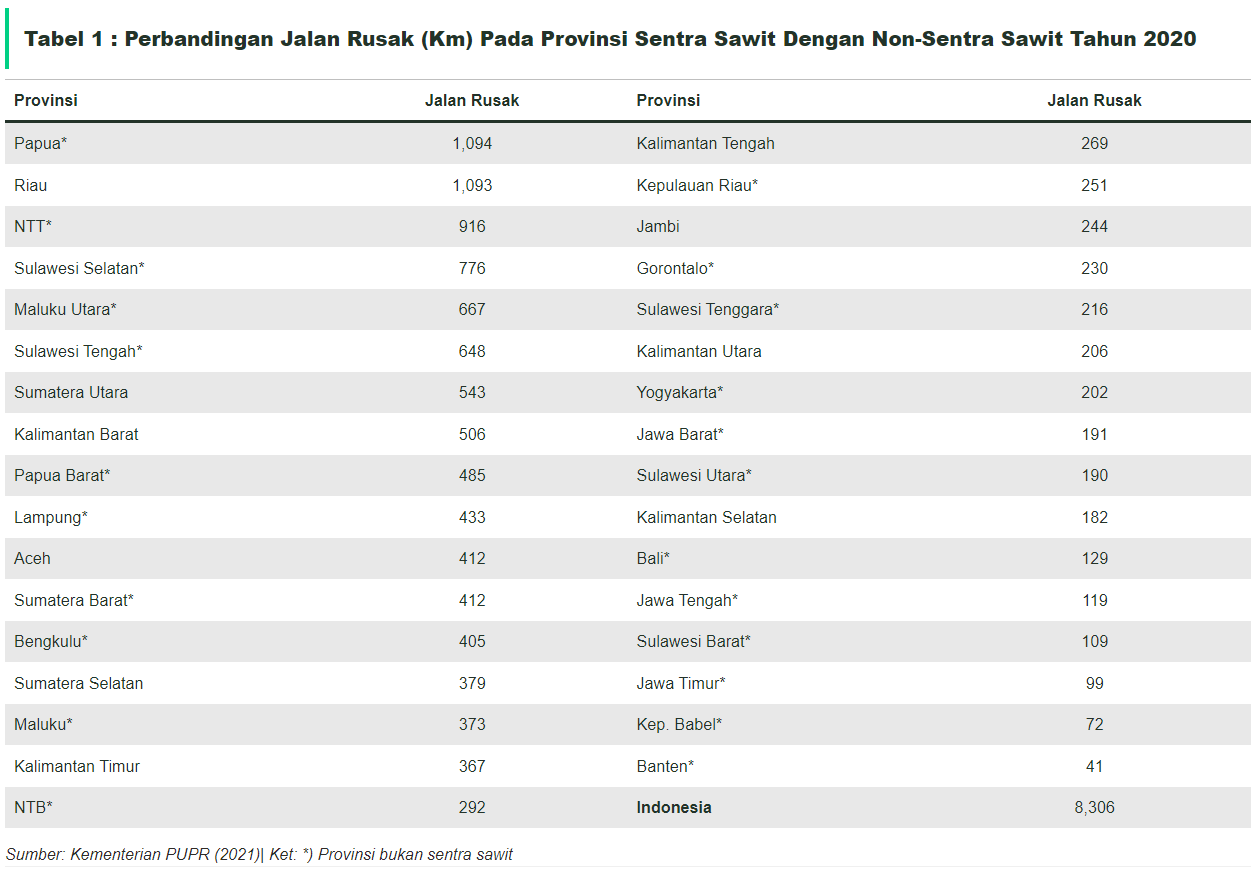
Based on provincial level (Table-1), the length of damaged roads in palm oil producing provinces reached 3,823 Km or 46 percent of the total length of the damaged national roads. The other roads (54 percent) are located in non-producing provinces, such as in Java island.
The data shows that the damaged roads are not only found in the palm producing provinces, but in the non-producing provinces as well. There is no convincing correlation that the damaged roads are only found in the oil palm plantation areas.
Based on data of potential villages (BPS, 2016, 2021) and Developing Village Index (Kemendesa PDTT, 2016, 2021) the proportion of quality non-asphalt roads (ground and hardened) in palm producing villages is higher than that in the non-producing villages (PASPI, 2022).
It can be easily understood considering that the palm producing villages are new villages that were developing after the development of palm plantations. Possibly, the issue that relates the palm plantations with the damaged roads is the fact that many non-asphalt roads are found in palm producing areas. But based on the context of damaged roads adopted by the government, the category of quality of public roads (good, medium, damaged and heavily damaged), is not related to the quality of road surface, asphalt or non-asphalt.
Despite the fact, however, the damaged roads, in palm producing areas and non-producing areas, are the issue that needs to be comprehensively tackled as it has to do with the cost of transporting people and goods and services.
Therefore, all stakeholders should take part in solving the problem with the aim of creating better quality of roads in the future. The stakeholders should keep realizing that public roads function to facilitate development, and they should always adjust the loads of their vehicles and trucks with the road capacity and durability in their respective regions. (*)
Source: Mitos & Fakta Kelapa Sawit – 4th Edition