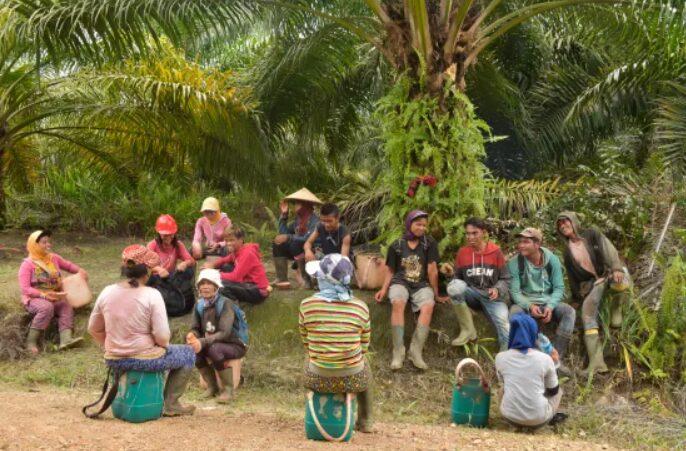
JAKARTA – Do palm oil industries restrict workers’ freedom of association? Let’s find out the answer through the following facts. The restriction of freedom of association among workers is one of social issues accused against the oil palm plantations. Many labor activists stated that palm companies ban and even intimidate their workers who involved in labor unions.
Within the current era of globalization and digitalization, when social media has been very advanced, it is almost impossible to limit the freedom of associations, freedom of organizations, and freedom of speech. The communication of workers is no longer limited within their respective companies, but it has been expanded beyond companies and even beyond countries.
In Indonesia, the freedom of associations is recognized and protected by the article 28E verse (3) of constitution, UUD 1945, which stipulates that every person has the rights for freedom of associations, organizations, and freedom of speech.
The phrase of “every person” mentioned in the article means all people in Indonesia, including workers in all economic sectors (including workers of palm plantations), have the rights for freedom of associations, organizations, and freedom of speech which are guaranteed by the constitution.
At international level, Indonesia has also ratified the convention of ILO (International Labor Organization) No.87/1948 and convention of ILO No.98/1956. The two ILO conventions confirm the rights of workers for freedom of associations and organizations, which are expected to enable them to fight for their interests. (Budiono, 2016). The guarantee of freedom of associations for workers in Indonesia has been further strengthened with the issuance of UU (Law) No.21/2000 on trade unions/labor unions; UU No.13/2003 on employment; and manpower minister’s decree No.16/2001 on guidelines of registering trade unions/labor unions.
As part of good corporate governance, palm plantations in Indonesia are also committed to admitting, guaranteeing, and protecting the freedom of associations among workers. The implementation of the commitment is reflected through the formation of labor unions at the level of respective palm plantations, and federations of labor unions, such as the national federation of palm plantations’ labor unions (FSPBUN) and the trade unions network/Indonesian palm labor unions (JAPBUSI). In addition to that, there are also palm associations, such as the association of Indonesian Oil Palm Smallholders (APKASINDO), Future Palm Oil (SAMADE), Farmers Group (POKTAN), Association of Farmers Group (GAPOKTAN), Palm Smallholders Cooperatives, Plantation Workers Cooperatives, etc, which have become parts of the freedom of associations and organizations.
The protection of the freedom of associations among plantation workers is also reflected in one of the principles of Indonesian Sustainable Palm Oil (ISPO), which is the responsibility of employment. Based on the ISPO principle, palm companies are required to facilitate the establishment of labor unions. It is expected that the palm plantation labor unions become part of stakeholders in creating a harmonious work ecosystem that can protect the rights of workers.
The above explanation shows that at the level of ideology, policies and SOP of companies, the freedom of associations among palm workers has become part of the corporate governance of palm companies.
The workers’ organizations are important partners of corporate managements in governing companies. But of course, the quality and intensity of palm workers’ organizations vary according to the conditions of respective palm companies. (*)
Source: Mitos & Fakta Kelapa Sawit –4th Edition (Mitos 4-18)