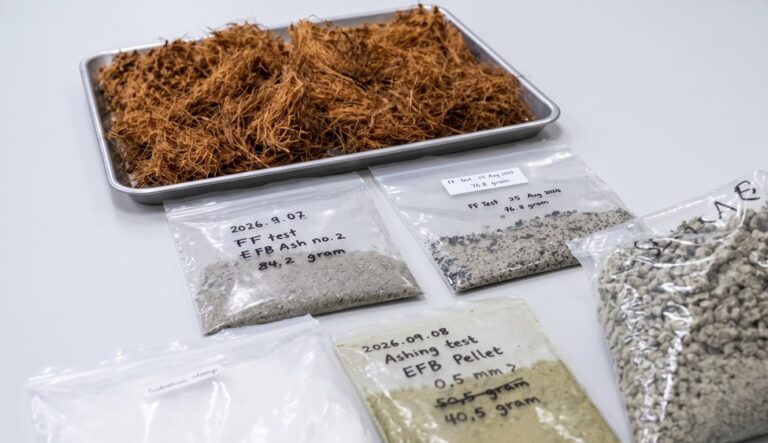
JAKARTA – Apparently, palm kernel shells (PKS) have many economic benefits, which are previously unthinkable. Previously, the palm waste is mostly used for furnace fuel, but now it is found potential as raw material for production of mild concrete required for construction of buildings.

The concrete based on the palm waste is named PalmCrete@. It is made based on the research result of the research team of the faculty of engineering of the University of Indonesia (UI), which is led by Sotya Astutiningsih.
The research on the use of PKS as raw material for production of concrete, which was started in 2021, was financially supported by the oil palm plantation fund management board (BPDPKS). The result of the research is reported in the book of Grant Riset Sawit 2023 with the title “PalmCrete: The Upcycle Use of Palm Kernel Shells as a Lightweight Aggregator toward Circular Economy”.
The team found through the research that the PKS can be categorized as wood-based material. The material has high hardness at the value of 26.9 based on the scale of hardness of Vickers method. If measured with the Vickers method, the hardness of the palm shells is close to the hardness of pure gold. Besides having high hardness, the shells also contain bio-oil , which has preservative properties to prevent termites.
Mild concrete made of palm kernel shells (PKS).
Concrete is a composite material consisting of gravel aggregate bound by sand and cement paste. Usually, the aggregates used in concrete are natural stone fragments. The normal concrete usually weighs around 2,400 kg/m3. But the aggregate with palm shells, named PalmCrete®, only weighs around 1,850-1,900 kg/m3.
According to Sotya Astutiningsih, the PalmCrete® has the average strength of 19.1 MPa (testing based on the standard of ASTM C-39 / SNI-1974-2011). The strength is equivalent with the normal concrete used in simple building structure such as house. The testing based on experiment by using Digital Image Correlation (DIC) was conducted on the cube specimens of 15 cm under compressive loading.
Besides the DIC method, a testing is also conducted on reinforced beam with dimensions of 15 cm x 25 cm x 300 cm under semi-cyclic loading.
With the DIC technique, it shows observation data of no cracking on the shells-based concrete blocks. The result of analysis shows that PalmCrete® behaves like normal concrete under four-point bending loading.
Under the semi-cyclic loading, the PalmCrete® shows higher ductility than the normal concrete. It indicates its potential to be more earthquake resistant. Other advantage of the PalmCrete® is its pervious nature, which is potential for application as paving blocks with drainage. But it still needs further and deeper studies for such potential usage.
The mild concrete from the palm shells was first introduced during the “Semarak Usaha Kecil Mikro dan Koperasi (UKMK) Sawit 2024” (Palm Oil Small Businesses and Cooperatives Forum 2024) in August 2024, organized by the BPDPKS in Makassar.
Sotya said that with potential use of palm shells for concrete, the oil palm trees have proven to be a very versatile plant from roots to leaves. There is nothing wasted from all parts of the palm tree from the roots to the leaves. (*)
Source: sawitkita.id