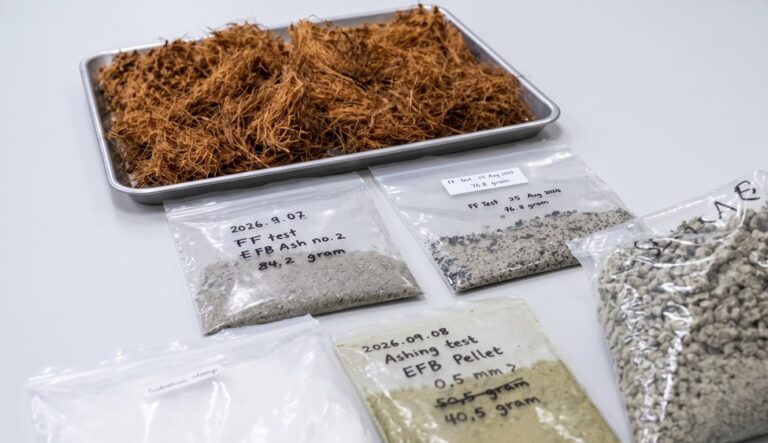
JAKARTA – A research team from Bandung Institute of Technology (ITB) has proven that wastes from oil palm trees can be also used to make batteries and supercapacitors.
Led by Professor Dr. Tirto Prakoso, the ITB research team has conducted their research on the battery since 2018. During their first stage of research, they created active carbon, modified graphene and carbon nanotubes (CNT). On the second stage, they managed to increase extraction of active carbon, graphene and CNT from the palm wastes, through the process of reproducible.
Then on the third stage in 2022-2023, their research was focused on increasing the application rate of technology to produce nanocarbon by validating the engineering design of nanocarbon production at commercial scale. During the third stage of research, they made single cell battery prototype with good performance and prototype supercapacitor stack module with polymer gel electrolyte. The prototype supercapacitor module is applied for electric bicycle.
The battery from palm waste is a zinc-air battery of the type of single coin cell, which is fabricated by using a nanocarbon-based cathode and polymer gel electrolyte.
The synthesis of polymer gel electrolyte based on the materials of PVA, SiO2, and CMC impregnated with 6 M KOH produces ionic conductivity at 12 mS/cm. This fabrication and testing produces the highest voltage at 0,3 V with discharge time of 400 seconds at current density of 0,01 mA.
Currently, the ITB research team is developing the energy source to get higher power capacitance per unit cell. They managed to get the highest ionic conductivity at 49 mS/cm. This fabrication and test of the zinc-air battery of pouch cell type also produces highest working voltage at 0.9 V with discharge time of 1.0 hour at current density of 10 mA/cm2.
On this research, the synthesis of polymer gel electrolite for supercapacitor based on KOH, PVA, and KI is resulted in the product with conductivity of 21 mS/cm. In this case, the highest capacitance of supercapacitor coin cell reaches 33.18 F/g, which is higher than the capacitance derived from supercapacitor cell based on polymer gel electrolite of 20.28 F/g. The stability of cycle of supercapacitor cell based on redox mediator also increases from 87% to 113% at 5,000 cycle.
To achieve higher capacitance per unit cell, the fabrication of supercapacitor is made in the form of pouch cell. The cell performance shows capacitance value at 90 F, voltage of 1.2 V, and current of 900 mA with charge-discharge time of 60 seconds.
To find out the profile of heat voltage/current, the ITB research team conducted a simulation of electro-thermal pouch cell. The thermal simulation shows the number of cells in the module affects the maximum temperature of module. The result of thermal simulation of a supercapacitor module consisting of 100 cells show the maximum temperature value still below the required temperature (T < 60 oC), so it does not require a cooling system.
The design and fabrication of the supercapacitor module is aimed to produce a voltage of 72 V and a capacitance of 90 Farad arranged in series. The application of supercapacitor module is applied to electric bicycles as provider of electrical energy by using the battery of electric bicycle. The testing result of the supercapacitor function in electric bicycles shows good performance, resulting in faster acceleration of 5-10% at peak power loads. (*)