JAKARTA – Mangroves are tropical trees growing in coastal intertidal areas. Creating coastal ecosystems which function as habitats for many creatures, such as birds, crabs, and other marine biota, the mangrove forests are able to create environmental balance and support climate resilience for the surrounding areas.

Realizing such strategic role of mangrove forests in environment, the Indonesian Palm Oil Entrepreneurs Association (GAPKI) has been continually implementing its green commitment of planting mangrove trees in a number of locations across the archipelagic country of Indonesia. The last of such endeavor was undertaken in Ketapang Urban Aquaculture, Ketapang village of Tangerang regency on Wednesday (04/12/2024).
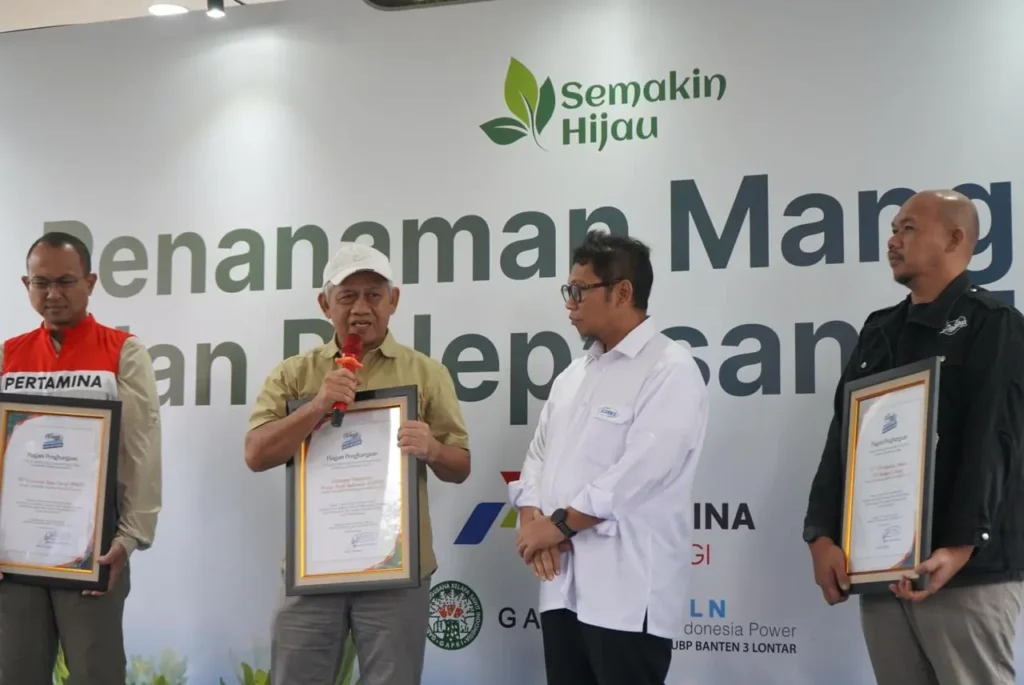
“Although we are palm oil producers grouped in the Indonesian Palm Oil Entrepreneurs Association, we’re highly concerned with the environment as a whole. We don’t just care about palm oil alone. GAPKI stays consistent in increasing climate resilience through reforestation and nature conservation such as the planting of mangrove trees,” GAPKI Executive Director Mukti Sardjono said at Ketapang Urban Aquaculture, Ketapang Village, Tangerang on Wednesday (04/12/2024).
In the Campaign of Going Greener initiated by Radio Elshinta, GAPKI was given the award of “Outstanding Conserving Sustainable Nature” for its role in preserving nature and the environment.
On the same occasion, the Tangerang Regency Government, GAPKI, PLN, Radio Elshinta and other stakeholders planted mangroves and released “mimi” (a kind of crab).
During the occasion of mangrove planting, which was attended by the Indonesian Environmental Forum (WALHI), Mangrove Jakarta Community, Kesemat Mangrove Volunteer, Indonesian Women Paddler Community, and the environmentalist community of UI, IPB, Yarsi, and UIN, the participants simultaneously planted mangrove trees and released 64 mimi or endangered horseshoe crabs at Ketapang Urban Aquaculture, Ketapang Village.
Previously, during the last three years GAPKI had rehabilitated 50 hectares of mangrove forest in West Kotawaringin, Central Kalimantan. It is aimed to prevent abrasion in the coastal area of West Kotawaringin, which saw the highest level of abrasion in Central Kalimantan province.
“We have to consider that the earth we step on today is not a legacy from our ancestors, but a gift from our children and grandchildren. There are two right moments to plant trees, 20 years ago and today. This means that it is never too late to plant trees,” said Acting Regional Secretary (Sekda) of Tangerang Regency, Soma Atmaja.
He said that the local government and Bogor University of Agriculture (IPB) will establish a Mangrove Research Center in the area. Since 2014, Ketapang Village has been carrying out mangrove rehabilitation as an effort to organize the coastal area. Soma Atmaja showcased the success of this effort with visits from world institutions such as the World Bank and the United Nations Development Program (UNDP). (*)