JAKARTA – Often during leisure times, we indulge ourselves in eating tasty fried snacks and seeping our coffee in-between our bites. But then, we’ll possibly hear someone, maybe our closest friend, said: “The fried snacks contain high cholesterol”.
Hearing such statement, what will be your response? Will you stop eating the snacks? Or will you perhaps just continue eating it unaffectedly?.
Actually, cholesterol is a common word, especially because it is concerned with human health. But apparently, many people do not understand the meaning of cholesterol.
What is Cholesterol?
Cholesterol is a fat compound found in blood and throughout human body. It is often a scary thing for many people, despite the fact that actually it is not completely bad.
Cholesterol is needed by human body to build cell membranes and make hormones. The cholesterol in human body is divided into 2 types, namely LDL cholesterol (Low-Density Lipoprotein) and HDL cholesterol (High-Density Lipoprotein).
LDL cholesterol
LDL cholesterol is a type of lipoprotein that carries cholesterol from the liver to the rest of human body. When the blood has a high level of LDL, cholesterol can accumulate on the walls of the arteries, which is called atherosclerosis. In that case, it can cause narrowing of the arteries and increase the risk of heart disease and stroke. That is why LDL cholesterol is often referred to as “bad cholesterol”. (*)
HDL Cholesterol
Called as “good cholesterol”, the HDL cholesterol is a type of lipoprotein that carries cholesterol from the body back to the liver. In the liver, the cholesterol is then processed and excreted from the body through bile. HDL cholesterol functions as a natural cleaner for the arteries, helping to remove excess cholesterol from the bloodstream and preventing plaque buildup so that it can help protect the body from heart and other diseases.
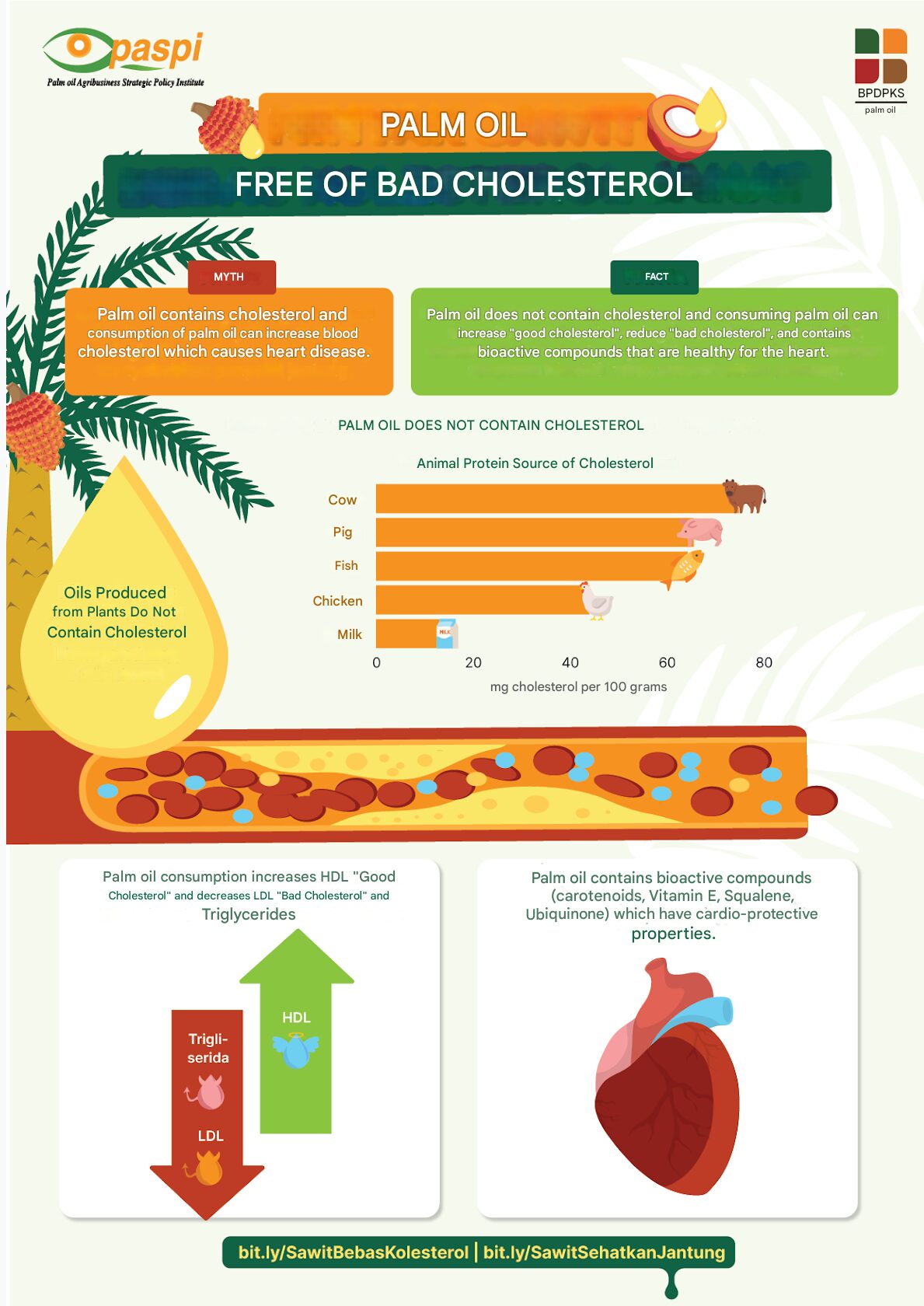
Cholesterol is also one of the issues used by anti-palm oil groups to launch black campaigns and disseminate false news such as palm oil contains cholesterol and consumption of palm oil can increase blood cholesterol which causes heart disease.
The Myth Of Containing Cholesterol
The growing stigma that palm cooking oil contains cholesterol has caused people to avoid foods containing palm oil, which include fried foods. However, it turns out that what the community feared was never proven. So far, not a single nutritionist in the world has said that palm cooking oil, which is a vegetable cooking oil, contains cholesterol. Various studies show that plants do not have the ability to produce cholesterol. Cholesterol is only produced by animals and humans. (*)
Scientific Facts About Palm Oil
Based on a study by Fauziati et al., (2019), palm oil contains phytosterols, which are vegetable sterols and function as bioactive compounds to reduce cholesterol levels in human blood. It shows that palm oil tends to be “net neutral” because it does not affect cholesterol levels in the body. Other bioactive compounds in palm oil such as squalene and polyphenols also have the function of inhibiting the absorption, reabsorption and synthesis of cholesterol.
The link between consuming palm oil and increasing cholesterol is also just a myth. The study of Mien et al. (1989) revealed that consumption of palm oil can reduce LDL by 21 percent and reduce triglycerides by 14 percent and increase HDL by 24 percent. It means that consuming palm oil actually reduces bad cholesterol and at the same time increases good cholesterol which is beneficial for body health.
Consuming palm oil can also prevent the risk of heart disease because palm oil has a balanced fatty acid content, free of trans fatty acids, and is equipped with various bioactive compounds which have the function of protecting heart health. (*)
Conclusion
Cholesterol is a fat compound that can be found in the blood and throughout the human body. There are two main types of cholesterol: LDL (Low-Density Lipoprotein) cholesterol and HDL (High-Density Lipoprotein) cholesterol. LDL cholesterol is often referred to as “bad cholesterol” because its high levels in the blood can increase the risk of heart disease and stroke. In contrast, HDL cholesterol is known as “good cholesterol” because it helps clean arteries and protects the body from heart disease.
So far, there has been a stigma that says that palm oil contains cholesterol, which has caused many people to avoid foods that contain palm oil, such as fried foods. However, until now, nutritionists around the world have never proven that palm oil contains cholesterol. This is because cholesterol is only produced by animals and humans, not by plants such as palm oil.
Scientific studies also support the fact that palm oil does not affect cholesterol levels in the body. In fact, several studies show that consuming palm oil can help lower LDL (bad) cholesterol levels while increasing HDL (good) cholesterol levels in the blood, providing significant health benefits. So, palm oil can be part of a balanced diet and help protect heart health. (*)
Palmoilina.asia. Minyak Sawit Mengandung Kolesterol Jahat ? (2023). https://palmoilina.asia/berita-sawit/apa-sawit-mengandung-kolesterol-jahat/. November 2, 2023