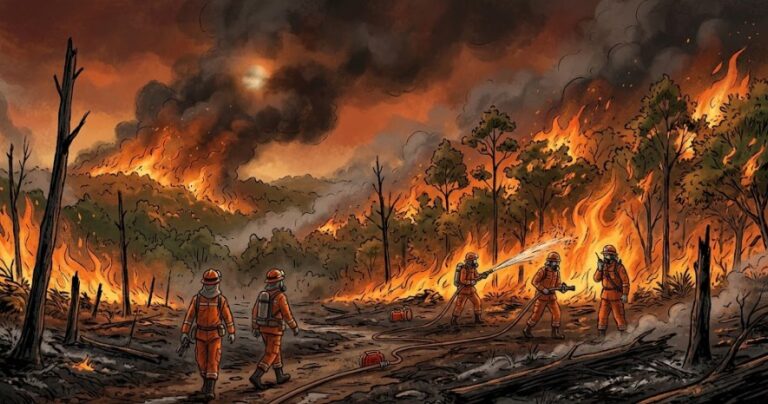
JAKARTA – You might be familiar with the word of deforestation. Perhaps, most of people do so. But do you actually know the meaning of deforestation?
It can be said that deforestation is a series of activities to convert forests into non-forest functions. It is aimed to provide land areas for certain development projects, such as development of residential areas, industries and agriculture or plantations.
Global History of Deforestation
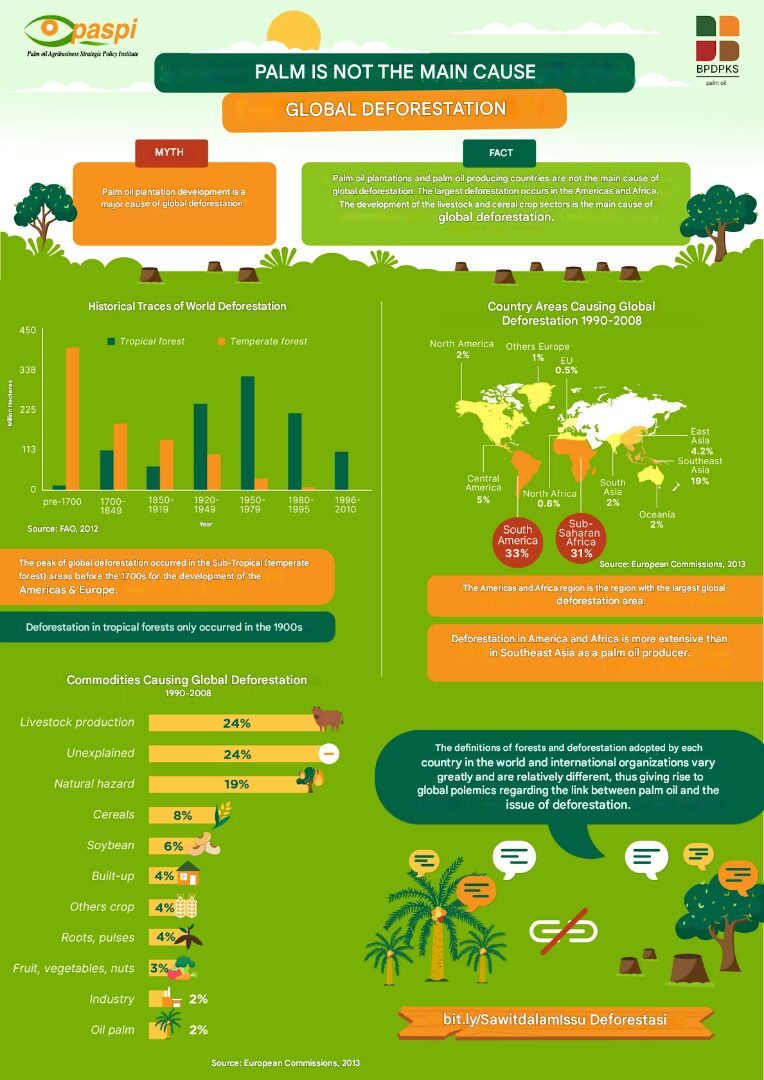
The history of human civilization shows that the deforestation is a normal phenomenon that occurs in every era and every country across the globe. The global development process that began earlier in subtropical regions (such as mainland Europe, North America, etc.) caused deforestation of subtropical forests (temperate forests) and reached its peak ahead of the year 1700.
Global Deforestation Patterns Based On Horton Study (1996)
A study conducted by Horton (1996) also confirmed global deforestation patterns. During the period of 1850 to 1990, land areas cleared throughout the world increased from 289 million hectares to 2.52 billion hectares, consisting of 1.6 billion hectares of temperate grass land, 508 million hectares of tropical forest, 91 million hectares of temperate forest, and 1.6 billion hectares of boreal forest.
There has been a perception among wider communities that the development of oil palm plantations is the main cause of global deforestation. But does it match the existing facts?
Based on the history of deforestation above, most of the deforestation of sub-tropical forests occurred in mainland Europe and North America. The regions with the largest amount of global deforestation are the Americas (South and Central America) and Africa. About 71% of global deforestation occurs in these two regions. Meanwhile, the rate of deforestation in Southeast Asia (the location of most of the world’s oil palm plantations) is currently only 19 percent.
Main Cause of Global Deforestation Based on EC Study (2013)
According to a European Commission (EC) study in 2013, the top 4 main drivers of global deforestations during 1990-2008 were the agricultural sector (54 percent), natural disasters (17 percent), housing infrastructure development (4 percent), and industry (2 percent). If we look at the biggest contributors to global deforestation based on commodity, the oil palm plantations have a very small proportion, which is only 2 percent. Meanwhile, the largest contributors are livestock (24 percent), cereals (8 percent) and soybeans (6 percent). (*)
Different Definitions of Forest Adopted By Countries
The attribution of oil palm plantations to the issue of deforestation is resulted from the fact that definitions of forest and deforestation adopted by countries and international organizations are very diverse and different. Lund’s study (2013) found that there are different definitions of forest from administrative aspects, land cover, land use, land capability, and found almost 1,600 definitions of forests and around 240 definitions of trees that apply in various countries in the world at both local, national and international levels. With these diverse definitions of forest, deforestation also has various definitions following the variations in the definition of forest adopted. This condition certainly raises polemics and links palm oil as the cause of global deforestation. (*)
Palmoilina.asia. Deforestasi Global: Perjalanan, Realitas, dan Kontroversi Perkebunan Sawit (2023). palmoilina.asia/berita-sawit/perjalanan-deforestasi-global/. November 27, 2023