JAKARTA – Considered increasingly worrying, the global climate change has become the most frequently discussed issue among global communities during the last few decades. As it is potential to cause serious impacts to human life on earth, the global communities have been trying to tackle the problem of global climate change.
Such efforts have been regularly pursued by global leaders every year through the Conference of Parties (COP) to discuss issues and commitments of each country in minimizing the increase of the earth’s temperature and mitigating the impacts of climate change.
One way to mitigate the impacts of global climate change is by reducing the increase of concentrations of greenhouse gas (GHG) emissions to the atmosphere through reduction of fossil-based energy consumption. The use of fossil energy (coal, oil, natural gas) that produces carbon dioxide (CO2) emissions is the main source of GHG emissions.
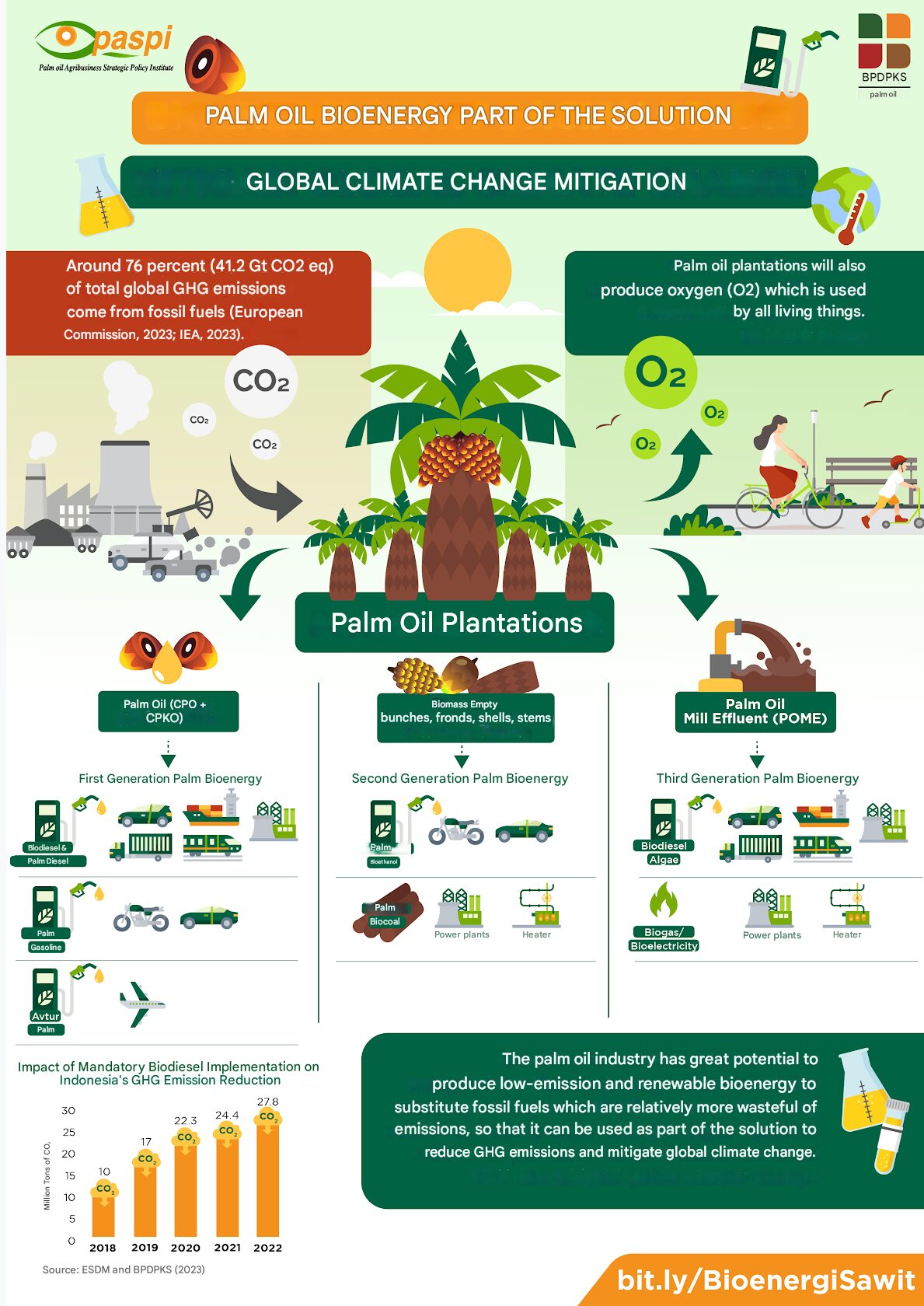
The latest data from the European Commission (2023) and IEA (2023) show that around 76 percent of global GHG emissions in 2022 (41.2 Gt CO2 eq) came from fossil fuels. The concentration of GHG emissions from fossil fuels has also increased by almost 1.5 times during the last 20 years. The large impact of the use of fossil fuels on global warming and climate change has led the global scientific community, such as the Intergovernmental Panel on Climate Change (2023), to issue a strong warning to stop using fossil fuels before it’s too late.
Reducing the consumption of fossil fuels to cut the GHG emissions to the atmosphere can be realized through the replacement of fossil fuels with renewable energy sources that only produce low emissions. One of the renewable energy sources is the palm oil-based bioenergy, which has proven to be an effective and efficient solution to mitigate the impacts of Global Climate Change.
The bioenergy from oil palm plantations can be produced in three generations of palm oil-based bioenergy as a joint product, which is increasingly sustainable.
Palm-based Bioenergy of First Generation
The first generation of palm oil-based bioenergy is obtained by processing palm oil (crude palm oil/CPO, palm kernel oil/PKO) as the main product of palm oil plantations. The first generation product is biodiesel (a mixture of fatty acid methyl ester and diesel fuel) which is used as a substitute of fossil diesel fuel.
In addition to biodiesel, green diesel or palm oil diesel is currently being developed to replace fossil diesel fuel, green gasoline (biopremium/palm oil gasoline) to replace fossil gasoline, and green avtur (palm oil bioavtur) to replace fossil fuel aviation fuel. The processing for green palm oil-based fuel also produces a joint product in the form of biogas which can be a substitute for natural gas/LNG.
Palm-based Bioenergy of Second Generation
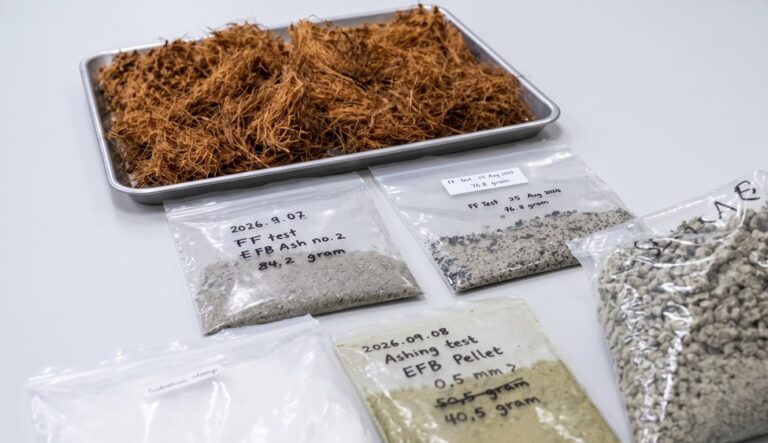
The second generation of palm oil bioenergy is obtained from the utilization of palm biomass. In addition to the production of palm oil as the main product (CPO/PKO), palm plantations also produce palm biomass wastes. The biomass wastes include empty bunches, palm kernel shells, fibers, palm trunks, and fronds. The palm biomass wastes can be utilized to produce various forms of bioenergy such as bioethanol, biocoal, briquettes, and biogas. Bioethanol can be a substitute or used in blending with fossil gasoline and biocoal is used as a substitute or blended with fossil coal.
Palm-based Bioenergy of Third Generation
The third generation of palm oil bioenergy is obtained from the utilization of POME (Palm Oil Mill Effluent) as the liquid waste from Palm Oil Mills. The methane capture technology can be used in POME ponds to capture methane gas and make it available for use in biogas/biomethane production. Biogas produced during POME processing is also widely used as a source of electricity for surrounding areas of the mills. Another technology that can be used to produce POME-based bioenergy is by using a methane capture sludge digester equipped with algae cultivation technology to produce algae biodiesel.
The advantages of Palm Bioenergy In Reducing GHG Emissions
Palm-based bioenergy has the advantage of being able to reduce GHG emissions if compared to fossil energy. The carbon footprint of palm bioenergy is also relatively lower compared to fossil energy. This is because palm bioenergy is produced from oil, biomass and wastes of plants which have first absorbed carbon from the earth’s atmosphere through their process of photosynthesis.
Various studies have also proven that palm bioenergy such as biodiesel has a relatively higher ability to reduce or minimize GHG emissions (emissions saving). Many researches conclude that the ability to save emissions produced by palm biodiesel is around 40-71 percent. The European Commission Joint Research Center study (2013) also revealed that palm biodiesel produced from palm oil mills, which apply methane capture technology, is able to save emissions (emission saving) by up to 62 percent. This ability is higher if compared to other kinds of biodiesel from other vegetable oils, such as rapeseed biodiesel (45 percent) and soybean biodiesel (40 percent).
Another advantage is that palm bioenergy is a renewable energy. As long as the sun shines and there is still carbon dioxide in the earth’s atmosphere, palm oil bioenergy will continue to be produced. But it is not the case with fossil energy which is a non-renewable energy that is increasingly depleted. Even the degree of sustainability of second and third generation palm-based bioenergy is getting higher because it is produced from palm wastes which have no value. (*)
Palmoilina.asia. https://palmoilina.asia/berita-sawit/3-generasi-bioenergi-sawit/. 3 Generasi Bioenergi Sawit. November 29, 2024