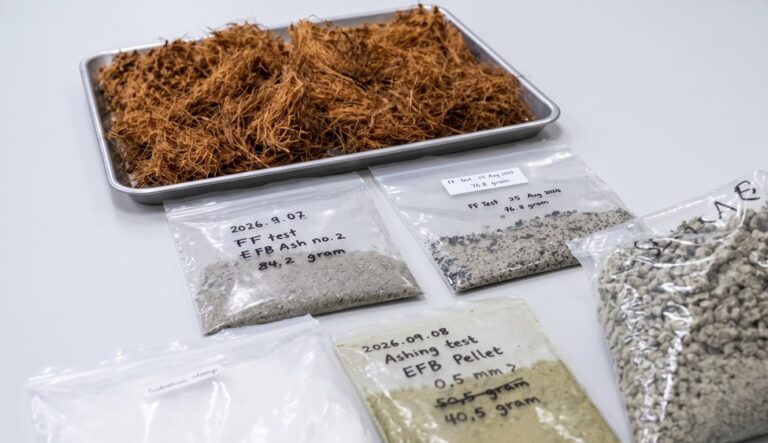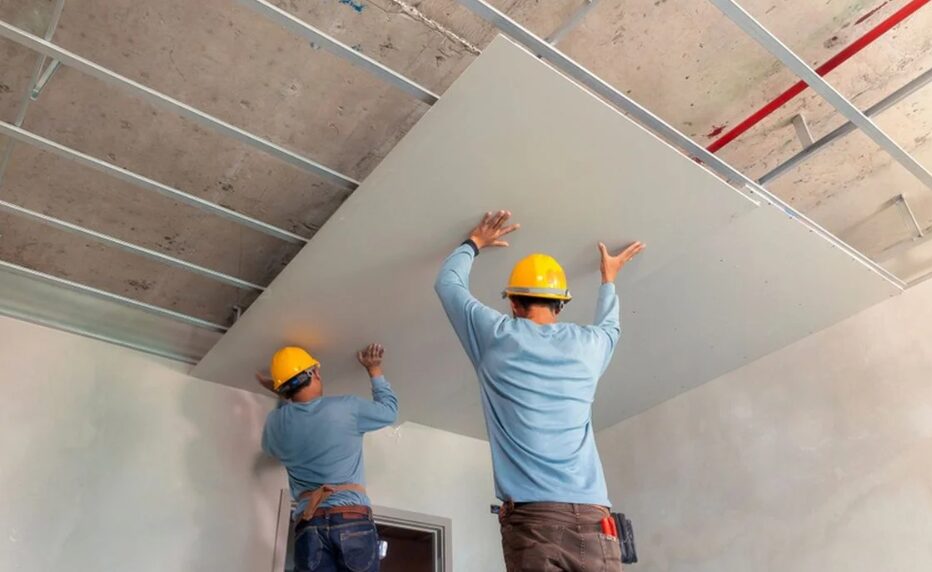
JAKARTA – The empty palm fruit bunches are one of the biomass wastes of palm oil industries, which can be processed into various products with economic benefits. Besides its potentiality as compost to fertilize soil and as raw material to produce energy products, the empty bunches are also potential to be processed into building materials, such as house ceiling.
Every hectare of oil palm plantations can produce around 23.3 tons of empty palm bunches per year, which can be used as raw material for production of the ceiling. The use of empty palm bunches for production of house ceiling is based on the research conducted by Ahmad, Ph.D from Ujungpandang State-owned Polytechnic College. The research result is reported in the book of “Grant Riset Sawit 2024” with the title “Development of Hybrid Composite of Empty Palm Fruit Bunches and Glass Which is Strengthened with Polyester For Application In House Ceiling.”
The discovery of Ahmad, Ph.D is named Composite Ceiling of TKKS Glass as diversification of the use of empty palm bunches in the form of lignoselulosa fiber resulted from the research he conducted with financing from the Plantation Fund Management Board (BPDP). The composite ceiling of TKKS Glass has scientifically proven that the addition of palm bunch fibers on polymer (biocomposite) with maximum concentration can increase the mechanic strength of ceiling usually used in building materials, such as plywoods, gypsum, asbestos and PVC.
To produce the composite fiber of TKKS Glass, Ahmad applies two methods, press and vacuum methods. His research resulted in a prototype of fiber composite ceiling of TKKS Glass in the forms of ceiling sheets with the size of 100 x 50 x 4 cm. The water and oil contents of the used bunch fibers after being cleaned with NaOH and dried out are respectively 6.06% and 1.44% as compared to the previous level at 40% (water) and 3% (oil).
Of the two methods, the method of press is able to increase the mechanic strength, such as tensile force, flexibility and impact compared to the vacuum method.
From aesthetic aspect, the press method produces very flat surface compared to the method of vacuum which is resulted in wavy surface. The palm bunch fibers hybridized with glass fibers with a composition of 40% : 60% resin increases the mechanic force, such tensile force, flexibility and impact.
Despite proven to raise strength, aestetics, flexibility and function, the research still needs further research by applying more regular use of empty bunches to balance the mechanic force per millimeter.
But the initial result of the research has proven that the empty palm bunches have other potentiality besides being processed into compost and energy products. The use of empty palm bunches as composite fibers for production of building materials will add the economic benefits of the palm biomass waste.
With the potential of empty palm bunches of 23.3 tons per hectare per year, the biomass waste has a huge potential for addition of economic benefits as Indonesia is the world’s largest producer of palm oil with a total plantation areas of 16.8 million hectares. The research is expected to be followed with other further researches until then reaching industrial scale to realize self-sufficiency in downstream technology and raw materials. (*) Source: sawitkita.id