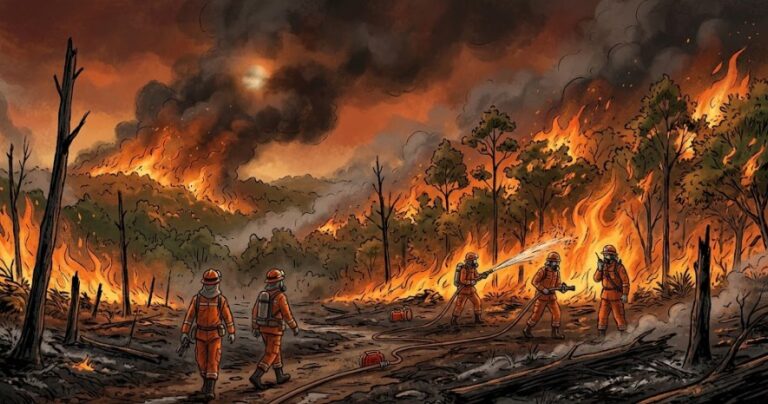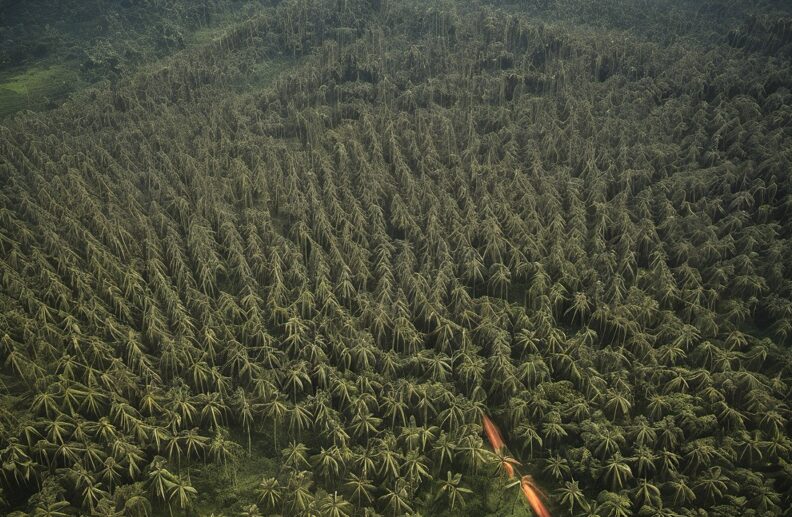
JAKARTA – The ministry of Forestry (Kemenhut) reported that deforestation in Indonesia in 2024 reached 175,400 hectares, which was mostly caused by forest and land fires (Karhutla), peatland fires, and illegal logging.
“After conducting ground check, and reviewing data, we know the causes of deforestation are mostly forest and land fires and illegal logging,” Kemenhut’s Forest Resource Inventory and Monitoring Director Agus Budi Santosa said during a press conference at the ministry on Monday (24/3/2025).
Based on the ministry’s data, net deforestation in 2024 reached 175.4 thousand hectares. The net deforestation is obtained by reducing gross deforestation at 216.2 thousand hectares with reforestation of 40.8 thousand hectares in 2024. Most of the gross deforestation occurred in secondary forests at 200.6 thousand hectares (92.8 percent), consisting of 69.3 percent inside forested areas and the rest outside forested areas.
He said that monitoring of deforestation was conducted across all land areas of Indonesia, covering around 187 million hectares, inside and outside forested areas, with satellite imagery of the National Research and Innovation Board (BRIN).
“Last year’s deforestation was higher than that in 2020. But based on the trend during the last 10 years, the deforestation rate was still declining compared to deforestation rate of 10 years,” said Agus.
Kemenhut reported that based on its monitoring result in 2024, Indonesia’s forest areas reached 95.5 million hectares or 51.1 percent of its total land areas. Of the total forest areas, around 91.9 percent or 87.8 million hectares are inside forested areas.
The ministry had been pursuing efforts of reforestation by rehabilitating forests and lands at the size of 217,900 hectares in 2024. The rehabilitation was conducted inside forests at the size of 71,300 hectares and outside forests at 146,600 hectares. The rest was aimed at maintaining the ecosystem of peatland to stay wet.
“One way pursued by Kemenhut to tackle the problem of deforestation is by rehabilitating peatland. Peatland is the most difficult to extinguish once it catches fire. So, we have to ensure that peatlands at the depth of more than 3.0 meters will stay wet,” said Agus.
“If it is wet, then once it catches fire, it won’t spread. So, it’s easier to be extinguished,” he said.
Another way of rehabilitation is through planting productive plants under program launched by directorate general of social forests. The plants vary from woody plants to non-woody plants.
He said that during the last one decade, the forest rehabilitation averaged at 230 thousand hectares per year. “Such effort will be recorded as addition of forest cover and agroforestry. A part of it will become secondary forest cover,” he said.
Agus said that steps taken by the ministry to reduce deforestation, include the implementation of the presidential instruction (Inpres) on moratorium of new licenses and improvement of primary forest and peatland governance, control of peatland damage and climate change, limitation of forest allocation for non-forest usage, forest conservation and development of social forest, rehabilitation of forests and lands, and forestry law enforcement. (*)
Source: TEMPO.CO / KOMPAS.com / ANTARA