JAKARTA – Palm oil companies under the Indonesian Palm Oil Association (GAPKI) have regularly implemented replanting program on around 4 – 5 percent of their total plantations, which are no longer productive due to their age of more than 25 years. The replanting is seen as a necessary step to increase or at least maintain the productivity and sustainability of palm plantations.
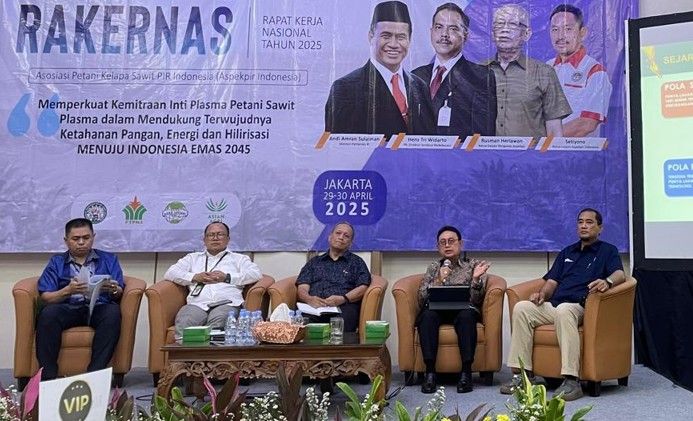
GAPKI Chairman Eddy Martono said that replanting is a must for the palm oil companies to maintain their production and financial performances. “Without replanting, their production will certainly drop. So, palm companies will have to conduct replanting program regularly every year to maintain their operational performances and to prevent any untowards from affecting their financial performances,” Eddy Martono said after addressing the national conference of the Association of Indonesian Nucleus – Plasma Plantations (Aspekpir) 2025 with the theme “Strengthening Partnerships of Nucleus – Plasma Palm Plantations In Realizing Food, Energy Resilience Toward Golden Indonesia 2045”, in Jakarta on Tuesday (29/4/2025).
GAPKI groups 731 palm oil companies operating in Indonesia. Based on data from Statistics Indonesia (BPS) in 2023 there were 2,466 palm oil companies operating in 26 provinces of Indonesia, mostly in Sumatera, Kalimantan and Sulawesi. BPS reported that Indonesia has a total 16,8 million hectares of oil palm plantations, of which around 9.0 million hectares are owned by private companies, 550,333 hectares by state-owned companies (PTPN) and around 6.1 million hectares owned by smallholders, and the rest were being verified.
But Eddy said that there are a number of palm companies reluctant to implement replanting despite their oil palm trees are already old, exceeding productive age of 25 years. “But they will finally realize that despite intensive efforts of fertilizing the old palm trees, their production will stay low, far below expectation. So then they will finally see that there is no avoiding of replanting,” he said.
During the occasion, Eddy Martono also highlighted the factors that hindered the implementation of the government’s replanting program for palm smallholders’ plantations. “Under the replanting program, the government targets to replant 180,000 hectares of smallholders’ plantations per year. But in 2024, only 38,244 hectares were realized,” he said.
Eddy said that since September 2024 the government has increased the replanting fund provided for smallholders from Rp30 million per hectare to Rp60 million per hectare. “But apparently the smallholders are still facing a number of problems in joining the replanting program. Besides their reluctant to replant because the palm oil price is still high, other factors include their legal status as many of them are found encroaching forests, administrative problems, technical problems, partnership problem, and other licensing problems,” he said.
According to him, in 2025 the implementation of replanting is still slow. “Despite some improvements, the implementation of replanting program is still slow. During the first quarter this year only 11,777 hectares had been realized. As a result , the government has revised down the target of replanting in 2025 from 180,000 Ha to 120,000 Ha. Seemingly, it’s difficult to realize the revised target this year,” Eddy said.
Eddy admitted that when subjected to replanting program, the smallholders will be facing a period of no income from their plantations. “Smallholders will have to wait 2.5 years before their new palm trees start producing fresh fruit bunches (FFB). But surely, their productivity will be much higher than before. Without replanting their plantations can only produce FFB below 10 tons per hectare. But after replanting they can get 14 tons per hectare. It’s good for them in long term,” he said.
Chairman of Indonesian Nucleus – Plasma Oil Palm Smallholders (Aspekpir Indonesia), Setiono said they are trying to accelerate the implementation of replanting for their member smallholders by strengthening partnerships between palm companies and smallholders who operate plasma plantations (nucleus – plasma plantations).
According to Setiono, the palm oil industries need mutually beneficial partnerships. “Without partnerships, smallholders will be facing problems, including in replanting and guarantee of FFB prices. But we also need the government to supervise the partnerships. We need supervision to ensure that there will be no sides, either smallholders or companies who only want to seek profit for themselves, without paying attention to their partners,” Setiono said.
He said that the partnership scheme of nucleus – people’s plasma plantations (PIR) can be made as a national example. The partnership scheme has proven to be able to increase the welfare of oil palm smallholders. “PIR has been well implemented since 1978. Initially, we have nothing. But through PIR partnerships our income reaches higher and our welfare has been much improved. It’s far different from the profit sharing scheme, which is unclear until now. Farmers could not repay their debts as their income below expectation,” he said.
Eddy underlined the importance of accelerating the implementation of replanting programs to increase Indonensia’s production of palm oil. “We’ve seen our palm oil production stagnant, and even tends to decline during the last five years. By accelerating the replanting program we can raise our national production. That way we can keep fulfilling the national and global demands that have been continually rising ,” Eddy said. (*)