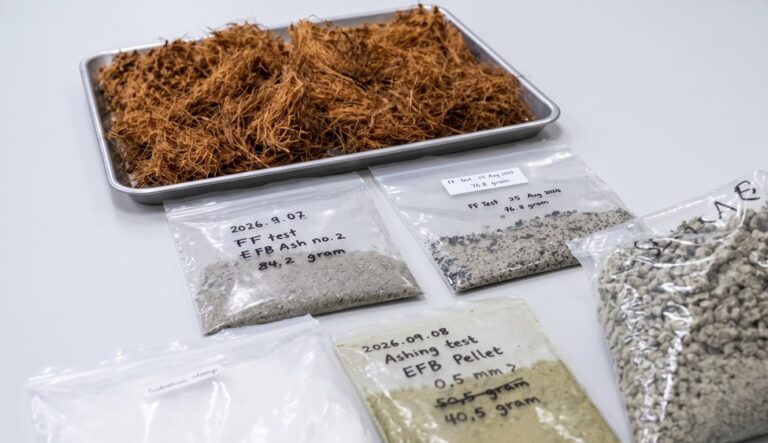
JAKARTA – Many people may think that the benefits of oil palm trees are only limited to their crude palm oil (CPO) and palm kernel oil (PKO) from their fresh fruit bunches (FFB), while the rest are just useless. But actually, nothing wasted from oil palm trees. Literally, all of their biomass wastes, from leaves to roots, can be used to produce a variety of products with high economic value.

One of the biomass wastes is the palm kernel shells (PKS), which are derived from the extraction process of palm oil. The Palm Oil Agribusiness Strategic Policy Institute (PASPI) in its 2025 report titled “Benefits of Palm Kernel Shells & Case Study” said that the processing of palm fresh fruit bunches (FFB) result in 23% CPO; 26% fibers; 16% empty fruit bunches; 8.5% liquid waste; 6% palm kernel shells; 4% palm kernel oil; 3% solid waste, and 13.5% other wastes.
Based on literature study conducted by PASPI (2025), the palm kernel shells can be utilized as raw material to produce various products of high economic value. Following are the benefits that can be derived from palm kernel shells:
- Light Aggregate → Palm kernel shells (PKS) have been proven effective as light aggregate in making concrete, especially in tropical countries. The PKS meets the minimum requirements needed for the application of light aggregate;
- Biochar and urea absorbent → Biochar and active carbon produced from PKS have the capacity to absorb urea through absorption method. Such advantage allows PKS for a variety of applications, including production of fertilizer;
- Polutant Sensors → Carbon quantum points doped with nitrogen and sulfur from PKS have the capacity to detect nitrophenol. It shows its role in detecting pollution and in monitoring environment;
- Filler in polymer matrix → the characteristics of PKS make it suitable as filler in polymer composite, both mono and hybrid, enabling to raise properties from the material;
- Construction Material → In tropical countries, such as Ghana, PKS is being researched as versatile and sustainable material for construction.
PASPI further said that the PKS can be also utilized as sustainable and eco-friendly souce of energy for steam power plants, thermal power plants, and activated charcoal.
The potential use of PKS as biomass fuel, which is environmentally-friendly and sustaible, is based on the result of researches regarding thermochemical characteristics of PKS, conducted by Wen-Tien Tsai (2019). The research shows the following facts of PKS:
- Moisture content is relatively low (11.89% and 12.20%) → indicating that PKS has the potential to burn better. Lower moisture content in the biomass reduces the energy need to evaporate water during combustion, increasing combustion efficiency;
- Measured ash content (3.87% and 2.98%) categorized as low → It is important as low ash content means combustion of PKS will produce less ash residue. Excessive ash can cause problems in combustion process, such as clogging and wearing on equipment;
- Combustibles with high percentage (85.76% and 84.82%) → showing that most of PKS are flammable materials. It also makes it as an effective source of energy;
- Its high content of carbon, hydrogen, and oxygen supports effective combustion → Carbon and hydrogen are the main energy contributors, while oxygen supports combustion process;
- Its very low content of nitrogen and sulfur (almost zero) is very beneficial from environmental perspective → the fuel combustion with low content of nitrogen and sulfur produces lower emissions of NOx and SOx, which are the major pollutants resulted from the fuel combustion;
- High calorific value (20.89 MJ/kg and 20.43 MJ/kg) → indicating that PKS is an efficient source of energy. Having high calorific value, the PKS is able to produce significant amount of energy per unit mass during combustion.
The above facts show that PKS is an effective and eco-friendly biomass fuel, which is potential to substitute or complement the fossil fuels in various applications, mainly because of the low emission and residue it causes from combustion process (PASPI, 2025).
Besides potential as a source of renewable energy, the PKS also has enormous economic potential. The economic potentials from PKS are as follows:
- Alternative source of energy → the PKS has big potential as biomass to produce energy. Considering the abundant supply of PKS in Indonesia, its utilization can be ensured as a significant source of renewable energy, and can play an important role in reducing reliance on fossil fuels;
- Industrial raw material → A variety of products like active carbon, biochar, and light aggregate for construction can be produced from the processed PKS. The products increase the economic value and potential to increase income in the palm oil industries;
- Contribution of Industrial Sector → When used as light aggregate in concrete or other construction materials, the PKS can become a more economic and sustainable solution for construction industry;
- Development of ecofriendly products → the utilization of PKS in making ecofriendly products, such as bioplastic and bioenergi, opens new market opportunity;
- Export of derivative products → Indonesia has big potential to export derivative products of PKS to the global market, especially to countries seeking solution of ecofriendly and sustainable products;
- Creation of job opportunities → PKS processing industry creates new job opportunities, not only in upstream sector but also in downstream sector. (*)
Source: sawitkita.id