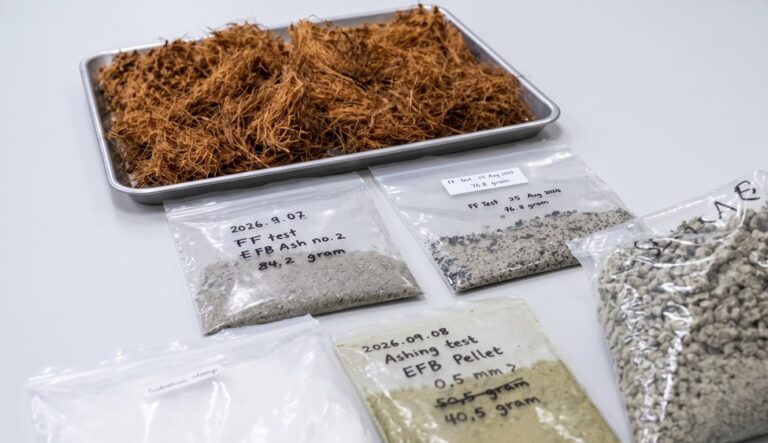
Many researches have proven that palm oil wastes can be reused to produce various products of high economic value.
Palm oil industry as the strategic industry for Indonesia is currently undergoing an industrialization phase to maximize the use of natural resources. The development of palm oil industries in the future is directed towards optimizing capital and science on the sector.
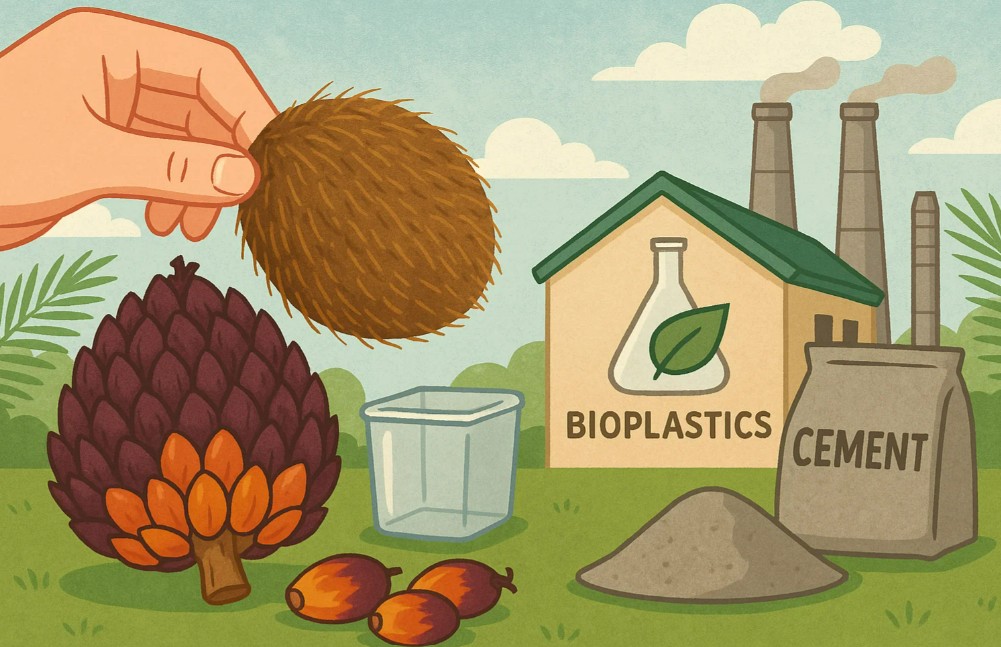
There have been many studies and innovations implemented for palm oil industries, ranging from innovative products in the upstream palm oil sector up to downstream products, such as brown palm sugar, palm-based bio-hydrocarbon, and others.
The Palm Oil Agribusiness Strategic Policy Institute (PASPI 2019) in a report titled “Innovative Products from Palm Oil Wastes” shows that innovative products of high value are not only produced from CPO and PKO as main products, but also from its wastes.
As Indonesia is the world’s largest producer of palm oil, the wastes are hugely available, as only around 20 – 22 percent of the fresh fruit bunches (FFB) can be extracted into the main products of CPO and PKO, while the rest, such as liquid waste (POME), fruit fibres, empty bunches, becomes wastes.
In the same report, PASPI said that solid wastes abundantly available at the palm oil mills are palm kernel shells, empty fruit bunches, palm kernel meal, fruit fibre, and others. A variety of research had proven that the solid wastes can be used as raw materials for production of a variety of products with high economic value.
For example, the palm kernel shells can be used as a replacement of coal, while the fruit fibre can be used for animal feeds.
The solid wastes of palm mills can be also used for production of various products of high economic value. One of the solid wastes is empty fruit bunches that can be used to produce bioplastic. Indonesia’s palm oil researches have proven that the empty fruit bunches can be further processed into bioplastic which is ecofriendly and can be degraded easily and naturally (PASPI, 2019).
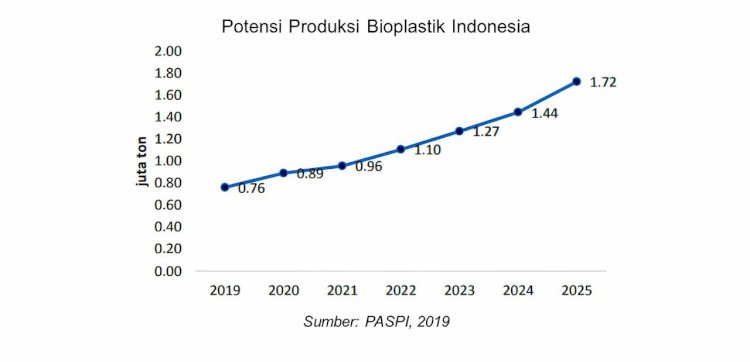
With the abundant supply of empty fruit bunches, Indonesia was potential to produce 0.76 million tons based on its palm production data in 2019. The potential will continue to rise every year along with the projection of palm production in Indonesia. Production of bioplastic can be realized at 1.72 million tons in 2025 (PASPI, 2019).
PASPI (2019) also stated that plastic waste that has polluted the environment, especially the waters, is difficult to decompose as it was made of fossil fuels. But the bioplastic made from empty palm fruit bunches is more environmentally friendly and can be easily degraded naturally.
Considering such condition, it is very important to replace the fossil fuels-based plastics with palm-based bioplastics in order to protect the environment. Such substitution will also save foreign exchange as it will reduce Indonesia’s imports of fossil fuel-based raw materials for plastic production.
Other potential of solid waste use is the use of palm oil fuel ash (POFA) as raw material for replacing cement. The ecofriendly innovative solution was created by a team of Sepuluh Nopember Institute of Technology (ITS) of Surabaya in 2018.
So far, the use of POFA in palm oil industries is still minimal, while it is continually rising and the industries need a large landfill area to dispose the waste.
PASPI also noted in the same report that POFA can be used as a substitution of cement as it has a high content of pozzolanic such as alumina, iron, and silica. The contents are beneficial to help create secondary hydration reaction to strengthen concrete.
The use of POFA as substitute material of cement has also met the national standard of Indonesia (SNI), in terms of concrete mix suitability and material strength. The research result is beneficial for development of infrastructure and facilities in oil palm plantations in around 200 regencies/mayoralties across Indonesia. (*)
Bpdp.or.id. https://www.bpdp.or.id/potensi-tandan-kosong-kelapa-sawit-menjadi-bioplastik-dan-semen. Potensi Tandan Kosong Kelapa Sawit Menjadi Bioplastik dan Semen. Jun 18, 2025