PALEMBANG — Amid global market turmoil and commodity price fluctuations, the palm oil industries still function as the backbone of Indonesian economy. As of May 2025, the export value of palm oil products reached US$15.38 billion, showing the strategic role of the palm oil sector in maintaining the surplus in the national trade balance.
The Indonesian Palm Oil Association (GAPKI) Deputy Chairman Susanto said that the palm oil industry is not only the contributor of foreign exchange income. More than 16.2 million families, including smallholders, workers and business players rely on the supply chain of palm oil to support their livelihood.
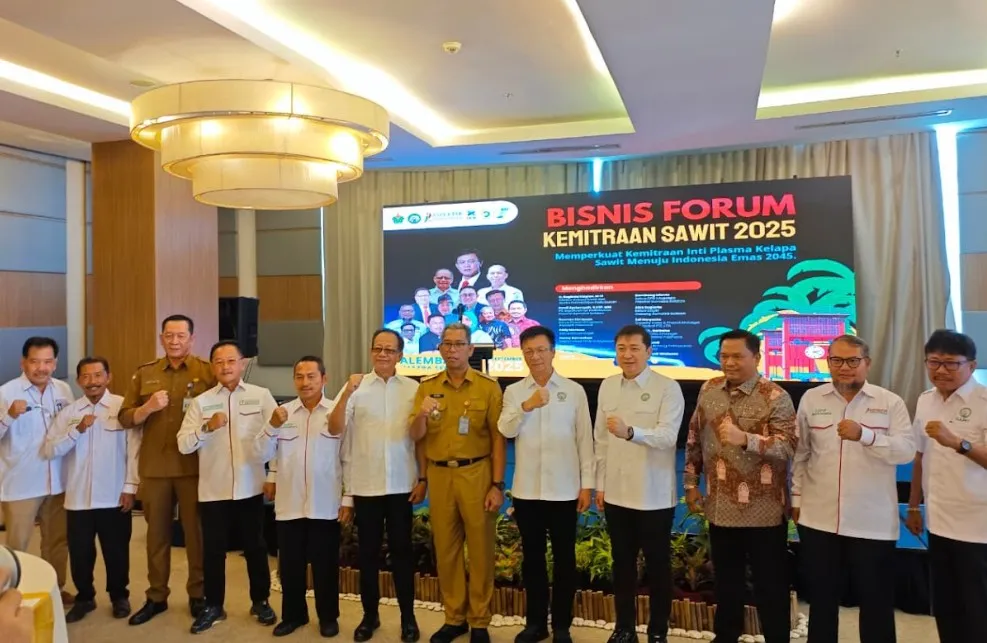
“The palm oil sector is still the largest contributor to Indonesia’s exports, even amidst global challenges. This cannot be underestimated,” Susanto said during the event of “Bisnis Forum Kemitraan Sawit 2025” (Business Forum of Palm Oil Partnership 2025), which was organized by Aspek-Pir in Palembang, South Sumatra on Tuesday (23/9/2025).
Despite reaching the record high in history in 2022 at US$39.28 billion, the export value dropped to US$27.76 billion in 2024 due to global challenges and international market turbulence. “But the palm oil sector has continually maintained its significant contribution to the national economy,” he said.
Susanto highlighted the good news from the upstream sector. The price of fresh fruit bunches (FFB) in Palembang reached higher than that of the previous year, raising the income of plasma farmers, who are the important part of palm oil supply chain in Indonesia.
Collaborations between nucleus plantation companies and plasma plantations are seen as the key factor for the success of palm oil industries. The synergy is expected to continually develop the palm oil industries, improving their competitiveness, sustainability, and their capability to deal with future challenges.
Production and Innovation
Despite solid industrial performance, GAPKI reminded the challenge of stagnant production during the last five years. As the need of palm oil for foods, energy, and industries has been continually rising, the acceleration of replanting (PSR) for smallholders’ palm plantations is crucial.
To support the increase of production, GAPKI has partnered with the agriculture ministry and the oil palm plantation fund management board (BPDPKS) to bring in latest oil palm genetic resources and pollinating insects from Tanzania. Currently, the innovation is undergoing an acclimatization and testing process by PT Socfin Indonesia and the research and development agency PPKS in Medan, before being applied to plantations.
“The replanting program and the upstream innovation are important to increase the productivity of oil palm plantations, the public welfare of farmers and other Indonesian people. That way we maintain our position as the largest producer and exporter of palm oil in the world,” Susanto concluded. (*)