There are still many people who assume that oil palm trees are water-intensive plants that cause drought. However, scientific evidence has shown otherwise. The oil palm trees have proven to be efficient in water use and play a vital role in hydrological conservation.

Based on a variety of studies, the oil palm requires much less water if compared to many other oil crops. Compared with natural forests and industrial crops such as rubber, bamboo, or acacia, oil palms have the lowest rates of evapotranspiration and transpiration.
Evapotranspiration rate
Evapotranspiration is the process of water evaporating into the atmosphere from soil and plants.
Based on research by Coster (1938), the evapotranspiration rate of oil palms is only around 1,104 mm/year, much lower than:
- Leucaena and bamboo: 3,000 mm/year
- Acacia: 2,400 mm/year
- Sengon: 2,300 mm/year
- Pine and teak: 1,300 mm/year
Transpiration rate
Transpiration is the amount of water evaporated from plants due to process of respiration and photosynthesis.
Studies from various sources (Kobayashi et al., 2014; Kohler et al., 2014; McJannet et al., 2007; Pradiko et al., 2022) show that oil palms have the lowest rate of transpiration:
- Rubber: 2.4 mm/day
- Cocoa: 0.5 – 2.2 mm/day
- Primary forest: 1.0 – 1.7 mm/day
- Oil palm: only 0.46 mm/day
Water Footprint: Oil Palm uses rainwater, not groundwater
Data from Mekonnen & Hoekstra (2010) shows that the total water footprint required to produce 1.0 ton of palm oil is lower than that of other vegetable oils such as cotton, sunflower, coconut, rapeseed, and soybean.
Most of water needs of oil palm trees are derived from rainwater (green water), not groundwater or surface water. It means that accusing oil palm plantations as the cause of depletion of groundwater reserves is scientifically baseless.
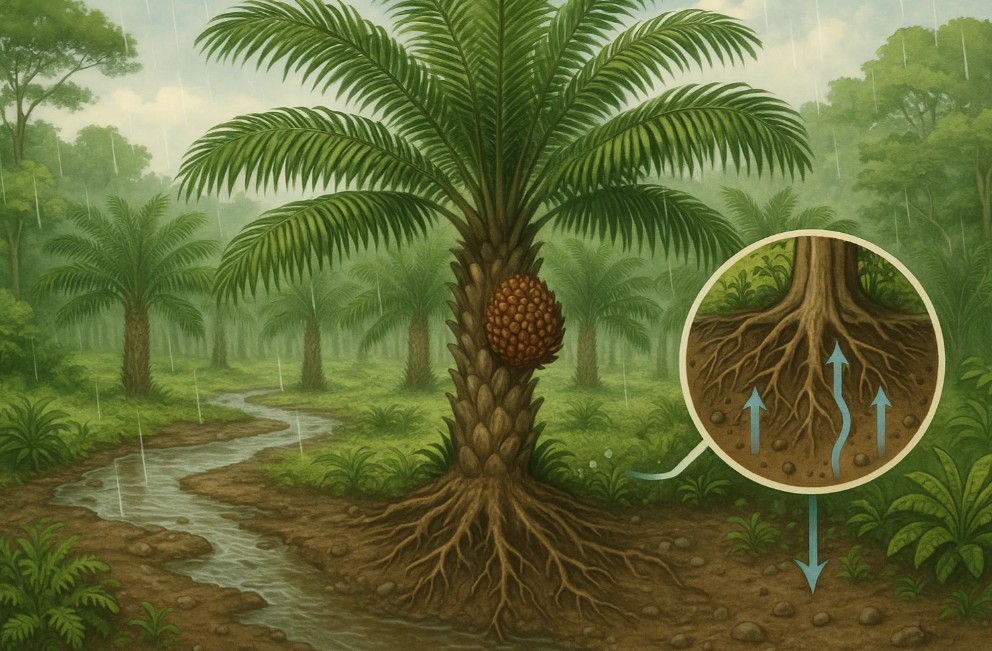
Oil palm plants have two natural mechanisms for maintaining water balance and preventing drought in their surrounding areas.
The layers of palm leaves cover almost the entire soil surface (canopy cover) in mature plants.
This canopy protects the soil from direct rainwater splashes, reduces erosion, and minimizes surface water runoff.
The oil palm’s root system is very deep, extensive, and fibrous. Those roots function as a natural network of biopores capable of:
- Retaining water (high storage capacity),
- Increasing rainwater infiltration into the soil,
- Reducing surface water runoff, and
- Storing large amounts of groundwater reserves.
Various indicators, ranging from transpiration rates, evapotranspiration, to water footprints, show that oil palm is the crop with the lowest water requirements compared to other forest crops and vegetable oil commodities.
In addition to its efficiency, oil palm also plays a vital role in water conservation and maintaining hydrological balance in its environment. (*)
- Coster, C. (1938). Evapotranspiration in Tropical Crops.
- Kobayashi, N., et al. (2014). Transpiration Rates in Rubber Plantations.
- Kohler, M., et al. (2014). Water Balance and Transpiration in Cacao Systems.
- Mc Jannet, D. et al. (2007). Transpiration in Primary Forest Ecosystems.
- Pradiko, D. et al. (2022). Transpiration Efficiency in Oil Palm Plantations.
- Mekonnen, M. M., & Hoekstra, A. Y. (2010). The Green, Blue and Grey Water Footprint of Crops and Derived Crop Products. UNESCO-IHE Institute for Water Education.
- PASPI (Palm Oil Agribusiness Strategic Policy Institute) & BPDPKS (Badan Pengelola Dana Perkebunan Kelapa Sawit). (2025). Palm Saves Water [Infografis].