Many people still assume that the economic growth generated by palm oil industries is only enjoyed by just a handful of large business players. However, the real facts of the industries show otherwise!

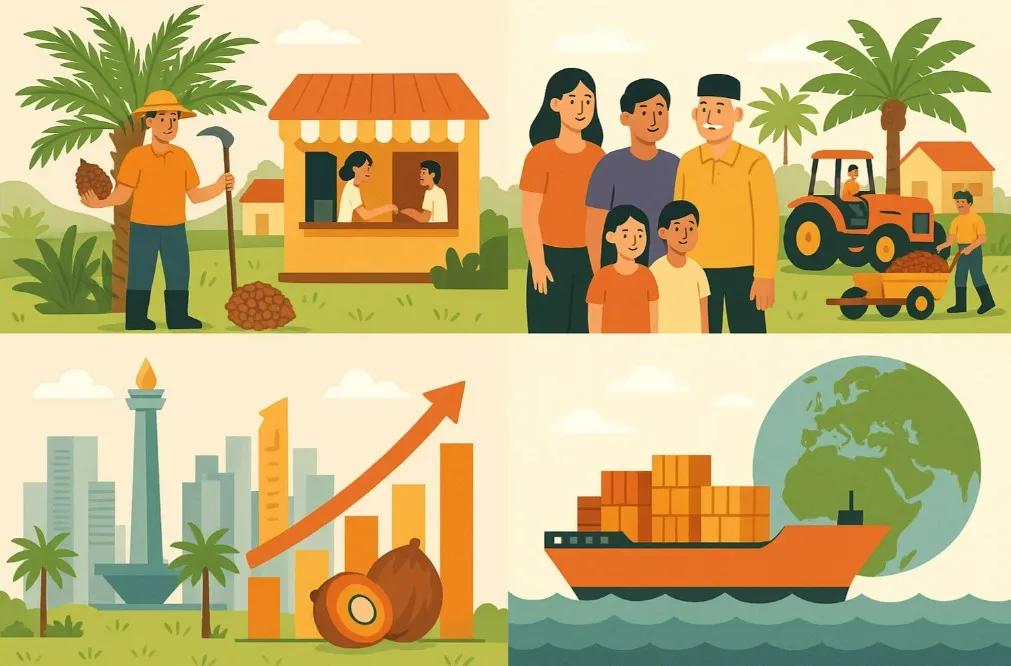
In Indonesia, the palm oil industries have been from the beginning functioning as a driving force of its national economy, creating inclusive economic benefits at the local, regional, national, and even global levels.
Oil palm plantations are not only the source of income for large companies, but also create tangible economic impacts for the wider community, including:
- Oil palm smallholders,
- Rural MSMEs,
- Local communities,
- Even palm oil importing countries worldwide.
Palm oil creates a multiplier effect that drives economic growth in various economic sectors such as trade, transportation, and services in rural areas.
Data shows that palm oil producing villages see faster growth compared to those of non-palm oil producing villages. According to PASPI (2022), the average economic growth of palm oil villages increased significantly from 2016 to 2021, far surpassing that of non-palm oil villages.
It means that the presence of oil palm plantations helps build new economic centers in rural areas, creating jobs, and increasing local incomes.
Based on PASPI data (2023), the income of oil palm farmers continues to increase and is growing faster than those of non-oil palm farmers.
In 2021, the average income of oil palm smallholders reached almost IDR 30 million per year, while non-oil palm farmers lagged far behind.
This has shown that oil palm offers greater opportunities for farmers in rural areas of Indonesia to improve their welfare.
Palm Oil Generates Economic Growth from local to global
- Village Level (Local):
Oil palm plantations also generate the growth of micro, small and medium enterprises (MSMEs) in the trade, services, and transportation sectors.
- Regency Level (Regional):
Oil palm centers have higher and faster growth of gross regional domestic product (GRDP) compared to the non-oil palm centers (PASPI, 2022).
- National Level:
The palm oil industry is a significant contributor to Indonesia’s Gross Domestic Product (GDP).
Output Aspect: The palm oil industry’s contribution increased from IDR 234 trillion (2000) to IDR 1,119 trillion (2021).
Value Added Aspect: Its added value increased from IDR 172 trillion (2000) to IDR 510 trillion (2021).
(Source: Input-Output Table BPS, processed by PASPI, 2023)
- Global Level:
The economic benefits of palm oil extend beyond Indonesia. Importing countries such as India, China, the European Union, and Africa also generate significant revenue from palm oil imports and downstream processing.
Total revenue for importing countries in 2013/2014 reached US$ 32.8 billion.
(Source: European Economics, 2016)
The palm oil industries have been proven to make a significant contribution to inclusive economic growth, including:
- Improving the welfare of farmers and rural communities,
- Strengthening regional economies,
- Significant contributions to national GDP,
- And global economic benefits through international trade.
In other words, palm oil is a driver of the people’s economy and a pillar of the global economy. (*)
- PASPI (2022). Economic Growth in Oil Palm Villages vs Non-Oil Palm Villages.
- PASPI (2023). Oil Palm Farmers’ Income Growth Data.
- Badan Pusat Statistik (BPS). Input-Output Table Indonesia (diolah oleh PASPI, 2023).
- European Economics (2016). Palm Oil Importing Countries’ Income Report.
- BPDPKS (2024). Palm Creates Inclusive Economic Benefits from Local to Global.