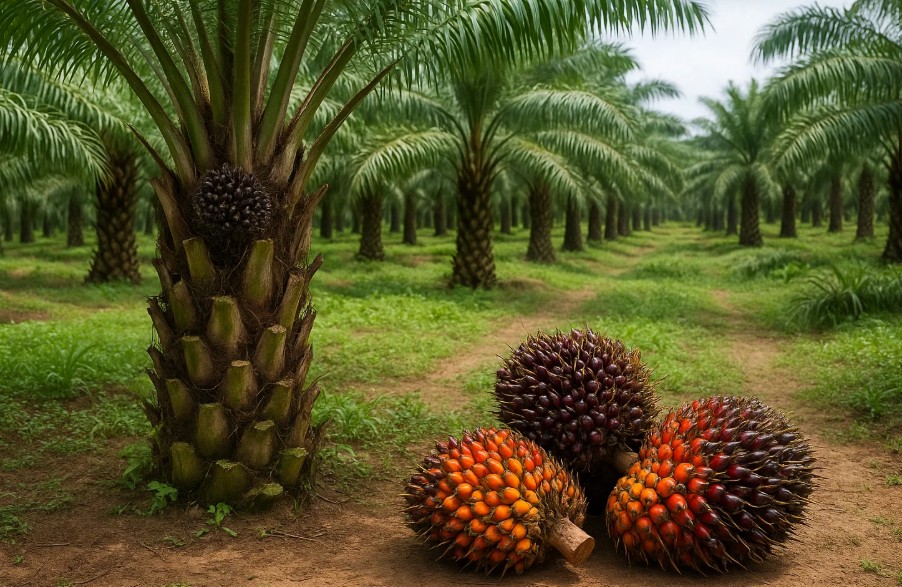
NUSA DUA, Bali – Two global analysts of vegetable oils, Dorab Mistry and Thomas Mielke, have warned Indonesia about the impacts of Indonesia’s decision to establish the Forestry Enforcement Task Force (Satgas Kehutanan), which has so far taken over millions of hectares of oil palm plantations.
Speaking during a press conference on the sidelines of IPOC 2025, both analysts see the action of the forest task force will affect the projected production of Indonesia’s palm oil during the next few years and potential to disrupt the global market.
Both Dorab Mistry and Thomas Mielke agree that without policy to support production increase, Indonesia will be facing problems of production in short term and the risk of high price at the global market. Such condition is potential to harm the domestic palm oil industry and weaken the competitiveness of Indonesia’s palm oil exports at international market.
Dorab Mistry, Director of Godrej International Ltd, said that Indonesia is potential to continually see the stagnant growth of its palm oil production. ”Based on current condition, Indonesia’s palm oil production next year will be stagnant or slightly increase at best,” he said.
“During the next two years, production will only increase between 1.0 – 1.5 million tons,” Mistry said during a press conference on the sidelines of IPOC 2025 at BICC The Westin, Nusa Dua, on Friday (14/11/2025).
According to him, without issuing new licenses for palm plantation expansion—for plasma and nucleus (private companies) plantations, it will be almost impossible to raise the production. Even if the new licenses are given soon, the production increase is projected to be realized during the next three or four years.
Mistry also highlighted the expansion of downstream palm oil industry, especially the oleochemical, which will absorb more supply of CPO at domestic market. It will further reduce the availability of palm oil supply for exports, especially for India as the largest importer of Indonesia’s palm oil.
If India could not get enough supply from Indonesia, then the price will increase. “This is why we project it will be bullish, but bullish projection is not always good as consumers will bear the impacts,” he said.
Mistry reminded the need for the government’s quick action, saying that ”a stitch in time saves nine”. It means that “it is better to prevent than to cure”.
”It means, quick action today will prevent big problem in the future. The government needs to quickly issue new licenses for new planting to increase production. Otherwise, the coming years will become difficult times,” said Mistry.
Thomas Mielke, Executive Director of Oil World, gave a firmer prediction regarding the production trend. “We estimate that production of Indonesia will drop in 2026 and further drop in 2027,” said Mielke.
He said the uncertainty is resulted from the plantation areas already taken over by the forest task force. If the acquired areas reached more than 3.0 million hectares or more, then the impacts will be very serious. The situation is sensitive as it can disturb the structure of global supply.
Mielke also reminded that the government cannot control the global prices. The global prices of vegetable oils in 2026–2027 will determine the domestic prices, so that Indonesia could not fully restrain the implication of international price increase. (*)