The palm oil industry in Indonesia has often emerged as a topic of debate about issues of environment and land use. The issues were seen from a variety of perspectives, ranging from ecological criticism to social concerns.
In this context, it is important to consider the palm oil objectively based on scientific data and field facts, and its implications for the environment and the economy, by referencing scientific literatures and official international sources.
Palm Advantages to Prevent Erosion and Keep Soil Structure
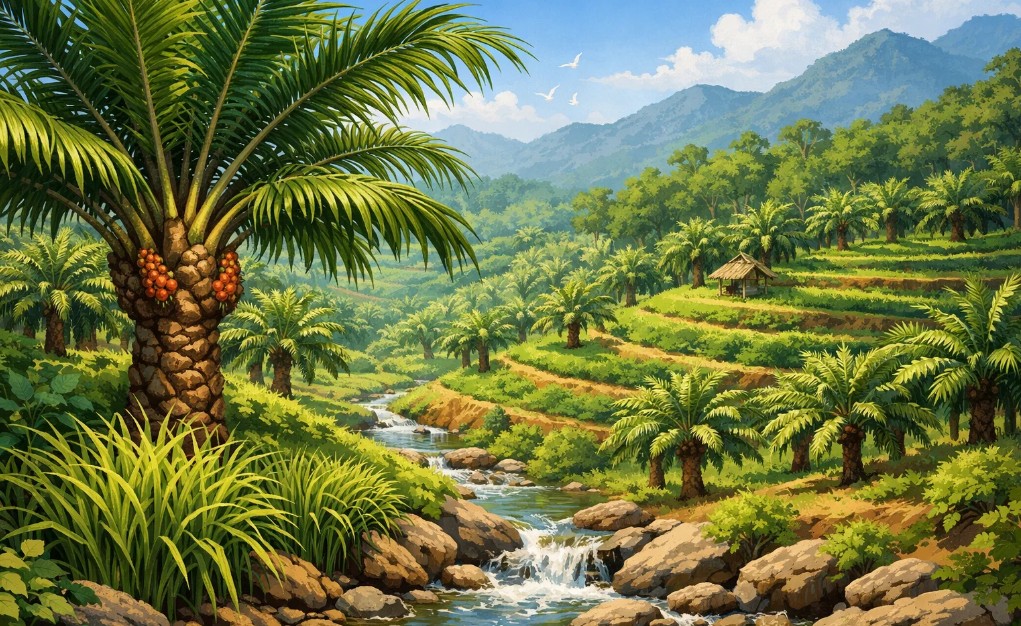
One ecological aspect of oil palm that is often ignored is its role in soil conservation. Unlike other rival oil crops like soybeans or rapeseed that are seasonal, the oil palm is a perennial crop having a deep and permanent root system. These roots form a relatively stable structure of soil throughout the plant’s productive lifespan, which can last 25–30 years. Also as a perennial plant, the oil palm plantations do not experience a regular phase of annual post-harvest open-soil.
The permanent cover of oil palm trees’ canopy protects the soil surface from direct rainwater impact, which then reduces surface runoff and the risk of erosion. Furthermore, fallen oil palm fronds and leaves form a layer of litter (natural mulch) that enriches the soil’s organic matter, increases its water-holding capacity, and supports the activity of soil microorganisms, which play a vital role in long-term fertility.¹
In contrast, the seasonal vegetable oil crops require repeated tillage for every planting season. This practice, as noted in soil science literature, can increase the risk of erosion, accelerate degradation of soil structure, and reduce organic matter content in the long term.²
Production Efficiency: Less Land and Less Environmental Pressure
The advantages of oil palm in soil conservation become even more relevant when related to its efficiency of productivity.
Data from the Food and Agriculture Organization (FAO) shows that oil palm plantations produce an average of around 3–4 tons of oil per hectare per year, significantly higher than:
- sunflower (±0.7–0.8 ton/ha),
- rapeseed/canola (±0.7–0.8 ton/ha),
- soybean (±0.4–0.5 ton/ha).³
Having higher productivity, oil palm only requires around 0.23–0.30 hectares of land to produce one ton of oil, while rapeseed and soybean require more than 1.4–2.2 hectares to produce one ton.⁴
The implication is clear: to produce the same volume of oil, oil palm requires 4–7 times less land than other vegetable oil crops. From an environmental perspective, this land use efficiency means less area needs to be cleared and managed, and more land can be maintained in its natural state or for other uses.
Hydrological Function Comparison: Oil Palm and seasonal Crops
In the context of hydrology and soil conservation, the oi palm and the seasonal crops also have stark differences.
The well-established oil palm plantations create a relatively stable microclimate. Root systems developed over decades create pathways for water infiltration into the soil, helping to recharge groundwater and reduce surface runoff.
In contrast, the seasonal crops leave bare land after harvest—a critical period when the soil is highly susceptible to erosion from rainfall. Repeated tillage can also damage soil aggregates and reduce natural porosity, reducing water infiltration capacity.²
These differences indicate that, from a soil and water management perspective, perennial oil crops like oil palm have structural advantages over the seasonal vegetable oil crops.
Palm Contribution to economy and global vegetable oil supply
Beyond its ecological aspects, palm oil plays a crucial role in the global economy and the resilience of global supply of vegetable oils.
According to the USA Department of Agriculture (USDA), global palm oil production in 2023 reached approximately 88 million tons, making it the largest contributor to the global supply of vegetable oils.⁵ Indonesia, as the world’s largest producer and exporter, contributes significantly to this global supply.
At the national level, palm oil provides a livelihood for millions of smallholders, creates job opportunities, and generates economic growth in rural areas. This socio-economic dimension is crucial in assessing the sustainability of a commodity.
Environmental Impacts If Palm Oil replaced with other Oil Crops
One important and intriguing question that often arises is: What would be the impacts if the oil palm is replaced with other vegetable oil crops?
A number of international studies have proven that replacing palm oil with lower-yielding crops will require massive land expansion. Research published in Nature Sustainability concludes that palm oil substitution has the potential to increase pressures on lands and forests globally, due to the significantly greater land requirements.⁶
Furthermore, the large-scale expansion of seasonal crops risks increasing:
- soil erosion,
- degradation of soil structure,
- loss of organic matter,
- and increased emissions from repeated tillage.⁶⁻⁷
Thus, from the perspective of global land use, the palm oil actually serves as a relatively more efficient option for fulfilling the needs of global vegetable oils.
Sustainability Standard and Responsible Management
Indonesia has formulated its sustainability standard named as Indonesian Sustainable Palm Oil (ISPO), which is mandatory for all oil palm growers and industries from upstream to downstream. The ISPO covers aspects of land legality, environment management, conservation of land and water, and social responsibility.⁸
A number of academic researches have shown that ISPO is part of efforts to strengthen palm industry governance and improvement of sustainability practices, despite its implementation will continually need further improvement.⁹
Based on available scientific data and literatures, several key points can be concluded:
- Oil palm is the most productive oil crop per unit area, requiring much less land areas if compared to other alternative crops.³⁻⁴
- As a perennial crop with permanent cover, oil palm has advantages in maintaining soil structure and in reducing risks of erosion if compared to seasonal vegetable oil crops with the age of less than one year.¹⁻²
- Replacing oil palm with other oil crops has the potential to create greater environmental pressures due to significant increase of land requirements.⁶⁻⁷
- The existence of standards such as ISPO demonstrates the existence of a formal framework to encourage more responsible practices of production.⁸⁻⁹
With a data-driven approach and balanced comparisons, discussions on oil palm can be directed towards improving sustainable practices, rather than simply focusing on a black-and-white assessments of this plantation commodity. (*)
¹ Corley, R.H.V. & Tinker, P.B. (2016). The Oil Palm (5th Edition). Wiley-Blackwell.
https://onlinelibrary.wiley.com/doi/book/10.1002/9781118953297
² Lal, R. (2001). Soil degradation by erosion. Land Degradation & Development.
https://onlinelibrary.wiley.com/doi/10.1002/ldr.472
³ FAO. FAOSTAT – Crops and livestock products.
https://www.fao.org/faostat
⁴ FAO. Oil Palm Development.
https://www.fao.org/3/i0100e/i0100e.pdf
⁵ USDA Foreign Agricultural Service. Oilseeds: World Markets and Trade (2023).
https://www.fas.usda.gov/data/oilseeds-world-markets-and-trade
⁶ Beyer, R. et al. (2020). Environmental impacts of palm oil alternatives. Nature Sustainability.
https://www.nature.com/articles/s41893-020-00603-4
⁷ Meijaard, E. et al. (2018). Oil palm and biodiversity: A situation analysis. IUCN.
https://portals.iucn.org/library/node/47753
⁸ Peraturan Presiden Republik Indonesia No. 44 Tahun 2020 tentang ISPO.
https://peraturan.bpk.go.id/Details/135275/perpres-no-44-tahun-2020
⁹ Hospes, O. (2014). Institutional change in Indonesia’s palm oil sector.
https://onlinelibrary.wiley.com/doi/10.1002/eet.1653