It has been an undeniable fact that the global demand for vegetable oil is a structural necessity that cannot be reduced without disrupting global systems of foods, energy, and industries. Data from FAO and USDA show that global consumption of vegetable oils will continue to increase through 2025, driven by growth of population, urbanization, and demand for renewable energy.¹
Under such condition, the world will continually need more supply of vegetable oils. Concerning this, perhaps the global consumers need to know the characteristics of each vegetable oil for consideration before deciding to buy.
As a vegetable oil, the palm oil has unique characteristics: higher production with l esser use of land areas. This fact makes palm oil a crucial element in the global sustainability discourse.
Palm productivity and land use efficiency
The productivity of vegetable oils varies greatly among each of the oil crops. Based on FAO data compilations and various agronomic studies, the average oil productivity per hectare is as follows²:
- Soybean: ±0.4–0.5 ton/ha/year
- Sunflower: ±0.7–0.8 ton/ha/year
- Rapeseed: ±0.7 ton/ha/year
- Oil palm: ±3.3–4.0 tons/ha/year
With this productivity, oil palm produces 5–8 times more oil per unit area than other major vegetable oil crops³.
The efficiency has direct implications for global land use: the same volume of oil can be produced on much less land.
Global vegetable oil need ceiling
The FAO and OECD reported that consumption of global vegetable oils has exceeded 250 million tons per year and is projected to continue increasing over the next decade.⁴ The demand includes:
- food,
- feed,
- oleochemicals,
- and bioenergy.
In the global food system, this figure is a ceiling requirement, not an optional figure. It means that a reduction in the supply of one commodity must be replaced by another commodity with equivalent volume.⁵
Implications of replacing palm oil with other vegetable oils
Taking into account differences in land use and productivity, several studies have shown that replacing palm oil with other vegetable oils will require significantly more land areas to produce the same volume of oil.⁶
Following is an illustration:
- 1 million hectares of oil palm can produce oil equivalent to
approximately 5 million hectares of rapeseed or
approximately 7 million hectares of soybeans.⁷
These land use implications are a crucial aspect of global agricultural planning, particularly in non-tropical regions, where land productivity is lower.
Oil palm as plantation crops
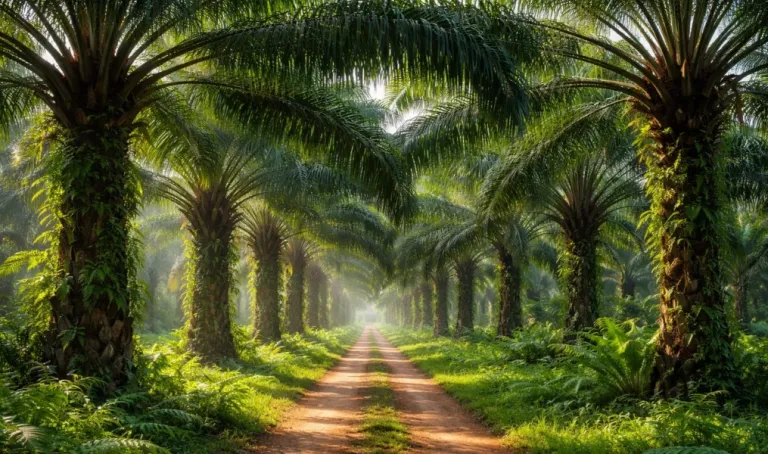
Oil palm is scientifically categorized as a plantation crop, not a natural forest. However, in studies of landscape ecology, oil palm is a long-lived, permanent vegetation with a higher capacity of carbon sequestration if compared to other seasonal crops.⁸
Research by the Bogor University of Agriculture (IPB) and various international journals notes that:
- oil palm biomass can store carbon stably,
- it has a long production or life cycle (25–30 years),
- and its canopy cover is continuous.
These characteristics make oil palm a productive land cover that is fundamentally different from open or degraded land.
Agroclimatic Suitability and Geographical Distribution
Oil palm requires specific agro-climatic conditions, such as the following:
- stable tropical temperatures,
- high rainfall throughout the year,
- consistent solar radiation¹⁰.
Such conditions are naturally found only in tropical regions, including Indonesia. Conversely, subtropical regions such as Europe are more agro-climatically suited to oil crops with lower productivity per hectare¹¹.
This difference explains why oil palm’s contribution to the global supply of vegetable oils is so significant despite its relatively small land area.
Palm oil contribution for Indonesia
Until 2025, palm oil remains:
- Indonesia’s largest earner of foreign exchange from non-oil and gas exports ¹²,
- a source of livelihood for millions of palm smallholders and workers,
- the foundation of renewable energy programs¹³.
Beyond its economic function, oil palm also plays a role in utilizing abandoned and degraded land areas and increasing the productivity of rural areas.
Within the framework of the rising global demand for vegetable oils, palm oil has demonstrated a strategic role as the oil crop with the highest land efficiency. The discourse on palm oil sustainability cannot be separated from the realities of productivity, food needs, and global land limitations.
Data-driven approaches demonstrate that palm oil serves as a pillar of the global system of vegetable oils, particularly in the context of efficiency in land use. (*)
¹ IEA, Renewables 2024 – Biofuels. International Energy Agency.
https://www.iea.org
² FAO, FAOSTAT – Oilcrops and Vegetable Oils, 2024–2025.
https://www.fao.org/faostat
³ FAO, Oil Palm: Production and Yield Statistics.
https://www.fao.org/3/i6895e/i6895e.pdf
⁴ OECD–FAO, Agricultural Outlook 2023–2032.
https://www.oecd-ilibrary.org/agriculture-and-food/oecd-fao-agricultural-outlook_19991142
⁵ USDA, Oilseeds: World Markets and Trade, 2024.
https://www.usda.gov
⁶ Meijaard et al. (2018). Oil Palm and Biodiversity. IUCN.
https://portals.iucn.org/library/node/47753
⁷ WWF (2016). The Impact of Replacing Palm Oil with Other Oils.
https://www.wwf.org.uk
⁸ IPCC, AR6 Working Group III – AFOLU.
https://www.ipcc.ch
⁹ Henson, I.E. (2012). Carbon Sequestration by Oil Palm.
https://www.academia.edu
¹⁰ FAO, EcoCrop Database – Elaeis guineensis.
https://ecocrop.fao.org
¹¹ European Commission, Oilseed Crop Yields in the EU.
https://agriculture.ec.europa.eu
¹² BPS Indonesia, Statistik Kelapa Sawit Indonesia.
https://www.bps.go.id
¹³ IEA, Renewables 2024 – Biofuels.
https://www.iea.org