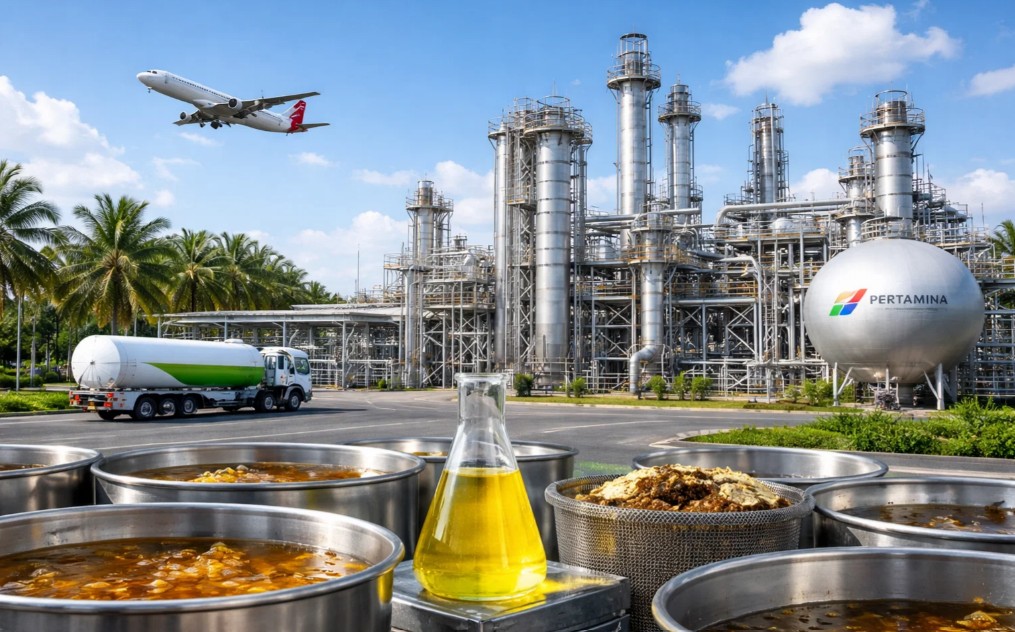
JAKARTA – The state-owned energy company PT Pertamina has started the development of biorefinery facility in Cilacap refinery, Cilacap, Central Java. The company will utilize the used cooking oil (UCO) as raw material to feed the biorefinery plant. The downstream project is positioned as a strategic step to strengthen the national energy resilience and create a significant economic value.
Pertamina’s Portfolio Strategy and Business Development Director Emma Sri Martini said the Bio-refinery project phase-2 is part of the national strategic program, which is in line with the Asta Cita vision of President Prabowo Subianto, especially on the agenda of energy self-sufficiency, downstreaming, and industrialization.
“The transformation of used cooking oil to green energy reflects the real implementation of President’s Asta Cita vision. The worthless waste is used to produce a strategic energy product that can strengthen the national energy resilience and reduce reliance on import,” she said after the groundbreaking ceremony of the project on Friday (6/2/2026).
Emma added the processing of the UCO to sustainable green fuel is not just a matter of producing biofuel, but it will also create a multiplier effect to national economy.
The project is expected to create 5,900 job opportunities, reduce emissions up to 600,000 tons of CO₂ per year, and contribute to the GDP at total value of IDR 199 trillion per year.
The investment needed for the project is estimated to reach US$1.1 billion or around IDR 19 trillion, with the local content (TKDN) is projected to reach 30%.
“It’s impacts will not be just in energy sector, but also in reducing deficit of current account and in raising competitiveness of national industries,” Emma said.
Pertamina Patra Niaga’s President Director Mars Ega Legowo Putra said the energy product that will be produced is the sustainable fuel that has been developed since 2023 and started commercial production in 2024. A number of domestic and international airlines have purchased the fuel.
From the supply side, Pertamina has extended the network of collecting UCO through collaborations with the general public and collectors associations.
“We want to see the network of collecting the UCO expanding so that more people will get economic benefit of the project,” he said.
Largest in Southeast Asia
With the expansion of biorefinery Cilacap phase-2, Pertamina has accelerated the roadmap of low-carbon fuel development and increased the production capacity of the Sustainable Aviation Fuel (SAF) from just 27 kiloliter per day to 887 kiloliter per day in 2029. The increase of capacity has placed Cilacap refinery as the largest producer of SAF in Southeast Asia.
The project is the continuation of phase-1 of Revamped TDHT Cilacap, which integrates the technology of co-processing to process UCO into bioavtur.
In the phase-2, Pertamina has started turning to the configuration of dedicated biorefinery, which allows the increase of yield, convertion efficiency, and stability of SAF supply for aviation sector. “This phase-2 project is designed to fulfill the long term need of aviation industries that are facing global regulatory pressures regarding decarbonization. (*)
Sawitku.id. “Biorefinery Cilacap Phase-2 tingkatkan kapasitas SAF hingga 887 KL per hari.” Sawitku, 6 Februari 2026. https://www.sawitku.id/ekbis/81416694737/biorefinery-cilacap-phase-2-tingkatkan-kapasitas-saf-hingga-887-kl-per-hari.