The food industry faces two major challenges in its distribution. First, natural deterioration after processing or storage. Second, the long distribution time before reaching its destination can degrade the quality of food products.
Generally, fresh food products have a short shelf life due to various types of natural deterioration after processing or being stored. This deterioration usually occurs due to microbial activity, enzyme reactions, and chemical changes, particularly fat oxidation, which will then lead to the decreased quality of the food products.
Those challenges need preservation technologies as a solution to maintain product quality without compromising nutritional value and food safety. One solution that is increasingly popular is the use of natural antioxidant compounds, including those derived from palm oil.
Food deterioration due to oxidation not only reduces product quality but also contributes to increasing global food loss. The Food and Agriculture Organization (FAO) reports that approximately one-third of foods produced globally are lost during the distribution and storage chain. One of the main causes of this quality decline is lipid oxidation, which can cause rancidity, discoloration, and degradation of the product’s nutritional value.
Natural protective ingredients
From the perspective of chemical engineering, palm oil utilization involves a fractionation process to obtain fractions richer in antioxidants. However, high temperatures during processing can cause the degradation of tocopherols and carotenoids, necessitating control of process conditions. Furthermore, encapsulation technology is used to protect active compounds and allow for controlled release of antioxidants during food storage.
Previously, the use of synthetic antioxidants such as Butylated Hydroxyanisole (BHA) and Butylated Hydroxytoluene (BHT) was widely used in the food industry. But growing concerns about long-term health impacts and consumer demand for natural ingredients have driven the development of bio-based antioxidants, which include the palm oil.
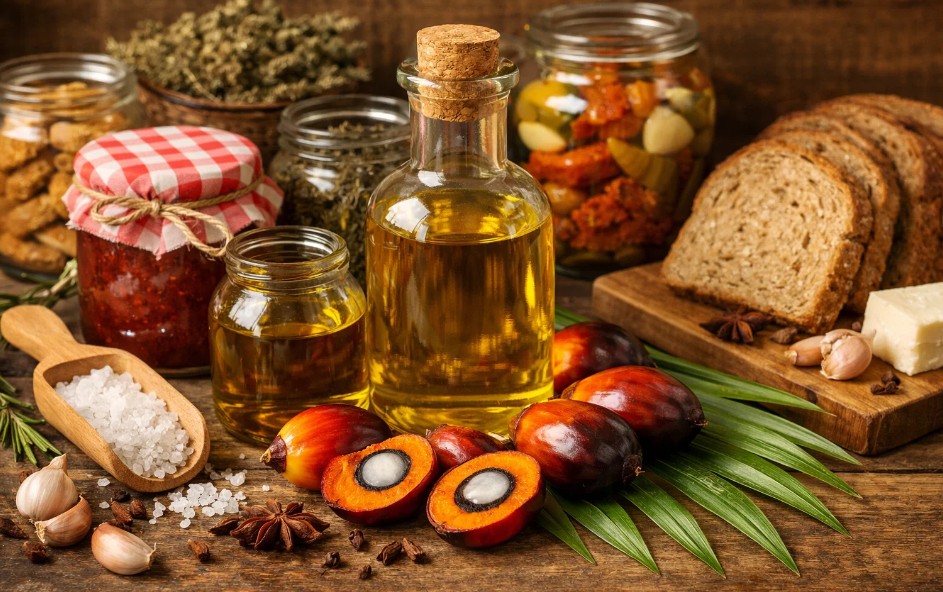
Palm oil is a widely used vegetable oil. Besides being used as a cooking oil, it also holds significant potential in food technology. It has a chemical composition rich in bioactive compounds, distinguishing it from other types of vegetable oils. This commodity contains natural antioxidant compounds that play a role in maintaining food stability, such as tocopherols, tocotrienols, carotenoids, and phenolic compounds that help prevent oxidative damage in foods. The presence of these ingredients allows palm oil to function as a natural protective ingredient that can extend the shelf life of food products.
Tocopherol and tocotrienol are the two main forms of vitamin E found in palm oil. Tocopherol acts as a hydrogen atom donor, stabilizing free radicals, and halting oxidation reactions.
Meanwhile, tocotrienols have unsaturated side chains that increase their mobility in the lipid phase, so that they can be more effective in antioxidant activity in food systems. Palm oil has a relatively higher tocotrienol content than other vegetable oils, giving it superior oxidative protection.
From its chemical engineering perspective, oxidation reactions can be explained by a chain reaction mechanism involving free radicals, which consists of three main stages: initiation, propagation, and completion. Antioxidants work by donating hydrogen atoms to free radicals to stabilize them and then halt the chain reaction.
LH → L• + H•
L• + O₂ → LOO•
LOO• + LH → LOOH + L•
The presence of antioxidants plays a role in stopping this chain reaction by stabilizing free radicals through the donation of hydrogen atoms.
In addition to acting as antioxidants, the fats in palm oil can also form a protective layer on the surface of food. This layer helps reduce direct contact between the product and oxygen and water vapor from the environment.
For applications of food technology, the concept is often applied to protective fat-based coatings used to wrap fruits, vegetables, or processed products. A thin layer of palm oil can slow down the respiration of food and prevent moisture loss during storage.
The use of palm oil in food preservation is also related to its thermal stability. Compared with other vegetable oils, palm oil has a balance of saturated and unsaturated fatty acids, making it more resistant to oxidation. This stability makes palm oil frequently used in processed food products that require durability during storage and distribution. In the snack food and margarine industries, the use of palm oil helps maintain product texture and extend shelf life without the need for extensive use of artificial preservatives.
From the perspective of process engineering, chemical engineering plays a crucial role in optimizing the use of palm oil as a natural preservative. Refining, fractionation, and oleochemical processes are carried out to obtain specific fractions rich in antioxidants. Control of process temperature, flow rate, and reaction conditions are crucial factors in maintaining the stability of active compounds to prevent degradation. In addition, encapsulation technology is also being developed to protect palm oil antioxidant compounds so that they can be gradually released during food storage.
Support technological innovations
The use of natural antioxidants from palm oil offers additional benefits in terms of food safety and environmental sustainability. Modern consumers tend to avoid synthetic preservatives due to concerns about long-term health impacts. Therefore, natural ingredients derived from plant sources are becoming increasingly popular alternatives. The use of palm oil as a natural antioxidant also supports the added value of national palm oil commodities through product diversification in the food sector.
However, not all palm oil has a high antioxidant content because excessively intensive refining processes can reduce the levels of carotenoids and other bioactive compounds. Therefore, controlling the processing is crucial in maintaining the quality of natural antioxidants.
Despite its many advantages, the use of palm oil in food preservation still requires precise formulation control. Too high concentration can affect the product’s sensory characteristics, such as taste and texture.
The antioxidant stability is also affected by storage conditions such as exposure to light and high temperatures. Therefore, a combination of other preservation technologies, such as refrigeration, vacuum packaging, or modified atmospheres, is often used to achieve optimal results.
Research developments indicate that integrating palm oil with active packaging and edible coating technologies has the potential to significantly increase the effectiveness of food preservation. This innovation opens up opportunities to utilize palm oil not only as a primary food ingredient but also as a functional component in modern preservation systems. With the right approach, palm oil can contribute to reducing food loss while increasing product distribution efficiency.
Overall, palm oil has significant potential as a source of natural antioxidants that can extend the shelf life of food products by inhibiting oxidation reactions and protecting against quality deterioration. Its bioactive compounds, such as tocopherols, tocotrienols, and carotenoids, make palm oil a relevant ingredient in the development of sustainable food preservation technologies. Supported by chemical engineering principles in its processing and application, palm oil can be optimally utilized, ensuring food quality is maintained during storage. This utilization is expected to not only improve food product quality but also strengthen the role of the Indonesian palm oil industry in future food technology innovation. (*)
Sawit Indonesia. 2026. “Peran Minyak Sawit sebagai Antioksidan Alami dalam Memperpanjang Umur Simpan Produk Pangan.” Sawitindonesia.com. Diakses pada 10 Maret 2026. https://sawitindonesia.com/peran-minyak-sawit-sebagai-antioksidan-alami-dalam-memperpanjang-umur-simpan-produk-pangan/