JAKARTA – Indonesia’s palm oil industry has been continually moving toward more and more sustainable practices. One of the latest breakthroughs being intensively undertaken is the utilization of Palm Oil Mill Effluent (POME), or liquid waste from palm oil mills. It is considered a concrete manifestation of the implementation of a circular economy, where pollutants that previously burdened the environment are now transformed into clean energy commodities in the form of high-value biogas and electricity.
The POME-to-Energy project is not only the right solution to adressing water and air pollution but also opens up opportunities for industry players to realize efficiency of billions of rupiah.
Through the anaerobic fermentation process, the utilization of Palm Oil Mill Effluent (POME), can produce methane gas, which can be a primary fuel for power plants. This technology not only offers a waste management solution but also addresses the energy crisis in remote areas.
How is liquid waste converted into electricity?
According to various sources, the process of converting pungent-smelling palm oil mill waste into electricity that lights up people’s homes relies on the power of natural microorganisms. Technically, this process is divided into three main phases:
- Liquid Storage Stage (POME)
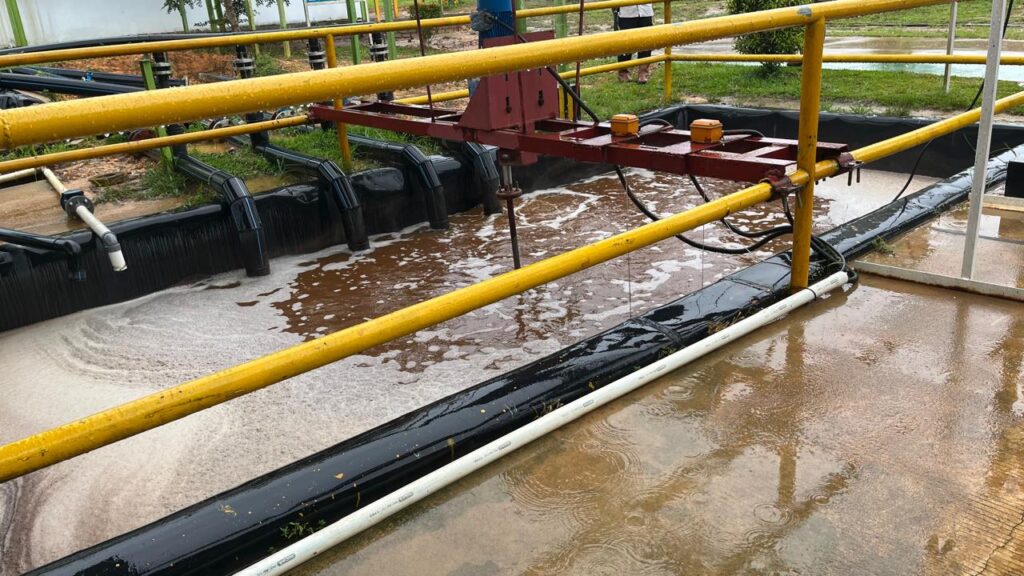
In the initial step, fresh liquid waste from palm oil processing is channeled and collected in a special installation. Typically, mills use a system of giant, airtight tanks (biodigesters) or covered lagoons.
- Anaerobic Fermentation (Bacterial Empowerment)
In a holding container isolated from oxygen, millions of bacteria work to decompose organic waste compounds. This biological process proceeds through three sub-stages: hydrolysis (the breakdown of complex compounds), acidification (the formation of acids), and methanogenesis, which produces methane gas (CH4).
- Biogas Harvesting and Energy Conversion
In the final stage, the methane gas trapped in the ceiling of the installation is then extracted, filtered, and channeled to a generator (genset) or boiler. This gas is burned to drive a turbine, producing ready-to-use electricity.
The energy potential generated with the palm oil waste is massive. Mathematically, the volume of waste is directly proportional to the energy independence achieved.
On a large industrial scale, POME-based Biogas Power Plants (PLTBg) are capable of producing up to several megawatts (MW) of power. This capacity not only covers the total operational needs of the plant but also provides abundant excess power. This excess electricity is now being channeled to provide electricity to thousands of families in remote areas and around plantations that are not yet linked to the main electricity grid.
Previously, at the 1st International Environment Forum (IEF) held by Media Perkebunan in commemoration of Earth Day, with the support of the plantation fund management board (BPDP), Sakti A. Siregar, a P3PI Practitioner and Secretary General of the Indonesian Biogas Association (ABGI), stated that palm oil mills can convert POME into biogas for power generation. Currently, there are 84 biogas power plants with a capacity of 165 MW, with 53.7 MW channeled on the grid. Five CBGs are under construction: 2 DSN, 1 Anglo Eastern, 1 Sipef, 1 TSE, 1 PTPN, and 11 Nubika/PHG. As of December 2024, cooking capacity was 94,626,065 m3, biogas boilers 68,682,582 m3, and biomethane 9,097,135 m3.
The national energy plan targets biogas utilization to contribute 5.5 GW of bioenergy-based power generation capacity, as well as biogas use up to 489.8 million m3 by 2025. Purified biogas can be upgraded to biomethane compressed gas, with a national feedstock potential of 9.96 Nm3/year.
One example of POME utilization in Indonesia that has already been implemented is the biogas-based power plant (PLTBg). The potential utilization of Indonesian palm oil liquid waste has been initiated by the state-owned enterprise, Pertamina. Biogas-based fuel is a clean energy source that does not produce air pollution and has even been proven to reduce air and soil pollution.
The POME-based power plant, which Pertamina has utilized since January 2020, can absorb up to 288,350 cubic meters of POME and has a power generation capacity of 2.4 MW. Because methane gas is converted into biogas in such large quantities, the use of POME can reduce carbon emissions by 70,000 per year, thus contributing to greenhouse gas emissions.
In addition to generating renewable energy in Indonesia, the use of POME biogas through a series of processes has been proven to also reduce greenhouse gas emissions. In 2018, the Public Relations Secretary of the Directorate General of New, Renewable Energy and Energy Conservation (EBTKE) stated that Indonesia’s 14 million hectares of oil palm plantations produce 146 million tons of fresh fruit bunches (FFB), which are then processed into 35 million tons of crude palm oil (CPO), 28.7 million tons of POME, 26.3 million tons of fiber, and others annually.
Based on data from the EBTKE (Energy and Energy Conservation Agency) directorate general, the potential electricity that can be generated from palm oil mills in Indonesia could reach up to 15 GW, of which 1.5 GW would come from POME. Currently, only 30 MW of the total generated electricity is utilized on-grid and off-grid. The generated electricity excess is then sold to PLN, or the developed power plants sell their total generated electricity to PLN.
To date, approximately 1.8 GW of bio-fueled power plants have been built in Indonesia, including approximately 22.8 MW from POME on-grid and 9 MW off-grid.
In line with this, Coordinating Minister for Economic Affairs Airlangga Hartanto stated in a press release in Jakarta on October 2, 2024 that palm oil wastes and other agricultural wastes can be utilized for a variety of economic opportunities, especially in rural areas. “By investing in these practices, we can create jobs, increase smallholders’ incomes, and strengthen local livelihoods. This is more than just sustainability; it’s about empowering our communities,” he said.
To encourage the expansion of information and knowledge regarding the wastes of palm oil as an alternative electricity source, Media Perkebunan remains committed to facilitating this, including through the hosting of the largest palm oil processing technology conference and exhibition, the 4th Technology & Talent Palm Oil Mill Indonesia (TPOMI) 2026 Conference & Exhibition, themed “Updating Technology & Talent Palm Oil Mill and Downstream,” on July 7-10, 2026, in Medan.
The event will be attended by Sakti Siregar, Deputy Chairman I of the Indonesian Biogas Association (ABGI), who will deliver his presentation on “Utilizing Palm Oil Mill Waste for Biogas and Electricity.” The presentation is expected to provide further insight into harnessing the potential of palm oil mill waste.
The event, themed “Down-streaming Plantation Commodities Towards Palm Oil as a Golden Pillar of Indonesia 2045,” will be attended by a wide range of stakeholders, including practitioners, academics, businesspeople, government officials, and students. This strategic forum aims to accelerate technological transformation and improve human resource quality in the palm oil mill (POM) sector, as well as bridge the worlds of practice, research, and policy to create efficient, adaptive, and sustainable factories. It also serves as a showcase for research and technology in the palm oil industry. (*)
mediaperkebunan.id. https://mediaperkebunan.id/mengubah-polusi-menjadi-energi-menengok-potensi-limbah-cair-pabrik-kelapa-sawit-sebagai-sumber-listrik-alternatif/. Mengubah Polusi Menjadi Energi : Menengok Potensi Limbah Cair Pabrik Kelapa Sawit Sebagai Sumber Listrik Alternatif. May 26, 2026