JAKARTA – The government has confirmed that the use of sustainable aviation fuel (SAF) or bioavtur in commercial flights does not require airlines to replace their aircraft engines. The Indonesian ministry of transportation (Kemenhub) has stated that the use of bioavtur blending of 1.0% will be started in 2027 with initial implementation for international flights from Soekarno-Hatta airport in Tangerang, and I Gusti Ngurah Rai airport in Bali.
Sokhib Al Rokhman, Director of Airworthiness and Aircraft Operations at the Ministry of Transportation’s Directorate General of Civil Aviation, stated that comprehensive technical testing was conducted before the government decided to gradually implement the Sustainable Aviation Fuel (SAF).
According to him, test results showed that aircraft engines continued to operate normally when using the bioavtur, meaning no engine replacement is required.
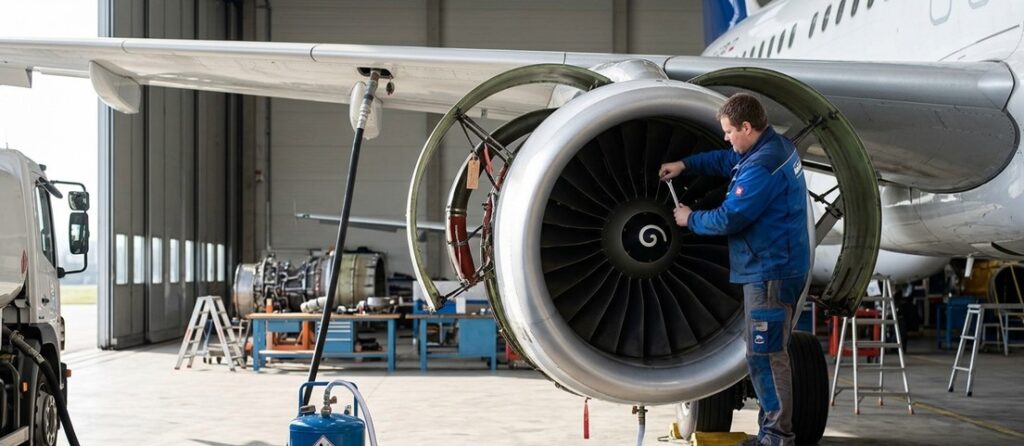
“The question was raised: did the engines need to be replaced? No—the answer is no. We conducted trials in test cells—specifically those at the Garuda Maintenance Facility—and carried out operations on a commercial Pelita Air Airbus 320. So, it is safe,” said Sokhib, as quoted by Antara on Sunday (12/07/2026).
He explained that SAF implementation will begin with a 1.0% blend as an initial phase. The government opted for a gradual application to ensure that all safety, operational, and fuel supply aspects could be evaluated before expanding the program to other airports.
SAF tested with Airbus A320
Prior to nationwide implementation, the government tested the use of the SAF on a Pelita Air Airbus A320 serving the Jakarta-Denpasar and Denpasar-Jakarta routes between August and December 2025.
According to Sokhib, the trial has entered the commercial operation phase and proceeded without technical problems. The results serve as the basis for confirming that the use of SAF is safe for civil aviation.
“The rollout of SAF is being done in stages, and we have set a target for 2027. The plan is to implement a 1.0% blending of sustainable aviation fuel with conventional jet fuel,” he said.
In the initial phase, the use of bioavtur will be limited to international flights departing from Soekarno-Hatta Airport, Tangerang, and I Gusti Ngurah Rai Airport, Bali.
“It is strictly for international flights, and we are focusing solely on two airports: Soekarno-Hatta in Tangerang and I Gusti Ngurah Rai in Denpasar, Bali,” Sokhib stated.
Bioavtur blend up to 50% in 2060
The Ministry of Transportation is currently awaiting the readiness of Sustainable Aviation Fuel (SAF) supply from PT Pertamina, which is in the process of increasing production capacity at its refineries in Cilacap, Balongan, and other facilities.
Following the implementation of the 1.0% blend, the government will evaluate the performance of aircraft engine, safety aspects, and operational reliability before increasing the SAF blending ratio.
The government has targeted to increase gradually the use of bioavtur, reaching a blending of approximately 30% to 50% by 2060, as part of its strategy to curb carbon emissions in the aviation sector.
“We will proceed in stages; after the 1.0% implementation, we will evaluate how the technology performs with aircraft engines. Subsequently, we will gradually increase the ratio, with the hope of reaching a 30% to 50% SAF blend by 2060,” said Sokhib.
Through the adoption of SAF, the government hopes the national aviation sector can support energy transition targets while simultaneously reducing emissions and maintaining the standards of aviation safety. (*)
Sawitindonesia.com. Pemerintah Pastikan Penggunaan Bioavtur Tidak Harus Mengganti Mesin Pesawat. https://sawitindonesia.com/pemerintah-pastikan-penggunaan-bioavtur-tidak-harus-mengganti-mesin-pesawat/. 13 Juli 2026