After green diesel 100 percent (D100) and green gasoline 100 percent (G100), there will be green avtur 100 percent for airplanes that is produced from palm oil, called J100. If you have read about the bio-jet fuel used by Garuda Indonesia a few years back, the J100 represents the “next level” of that achievement. Let’s take a look at what J100 is and what is its current development.
What is J100?
J100 is an aviation fuel made entirely (100%) from palm oil, containing no fossil-based jet fuel whatsoever. It is also frequently referred to as “green jet fuel” or bio-hydrocarbon jet fuel.
It differs from the J2.4 bio-jet fuel that had previously undergone successful flight testing in Indonesia. The “J2.4” designation indicates a blend of 2.4% biofuel and 97.6% conventional fossil-based jet fuel. Thus, while J2.4 contains only a small proportion of palm oil, J100 represents the full version—derived entirely from palm oil.
Produced from palm kernel, not from palm fruit pulp
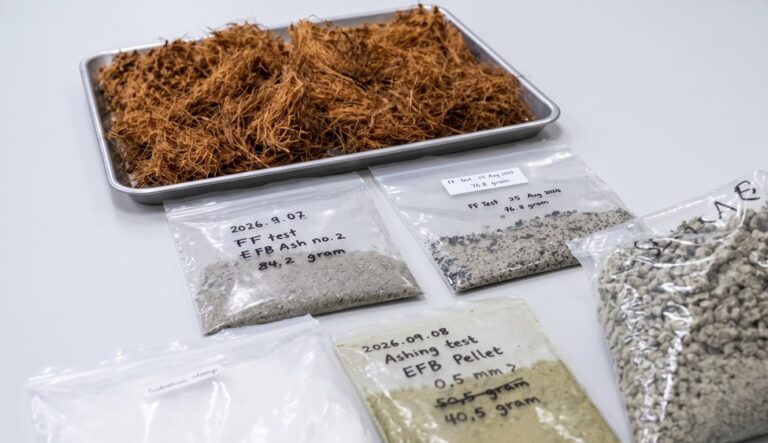
Interestingly, the production of J100 does not use CPO (oil derived from the palm fruit pulp) like D100 and G100 do. Its feedstock is RBDPKO—refined palm kernel oil. So, while CPO is extracted from the reddish-orange palm fruit pulp, the J100 production utilizes the kernel—the seed found inside the palm fruits.
One of the “fuel trio” fully based on palm oil
J100 is one of the three pure bio-hydrocarbon fuels currently being developed by the government in partnership with Pertamina:
- D100 — a diesel substitute, successfully produced at the Dumai Refinery.
- G100 — a gasoline substitute, currently in the trial phase at the Plaju Refinery.
- J100 — an aviation fuel substitute, derived from palm kernel oil.
All three utilize the “Katalis Merah Putih” (Red and White Catalyst) technology—an authentic creation of Indonesian people under a collaboration between Pertamina’s Research and Technology Centre and the Bandung Institute of Technology (ITB).
How is it progressing?
The government, through the Ministry of Energy and Mineral Resources (KESDM), has been partnering with Pertamina to develop this green fuel at refineries located in palm oil production hubs—either by “injecting” palm-based feedstock into existing refinery processes or by constructing new refineries dedicated to green fuel in the future.
To date, the achievement that has been realized and proven flight-ready is the J2.4 bio-aviation fuel. Meanwhile, J100—a pure plant-based aviation fuel—remains a target for future development, alongside G100, which is also still undergoing refinement.
Why is it important?
The advantages of palm-based bio-hydrocarbon fuels—such as higher cetane numbers, lower sulfur content, superior combustion stability, and greater clarity compared to conventional fossil fuels—have already been demonstrated by the experience with the D100. If similar benefits can be achieved with J100, then it will offer a dual benefit, namely the aviation industry will gain a cleaner fuel, while Indonesia—the world’s largest palm oil producer—will secure a vast new market for its palm kernel oil derivatives.
Big dream being pursued
J100 fulfills Indonesia’s ambitious vision of establishing palm oil as a comprehensive pillar of national energy sector from land vehicles to aircraft. With continued support for this development, it is very likely that one day the planes we fly in will truly be powered by fuel derived from the hard work of Indonesian palm oil smallholders. (*)
WikiSawit. Apa Itu J100 (Green Jet Avtur)?. https://gapki.id/id/wikisawit/knowledge-base/apa-itu-j100-green-jet-avtur/