JAKARTA — The Indonesian Forest Concessionaires Association (APHI) and the Indonesian Palm Oil Association (GAPKI) have called on their member companies to ensure their full preparedness and take all necessary preventive measures against potential forest and land fires (Karhutla) amidst the ongoing dry season. Both associations emphasized the importance of enhancing early detection, patrols, and the readiness of personnel and equipment, as well as improving coordination with local communities and governments in fire-prone areas.
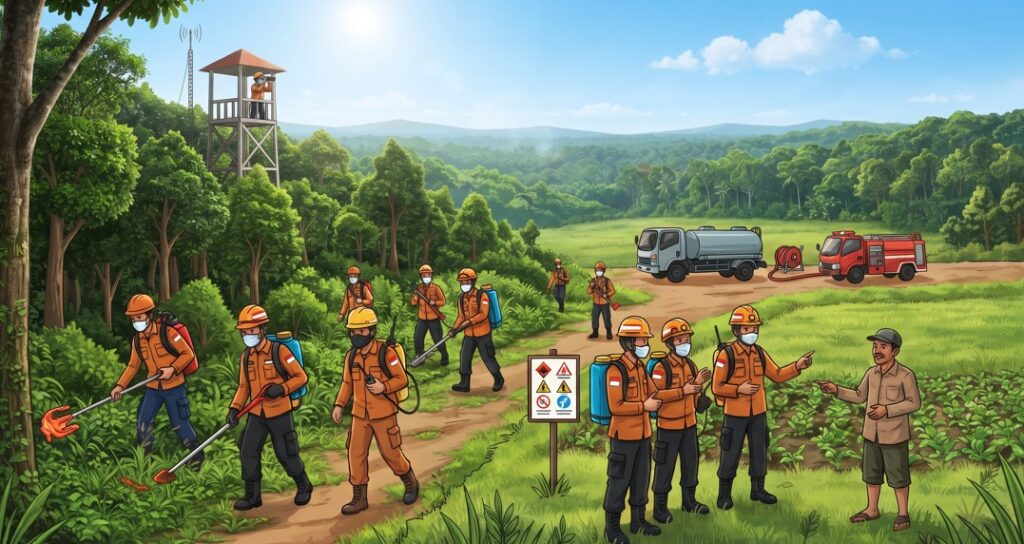
APHI Chairman Soewarso stated that the prevention of forest and land fires must be a priority for all companies holding Forest Utilization Business Licenses (PBPH). Every APHI member is required to ensure the readiness of personnel, facilities and infrastructure, early detection systems, and patrols, as well as coordination with local communities and regional governments.
“We urge all APHI members to heighten vigilance and not wait until a fire actually breaks out. Conduct early detection, routine patrols, and checks on water sources, equipment, and personnel readiness, and respond immediately to any detected hotspots,” Soewarso said in a written statement on Thursday (13/08/2026).
According to him, companies also need to strengthen coordination with Manggala Agni (the forest fire brigade), Regional Disaster Management Agencies (BPBD), local governments, law enforcement, and neighboring companies. Such coordination is essential because forest and land fires do not respect administrative or concession boundaries.
Soewarso also called on APHI members to enhance engagement with communities surrounding their operational areas through education on no-burn land clearing methods, strengthening “Fire-Aware Communities” or “Fire-Aware Villages,” conducting joint patrols, and fostering alternative economic opportunities.
“Forest and land fire prevention cannot be achieved solely from within company premises. Communities must be involved as key partners, as they are closest to the sites and can serve as the first line of defense in detecting and preventing fires,” he stated.
APHI also encourages its members to share information quickly and transparently regarding field conditions and the prevention measures undertaken. Information transparency is considered crucial so that the government and the public are aware of the business sector’s preparedness and contributions toward controlling forest and land fires.
Companies are expected to document activities such as patrols, outreach, training, equipment checks, hotspot monitoring, the wetting of fire-prone areas, and community engagement. This documentation will also serve as a basis for evaluation to continuously improve forest and land fire prevention systems.
Cross-sector Coordination
Meanwhile, GAPKI Chairman Eddy Martono Rustamadji emphasized that all GAPKI-member palm oil plantation companies must enhance preparedness, ensure no land clearing or preparation involves burning, and strengthen surveillance within and around plantation areas.
“We urge GAPKI members to ensure that all prevention systems are functioning effectively—ranging from hotspot monitoring, field patrols, and the readiness of firefighting teams, equipment, and water sources, to coordination with local communities and stakeholders,” said Eddy.
According to him, preventing forest and land fires is a shared responsibility, as the impact extends beyond the environment to public health, social activities, the economy, and business sustainability.
GAPKI also encourages its members to strengthen support for farming and plantation communities, provide facilities and infrastructure for fire control, and develop productive economic activities that reduce the practice of clearing land by burning.
“Companies must stand with the community, not just when a fire breaks out. Education, training, joint patrols, and the development of alternative livelihoods must be carried out consistently so that prevention truly becomes a shared culture,” Eddy stated.
APHI and GAPKI will strengthen cross-sector coordination through education and awareness-raising, integrated patrols, alternative economic empowerment, human resource capacity building, the use of early detection technology, and the strengthening of the organizations of Masyarakat Peduli Api (Fire-Aware Communities).
Weather information
APHI and GAPKI believe that, given the potential El Niño phenomenon and the rising threat of forest and land fires, the dissemination of public information regarding regional and local weather forecasts via mass media needs to be further intensified. Corporate management is also expected to actively monitor weather developments through official BMKG channels and other weather information platforms as a basis for heightening vigilance, strengthening preparedness, and implementing early prevention measures against fires.
The two associations also urge their members to promptly report any signs of fire and deploy available resources for initial response actions to prevent the fire from spreading. Through this joint appeal, APHI and GAPKI reaffirm the commitment of the forestry and palm oil plantation sectors to protecting the environment from the threat of forest and land fires. (*)
News Majalah Hortus. APHI dan GAPKI Imbau Anggota Perkuat Pencegahan Karhutla. https://news.majalahhortus.com/aphi-dan-gapki-imbau-anggota-perkuat-pencegahan-karhutla/