Indonesia’s palm oil industries are not only supported by big companies, but also by millions of palm oil smallholders. In practice, there are two main types of palm smallholders: plasma and independent ones. Both have an important role in the national supply chain of palm oil, but with different characteristics, opportunities, and challenges.
Understanding the differences between the plasma smallholders and the independent ones has been increasingly important, especially in relation to government programs, such as replanting of smallholders’ plantations (PSR), increasing productivity, sustainability certification, and strengthening of the smallholder-related institutions.
Understanding Plasma Plantations
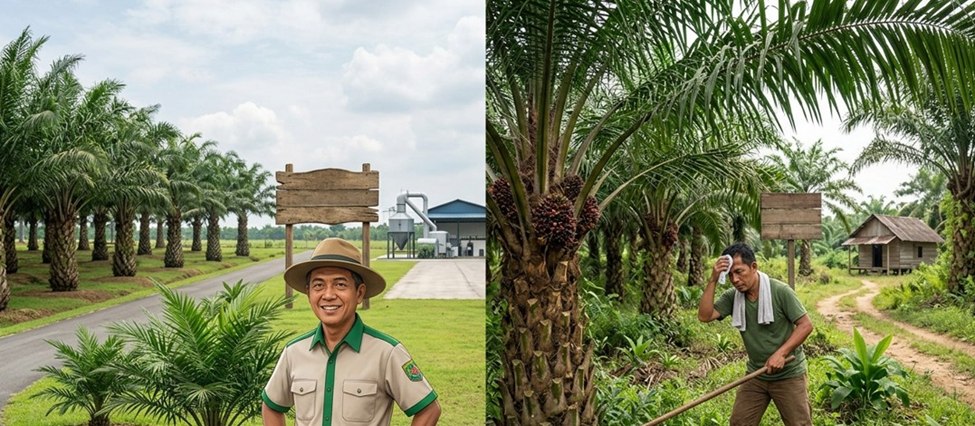
The plasma scheme of oil palm plantations is a partnership model between a plantation company acting as the nucleus and farmers acting as the plasma (smallholders). The company provides support ranging from technical guidance and access to high-quality seedlings to guaranteed market access.
Under this partnership, plasma farmers generally sell their fresh fruit bunches (FFB) directly to the partner’s mill.
Understanding Independent Plantations
Unlike plasma (partnered) farmers, independent oil palm smallholders manage their plantations autonomously, without being bound by formal partnerships with plantation companies.
These independent farmers make their own decisions regarding seedling sources, fertilization patterns, cultivation techniques, and marketing channels. While their freedom offers great flexibility, it also requires farmers to face challenges on their own.
The Differences Between Plasma and Independent Plantations
Here are some fundamental differences:
- Business status — Plasma (scheme) oil palm farmers partner with a core company, whereas independent smallholders operate their palm plantations autonomously.
- Technical assistance — Plasma farmers receive continuous support, while independent smallholders have relatively limited access.
- Access to seedlings and inputs — Plasma farmers have easier access through partnerships, whereas independent smallholders rely on their own resources.
- FFB marketing — Plasma farmers generally have guaranteed market access, while independent smallholders are subject to market conditions.
- Bargaining power — Plasma farmers are supported by partnership structures, whereas independent smallholders rely on farmers’ organizations, but not all of them.
- Decision-making — Plasma farmers adhere to partnership agreements, whereas independent smallholders enjoy greater flexibility and autonomy.
Productivity: Plasma Tends to Be Higher
Various studies indicate that plasma smallholders generally achieve higher productivity. Research by INSTIPER Yogyakarta shows that the productivity of plasma farmers is approximately 2.37 tons/ha, whereas that of independent smallholders is around 1.86 tons/ha.
Opportunities of Plasma Smallholders
The plasma scheme offers benefits such as structured technical assistance, access to high-quality planting material, guaranteed market access, and stronger institutional arrangements.
However, plasma farmers also face challenges, such as dependency on partner companies.
Opportunities of Independent Smallholders
Independent smallholders possess the advantage of autonomy in managing their plantations and determining their own business strategies.
Challenges Facing Independent Smallholders
Despite their high flexibility, independent smallholders face challenges such as limited access to information and technology, the use of planting material that is not always of high quality, financing difficulties, restricted market access, land legality issues, and relatively lower productivity.
Relation to Replanting Program
The replanting program for smallholders’ oil palm plantations (PSR) is one of the government’s initiatives to boost the productivity of aging smallholder plantations.
Plasma (scheme) smallholders generally find it easier to access the program due to their existing institutional structures. However, the majority of smallholder plantations requiring replanting belong to independent smallholders. Strengthening institutions and providing technical assistance are crucial factors for the success of the PSR program.
Plasma and independent smallholder plantations represent two vital pillars in the development of Indonesia’s smallholder sector. With appropriate policy support, both can contribute significantly to productivity, farmer welfare, and the sustainability of Indonesia’s palm oil industry.
WikiSawit. Sawit Plasma dan Sawit Swadaya: Peluang, Tantangan, dan Perbedaannya. https://gapki.id/id/wikisawit/knowledge-base/sawit-plasma-dengan-swadaya-apa-bedanya/