JAKARTA – Indonesia’s digital transformation is entering a new phase. Digitalization is no longer merely about network development and technology adoption. It is increasingly geared towards boosting productivity, strengthening industrial competitiveness, and generating tangible impacts on national economic growth.
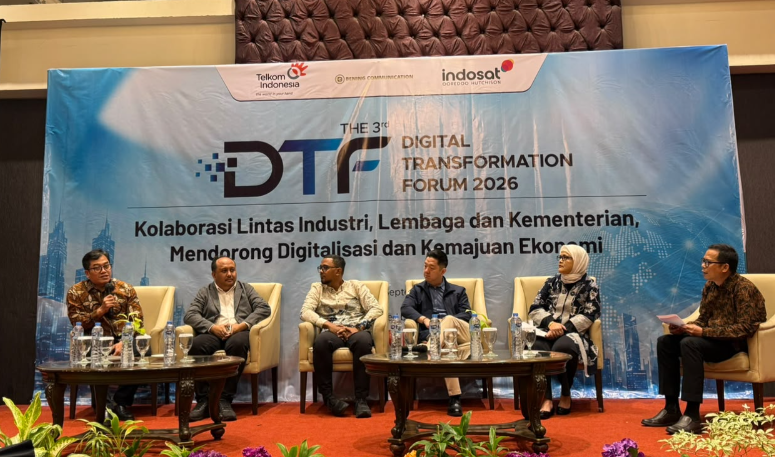
The digitalization was among the subjects discussed at the 3rd Digital Transformation Forum (DTF) 2026, organized by Selular Media Network at the Arion Suites Kemang Hotel in Jakarta on Monday (21/09/2026).
Centered on the theme “Cross-Industry, Institutional, and Ministerial Collaboration: Driving Digitalization and Economic Advancement,” the forum brought together stakeholders from the government, telecommunications operators, internet associations, the device and technology retail industries, and the oil palm plantation sector.
Government digitalization strengthens ecosystem of economy
Mamur Saputra, Head of the Public Relations and Information Technology Bureau at the Coordinating Ministry for Law, Human Rights, Immigration, and Correctional Affairs (Kemenko Kumham Imipas), stated that digitalization has become a necessity in the delivery of public services.
According to him, technological advancements demand that government services become faster, more transparent, and easily accessible to the public.
The digital integration of services related to law, human rights, immigration, and corrections is considered capable of strengthening legal certainty while supporting the investment climate and the creation of a more inclusive economic ecosystem.
A number of services have been developed digitally, including online passport applications, automated gates (autogates), electronic visas, digital residence permits, an integrated inmate database, and the Legal Documentation and Information Network (JDIH).
In addition to service digitalization, the government also prioritizes cybersecurity, human resource capacity building, system interoperability, and industry collaboration as crucial components of the digital transformation.
Telecommunication industry moves towards TechCo
In the telecommunications sector, advancements in artificial intelligence (AI), the Internet of Things (IoT), and cloud computing are driving a shift in operator business models.
Machdi Fauzi, VP Head of Ecosystem Regulatory Affairs at Indosat Ooredoo Hutchison (IOH), noted that the telecommunications industry is transitioning from a “Telco” model to a “TechCo” model.
While connectivity remains the fundamental base, value creation is increasingly driven by digital services, applications, industry solutions, and AI.
This transformation requires regulatory support that ensures investment sustainability. A key issue being highlighted is spectrum costs, including the evaluation of existing frequency utilization.
According to Machdi, achieving efficiency through infrastructure and spectrum sharing can also play a role in strengthening the digital ecosystem.
“Connectivity remains the foundation, but the greatest monetization potential in the future lies in the upper layers—such as applications, digital solutions, and AI. Collaboration between regulators and operators is crucial for propelling Indonesia’s digital ecosystem to the next level,” he said.
The need for cross-sector collaboration
Elly Noor, Head of the Institutional Affairs Division at the Indonesian Internet Service Providers Association (APJII), emphasized the importance of collaboration among ministries, agencies, associations, and industry players.
According to her, accelerating the digital economy will face challenges if each party continues to implement programs in isolation.
Coordination, she noted, is required not only between the association and the Ministry of Communication and Digital but must also involve other ministries and agencies relevant to digital economy development.
“None of us can work alone. We must sit down together to find solutions for the issues encountered on the ground. Most importantly, there must be no more sectoral ego or working in silos,” said Elly.
AI Drives Change in the Device Industry
The advancement of AI also presents challenges for the digital device industry.
Mark Jefferson Go, Chief Strategy, Research and Development, and Enterprise and Education Director at Erajaya Digital, stated that the growing need for AI is accelerating the demand for chipsets.
The smartphone industry must now compete with various other sectors that also require high-performance chipsets for AI technology development. This situation could exert upward pressure on device prices.
Meanwhile, manufacturers and distributors need to collaborate with principals, financing companies, telecommunications operators, and over-the-top (OTT) service providers to maintain public access to digital devices.
Smartphone starts transformation into AI Ecosystem
Similar changes are also evident in the smartphone industry.
Motorola Indonesia Country General Manager Bagus Prasetyo explained the development of the “Hybrid AI” concept, which combines on-device AI processing with cloud-based AI.
Motorola is also developing the “Interconnected AI” concept an AI ecosystem capable of functioning across multiple devices.
This approach demonstrates that future competition in the device industry will not hinge solely on specifications such as RAM, cameras, chipsets, or battery capacity. The integration of smartphones, smartwatches, tablets, and computers is becoming a key component in the development of AI-driven technology ecosystems.
Palm digitalization drives traceability and productivity
Digital transformation is becoming increasingly relevant for Indonesia’s palm oil industry.
Mochamad Husni, a communications representative for the Indonesian Palm Oil Association (GAPKI), noted that the industry still relies on manual processes for various operations ranging from plantation record-keeping and fresh fruit bunch (FFB) logistics management to sustainability reporting.
This persists even as global market demands for traceability continue to rise. The industry needs the capability to identify and document product origins, right down to the plantation level.
Traceability is becoming increasingly critical as the market seeks more information regarding raw material origins and production processes.
In this context, technologies such as AI, drones, satellite imagery, IoT, and data analytics can be leveraged to enhance the efficiency and accuracy of plantation management.
AI, for instance, can assist in predicting fruit yields, while drones and satellite imagery can be utilized for mapping and monitoring plantation conditions.
Digitalization also opens up opportunities to develop various support services within plantation areas, including connectivity, IoT, cloud computing, digital financial services, logistics, and marketplaces.
Digital infrastructure needs to reach plantations
Ultimately, the digitalization of the palm oil sector depends on more than just the availability of software and AI.
Connectivity serves as the fundamental infrastructure required to effectively implement digital technologies across plantation areas characterized by vast and dispersed geography.
Therefore, collaboration among palm oil industry players, telecommunications operators, technology providers, the government, and digital service providers is essential to building an ecosystem that meets the industry’s needs.
The application of technology must also be aligned with real-world operational needs. This ensures that digitalization goes beyond mere technology adoption to deliver tangible improvements in productivity, operational efficiency, and data quality.
Collaboration is the key to digital transformation
Discussions at DTF 2026 highlight that Indonesia’s digital transformation involves cross-sector interests.
The government requires technological support and industrial investment to enhance the quality of public services. Telecommunications operators need regulations and business models that support investment sustainability, while the device industry relies on a robust ecosystem, connectivity, and purchasing power of consumers.
Meanwhile, productive sectors such as plantations require a combination of connectivity, AI, IoT, satellite imagery, drones, and data analytics to boost productivity while meeting traceability and sustainability requirements.
Uday Rayana, CEO and Editor-in-Chief of Selular Media Network, stated that the ultimate success of digital transformation is not determined solely by the volume of new technologies deployed.
“The real challenge lies in ensuring that digitalization enhances industrial competitiveness, expands the benefits of technology, and serves as a new engine for Indonesia’s economic growth,” he emphasized.
Thus, the next phase of Indonesia’s digital transformation is not just about technological development. It is also about how the government and the business sector collaborate to ensure these technologies are implemented effectively and generate tangible economic value. (*)
Selular.id. Transformasi Digital Indonesia Tak Bisa Jalan Sendiri, Kolaborasi Jadi Kunci. https://selular.id/2026/09/transformasi-digital-indonesia-tak-bisa-jalan-sendiri-kolaborasi-jadi-kunci/. 21 September 2026