The straightforward statement made by the Coordinating Minister for Political and Security Affairs in early September—banning the local wisdom of practicing traditional burning during periods of extreme drought—has touched upon an issue long left in limbo due to its sensitivity. This policy has understandably sparked strong opposition from activists championing indigenous communities, who are vigorously pushing for the enactment of the Indigenous Peoples Bill and the recognition of customary land rights.
Yet, the facts on the ground compel us to view reality clearly and thoroughly, without wearing horse blinders.
Misinterpretation of local wisdom in Karhutla Mitigation
The rate of deforestation and the threat of forest and land fires (Karhutla) are increasingly intersecting with the population growth and the escalating climate crisis. Unfortunately, amidst this critical situation, public perception has become overly simplistic: treating customary law and local wisdom as sacred norms that are taboo to question, let alone alter. This misconception is reinforced by international institutions and global NGOs that often uncritically accept local wisdom as cultural heritage that must be preserved unconditionally.
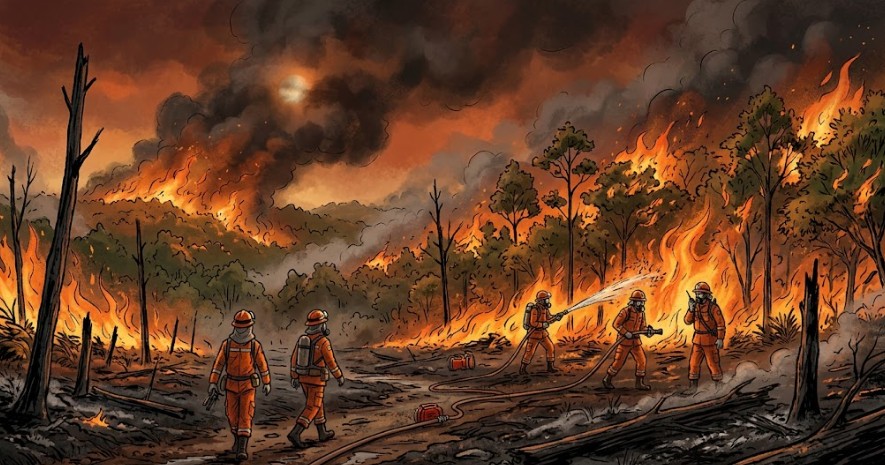
Yet, empirical field studies reveal that some of the annual fire hotspots actually stem from land-burning activities—legal under regulations, albeit limited in scope—justified by local wisdom. When a practice clearly triggers a chain reaction of ecological destruction, upholding it in the name of tradition is undeniably misguided. Smoke from fires does not distinguish between customary territories and general settlements. The ultimate victims are the millions of people whose health is under threat.
This reality should serve as a primary catalyst for re-evaluating traditional customary rights, communal land rights (hak ulayat), and the various derivatives of existing customary law.
Respecting culture and indigenous communities is indeed a constitutional mandate. However, such protection should not be interpreted as an attempt to freeze traditions in time, shielding them from the evolution of the modern era. On this special case, there is an urgent need to “desacralize” customary law and local wisdom.
The public and policymakers must have the courage to distinguish between spiritual-cultural values and the technical practices of environmental management. Local wisdom is not a static dogma, as it is actually a product of human adaptation to social and environmental conditions in a certain time period—one that remains perpetually open to scrutiny and adjustment.
Technically, the practice of land clearing by burning may have been effective and relatively safe when rainfall patterns were regular, population density was low, and forest cover was dense. However, under the threats of El Niño and extreme climate change, the environment’s carrying capacity has shifted drastically. Practices that were once in harmony now carry a high risk of triggering massive disasters.
Such situation calls for the academic and technocratic courage to make discerning choices: preserving positive, ecologically supportive values while discarding traditional practices that conflict with modern environmental science. Practices that are no longer relevant should be archived as part of cultural history rather than forced upon the present day.
Reform of Customary Regulations and Environmental Protection
In light of this evaluation, the House of Representatives (DPR) and the government ought to overhaul the legal framework governing customary practices. Regulatory adjustments—including harmonization with Law No. 32 of 2009 concerning Environmental Protection and Management—must boldly transcend sectoral boundaries to ensure public safety and the equitable distribution of benefits to the wider community.
A legal perspective provides a solid foundation for this overhaul. Experts in constitutional and environmental law emphasize that customary law is essentially “living law”, as it grows and evolves dynamically alongside civilization rather than remaining a static relic.
Environmental law expert Prof. Valerie J.L. Singal (University of Indonesia) and constitutional law expert Prof. Mahfud MD affirm that while Article 18B, Paragraph (2) of the 1945 Constitution acknowledges customary law, the Constitution sets clear boundaries: such rights are recognized only insofar as they remain active and do not conflict with the times or the principles of the Unitary State of the Republic of Indonesia (NKRI).
When cultural practices are proven to threaten the public welfare, the classic legal maxim “salus populi suprema lex esto” (the safety of the people is the supreme law) must serve as the guiding principle, taking precedence over any local custom.
Furthermore, environmental law expert Prof. Maria S.W. Sumardjono (Universitas Gadjah Mada–UGM) underscores the critical need for regulatory alignment. Customary land rights and local customs must not be allowed to morph into zones of legal immunity—enclaves beyond the reach of national environmental safety oversight. The recognition of customary rights should be commensurate with the ecological responsibilities attached to them.
Local wisdom adaptation amidst climate crisis
We must respond to the changes and dynamics of life resulting from global warming, population growth, modernization, and evolving needs—with the flexibility to adapt. Such adaptation entails evaluating and rationalizing our values: retaining those that remain relevant and beneficial, while modifying practices no longer suited to the times based on in-depth analysis.
Therefore, it is essential to strip customary law and traditional wisdom of their sacrosanct and dogmatic nature, aligning them instead with contemporary realities and universal human values. The necessary endeavor is to foster a discourse on a new form of wisdom—one that is more beneficial and virtuous, yielding positive impacts not only for the communities that hold this wisdom but also for the nation and humanity at large.
Desakralisasi Kearifan Lokal untuk Mitigasi Karhutla. Edi Suhardi – Analis Berkelanjutan. https://www.infosawit.com/2026/09/24/desakralisasi-kearifan-lokal-untuk-mitigasi-karhutla/. 24 September 2026