Press Release
Indonesian Palm Oil Association (IPOA)
Palm Oil Industry’s Performance In 2022
The year 2022 in Indonesia was marked by unusual incidents which include extreme wet weather, surging cases of Covid-19 in February, the outbreak of Russia – Ukraine war in February, very high prices of vegetable oils that include palm oil, very high prices of oil, government’s palm oil export ban during 28 April – 23 May, high prices of fertilizers and very low realization of replanting program for smallholders (PSR).
All of the unusual incidents had significantly affected the palm oil industry in Indonesia in terms of production, consumption, and exports.
Extreme wet weather had impacted the activities of pollinating insects and harvest. Fertilizers that are expensive and hard to find had affected the activities to maintain the plants, while the export ban had caused the farmers to stop harvesting their fresh fruit bunches (FFB) during the export ban and several months after the ban as the stock was still very high.
The failure of PSR program to realize target and the only small increase of plantation acreage at 600,000 hectares during the last 5 years due to moratorium of oil palm plantation licenses had made the growers to lose hope of increasing production through the new planting. The very high prices of palm oil have also caused the smallholders to delay their replanting program, causing the acreage of old plantations with lower productivity was still in larger portion.
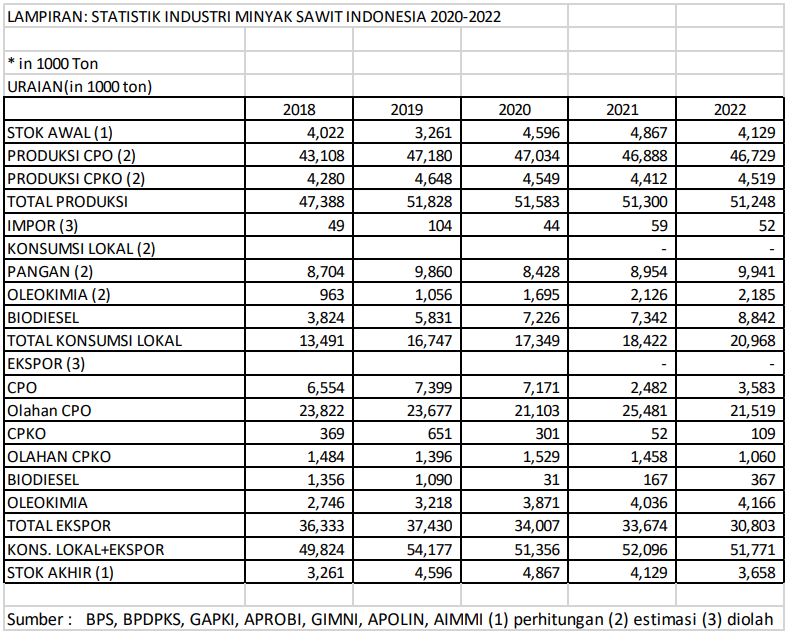
Such condition had contributed to the stagnation of CPO production in 2022 at 46.729 million tons, which was slightly lower than that in 2021 at 46.888 million tons and it was the fourth consecutive year that saw stagnant growth of palm oil production. Local consumption in 2022 reached 20.968 million tons, which was higher than that in 2021 at 18.422 million tons.
The consumption was dominated by food industries at 9.941 million tons, which was higher than that in 2021 at 8.954 million tons and higher than that in 2019 before pandemic at 9.860 million tons. The consumption for oleo-chemical industry reached 2.185 million tons, which was 2.8% higher than that in 2021 at 2.126 million tons. It was much lower than the increase of consumption during 2019-2020 at 25.4% and period of 2018- 2019 at 60% which was suspected to have been caused by the Covid-19 pandemic.
The consumption for biodiesel in 2022 reached 8.842 million tons which was higher than the consumption in 2021 at 7.342 million tons. The exports in 2022 reached 30.803 million tons, which were lower than that in 2021 at 33.674 million tons, and it was the fourth consecutive year that saw export drop from year to year. The export value in 2022 reached US$39.28 billion (CPO, processed and derivative), higher than that in 2021 at US$35.5 billion. It was caused by the fact that the price of palm oil products in 2022 was higher than that in 2021.
Ten destination countries of Indonesian palm oil exports are China, India, USA, Pakistan, Malaysia, Netherlands, Bangladesh, Egypt, Russia and Italy. The USA rating as palm oil importer rose from fifth in 2020 to third in 2022.
With the realization of production, local consumption and exports mentioned above, then the local stock of palm oil is estimated to reach 3.658 million tons. Based on the growth rate of production and consumption, all those problems hindering the production increase should be tackled soon.
The condition that has affected the palm oil industry during 2022 is predicted to continue affecting the performance of palm oil industry in 2023. Production is projected to remain stagnant, while the domestic consumption is projected to rise due to the implementation of the mandatory B35 program since 01 February 2023.
Jakarta, 25 January 2023
Indonesian Palm Oil Association (IPOA)
For further information, please contact:
Mukti Sardjono
Executive Director GAPKI