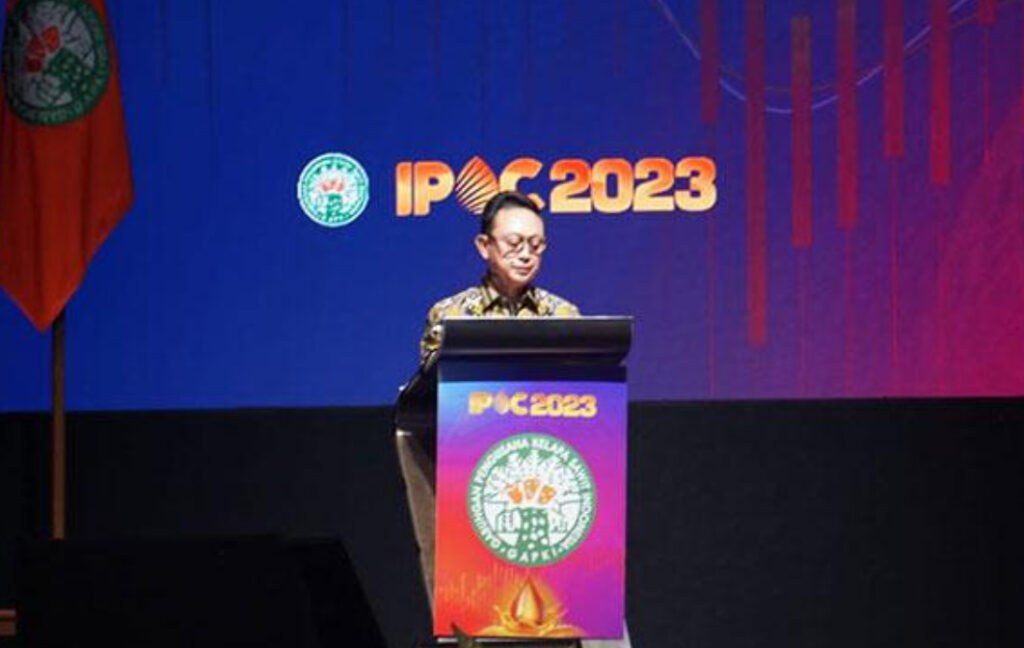
Nusa Dua, Bali – The Indonesian Palm Oil Association (GAPKI) held the 19th Indonesian Palm Oil Conference and 2024 Price Outlook 2023 (IPOC 2023) on Thursday by echoing the ongoing global market certainty in which the industry players badly need the support of Indonesian government and other governments in Asian region, especially on the use of bioenergy.

Economic Coordinating Minister Airlangga Hartarto pointed out in his keynote speech, before formally opening the IPOC 2023, about the global condition that caused the market uncertainty. “The market uncertainty has been caused by the slow growth of global economy that might cut demand, trade barriers (tariff and non-tariff ones) that include the European Union Deforestation-Free Regulation(EUDR), geopolitical tension in Ukraine and the Middle East, and the global problem of climate change that requires the implementation of sustainability principles,” he said.
GAPKI Chairman Eddy Martono reminded the conference participants about the important role of palm oil as the top commodity in Indonesia, which has made it as the world’s largest producer, consumer and exporter of palm oil. Employing more than 16 million workers, the palm oil also shows its important role in Indonesian economy by contributing around Rp600 trillion in foreign exchange last year.
He highlighted the strong performance of palm oil during the Covid-19 pandemic that last for almost three years (2020-20220), while most of the other economic sectors declined and even collapsed. Its strong performance has significantly helped supporting Indonesia’s trade balance to stay positive.
As of August 2023, Indonesia’s palm oil production reached 36.3 million tons, while its exports, which include biodiesel and oleochemical, at the same period amounting to more than 23.4 million tons at a total value of US$20.6 billion or around Rp600 trillion,” said Eddy Martono.
The palm oil has outcompeted other top vegetable oils, namely sunflower, rapeseed and soybean, and managed to control a market share of more than 35 percent at the global market of vegetable oils.
Due to its productivity, efficiency, and versatility, the palm oil has been used in almost all of consumer goods found in the shelves of malls and supermarkets across the globe.
During the first session of the conference on Thursday, the oil palm plantation fund management board (BPDPKS) Chairman
Eddy Abdurahman concluded the palm oil performance with an adagium: “No Palm oil, No Life.”
But Aika Yuri Winata, Green Energy General Manager of Apical Group, raised the green issue to balance the economic side of palm oil as consumer goods. Referring to the mother earth that should be protected, she said: “No healthy mother, no life”.
She mentioned the importance of using green airline fuel as a way to reduce the greenhouse gas emission that has recently worsened the climate change problem.
Eddy Abdurrahman underlined the importance of strengthening the resilience of palm oil through the government’s programs of replanting for smallholders and bioenergy program.
Yudo Dwinanda Priadi, Director General of New and Renewable Energy and Energy Conservation at the ministry of energy and mineral resources (MEMR) mentioned the rising growth of bioenergy as more and more countries turn to the use of renewable energy sources to reduce carbon emissions and a result of countries’ commitment to transition from fossil fuels, which are not friendly to the environment, to green energy sources which are sustainable and ecofriendly.
He said that the government has now implemented the biodiesel 35 percent (B35) mandatory program and ready for the launching of bioethanol, biogasoline and bioavture as sustainable aviation fuel (SAF).
He said that the government under a collaboration with other stakeholders, including the transportation ministry and state-owned oil-gas company PT Pertamina, has completed a series of necessary tests on the use of the Sustainable Aviation Fuel (SAF) or BioAvtur 2.4% (J2.4) in flights.
“But as we’re now still in the stage of conducting a pilot project, we need to conduct further assessments and preparations for commercial production,” he said.
Regarding the bioavture alone, Aika said that its production and application in aviation needs the commitment of the Indonesian government and other Asian governments through regulaions. “This is concerned with investments. Without a strong commitment of governments in supporting it through policies, no company interested in such production. It should be implemented under a concerted effort with other governments in Asian region to make it viable and feasible,” she said.
Considering the facts expressed by all speakers during the first day IPOC 2023 conference, apparently the uncertainty has not only posed challenges. It also holds opportunities that can be worked out for the benefits of the palm oil industry.
Eddy Martono hopes that the Indonesian government will take appropriate policies that will strengthen the sustainability and resiliency of Indonesian palm oil and keep its competitiveness at the global market.
“The global uncertainty can also become opportunities for industry players if they take the right steps with the help of the Indonesian government. We believe that with the right policies of the government, the Indonesian palm oil industry can grow robustly amid the global uncertainty,” said Eddy Martono. Benget Besalicto ST