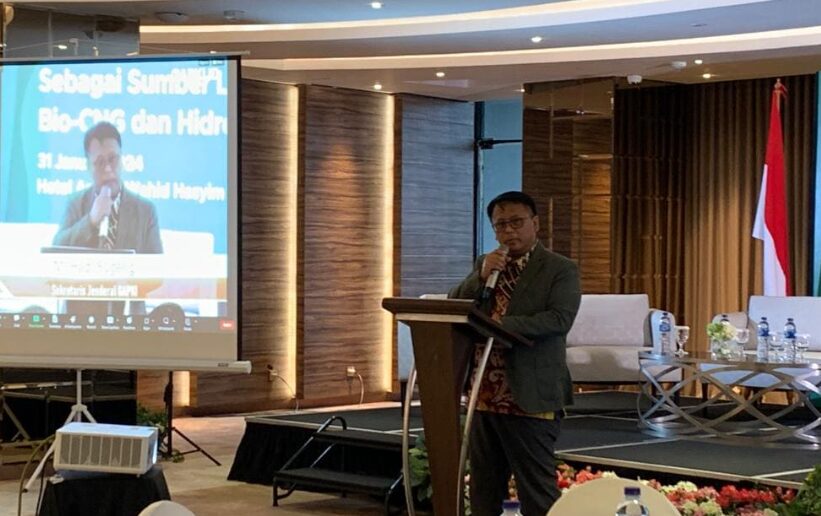
The Indonesian Palm Oil Association’s (GAPKI) Secretary General Hadi Sugeng said that by applying gas methane capture technology and use it as an energy source, palm oil producers can reduce their production cost and further increase their efficiency.
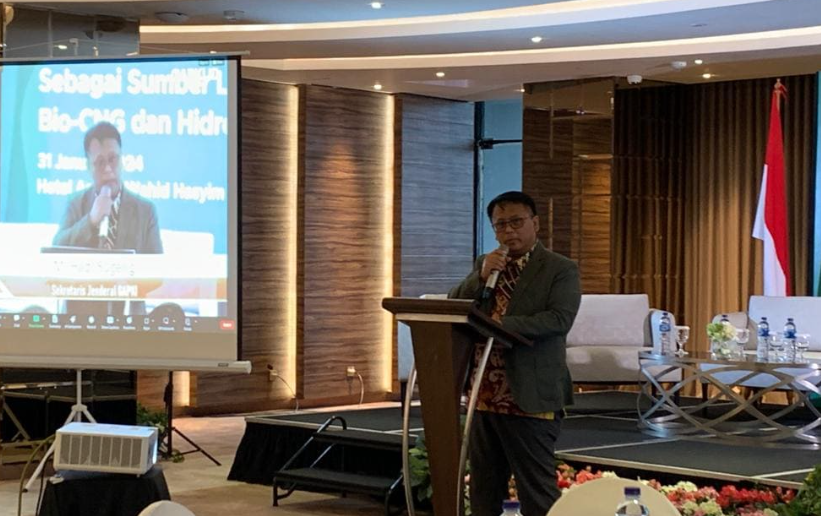
Speaking during a seminar on acceleration of methane gas use in palm oil mills for power generation, and production of Bio-CNG and Hydrogen in Jakarta on Wednesday (31/1), he said that methane is one of the biggest contributors to the global warming, which is 27.9 times more potential than Co2 emissions.
“To reduce its negative impact, producers can apply the methane capture technology and use it as an energy source for vehicles or processed it into Bio-CNG and Hydrogen,” said Sugeng.
According to him, the three types of energy can be used on the location of palm oil mills or transmitted to other locations. “The electricity generated from the methane-fired power plants can be transmitted through the power grid of PT PLN. The Bio-CNG and Hydrogen can be transported to other places after being compressed in canisters,” he said.
According to him, Indonesia has now a total of 1,142 units of palm oil mills with processing capacity of 30-90 tons fresh fruit bunches (FFB) per hour. With the assumption that each palm oil can generate power at 2 megawatt (MW) then a total of 2,200 MW can be generated from all of the mills.
He said that a number of companies have produced the Bio-CNG and Hydrogen. Such achievement is an innovation to raise added value for companies.
Other companies can also apply the technology of methane capture, Bio-CNG and Hydrogen. “But certainly, they need the support of government policy and incentives. “Good policies and incentives will push up investments for the use of methane gas, which will increase the contribution of renewable energy to the national energy mix,” he said.
But Sugeng admitted that the use of methane gas is actually seen less economic due to its lower energy content compared to LPG and the oil palm shells. “The methane gas has energy content of 12.7 Kkal/Kg, while LPG at 11,254.6 Kkal/Kg and palm shells at 3,380 Kkal/Kg,” he said.
Sugeng also said that the process to purify the methane needs big investment. “We need to find the right way to mitigate the methane in the palm oil production process without causing the increase of production cost. But it should be an addition of income that reduce the production cost of palm oil,” he said. (*)
Source: news.majalahhortus.com