Ever since gaining a big share in the global market of vegetable oils, the palm oil commodity has played a very important role in Indonesian economy. Now it has become the country’s biggest contributor to the state income, outperforming the oil and gas, which was previously the mainstay of Indonesian economy, especially during the New Order under the administration of President Soeharto.
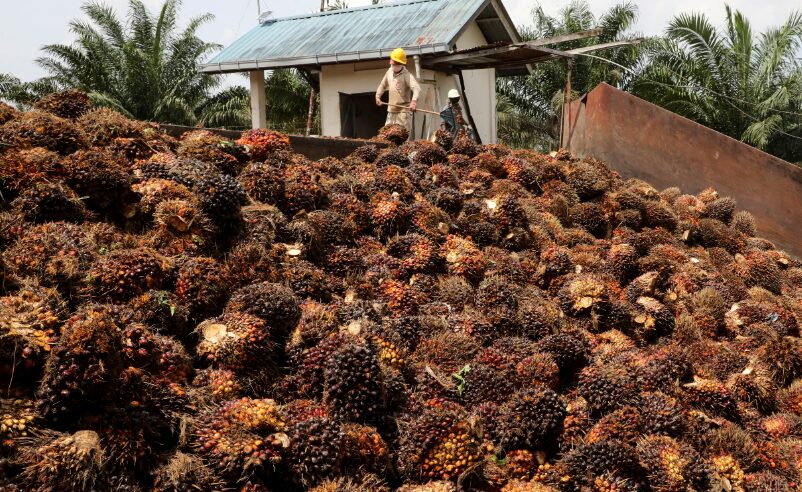
Based on data from the Indonesian Palm Oil Association (GAPKI), in 2022 the palm oil industry contributed US$39.07 billion or around Rp600 trillion in foreign exchange, which is the highest in the history of Indonesian palm oil. With a total oil plantation areas of 16.38 million hectares, the Indonesian palm oil industry employs more than 16 million people directly and indirectly. In 2023, Indonesian production of palm oil was estimated at 49 million tons, of which about half was exported. Accounting for around 59 percent of the total global export of palm oil, the Indonesian palm oil industry commands around 40 percent of global market of vegetable oils, outcompeting other three main rival vegetable oils, namely sunflower oil, rapeseed and soybean oil.
But during the last few years, the Indonesian palm oil industries have been dealing with a number of problems locally and globally, threatening Indonesia’s position as the world’s largest producer and exporter of palm oil products. Those problems are indicated by the declining trend of exports during the last four years, while production was stagnant and inclined to decrease during the period.
GAPKI reported that Indonesia’s palm oil exports had decreased from 37.4 million tons in 2019, to 34 million tons in 2020, 33.6 million tons in 2021, and slightly rose to 33.9 million tons in 2022, then it was estimated at only 32.9 million tons in 2023.
Addressing a public discussion on the prospect of palm oil industry after the implementation of the omnibus law on job creation (UUCK) in Palangka Raya recently, GAPKI Secretary General Muhammad Hadi Sugeng said that the problems facing the Indonesian palm oil industries are concerned with stagnant production, smallholders’ plantation development, and forestry-related ones.
The Indonesian Palm Oil House (RSI) Chairman Kacuk Sumarto concurred with Hadi on the three main problems. But he added that another problem facing the palm oil industry is the rising trend of production cost while prices were slow to increase.
GAPKI Chairman Eddy Martono has also revealed those problems during several occasions. “Regarding the palm oil production, it is very important for the Indonesian palm oil industries to increase production to fulfill rising demand for vegetable oils at local and global markets. At local market, there has been an increase of palm oil consumption for foods and oleochemical products,” he told reporters during a journalistic workshop recently.
Eddy underlined the importance of the government’s replanting program (PSR) for smallholders as 41 percent of the total oil palm plantation areas in Indonesia are owned by smallholders. So far, the smallholders’ productivity is still very low at only 2.5 tons of palm oil per hectare per year, as compared to those of oil palm plantation companies at around 5 – 6 tons per hectare per year.
He said that the government should also tackle all forest-related problems which have hindered the legal process of replanting program. The forest and deforestation problems have been a recurring issue with regard to the Indonesian palm oil industries.
As Indonesia is about to see an administration transition from the current government under President Joko Widodo (Jokowi) to the next government through the presidential election 2024, the palm oil industry players have expressed the hope that the next government should continue the ongoing efforts of improving the palm oil governance, accelerate the current replanting program, further expand the downstream palm oil industries, and address the problems facing at the global market, especially the negative campaigns against the palm oil.
Despite the problems, analysts see that the palm oil industries have the big potential to grow much higher. Senior Economist of the Institute for Development of Economics and Finance (Indef) Aviliani said that Indonesia’s palm oil has a high competitiveness at global market and big potential to grow higher. “Palm oil is part of human primary needs of foods and energy, so it will be always sought after,” she told participants of a public discussion on palm oil recently.
According to her, through the expansion of downstream palm oil industries, Indonesia can reach an economic growth of 7.0 percent, exceeding the average growth of 5.0 percent seen during the last few years. “But while expanding its downstream industries, its problems in upstream sector should be also resolved thoroughly,” she said.
The Association of Indonesian Vegetable Oils Industries (GIMNI) Executive Director Sahat Sinaga said that Indonesia should also pursue a massive effort of research and development (R&D) to help accelerate the growth of its palm oil industries. Currently, Indonesia is still lacking in terms of research and development. “Through R&D activities, we can expand our downstream industries, we can produce innovative products and increase the added value of palm oil products for Indonesian people,” he said during a public discussion recently.
The Palmoil Agribusiness Strategic Policy Institute (PASPI) Executive Director Tungkot Sipayung reminded that Indonesian palm oil industries will continue facing tougher challenges locally and globally. “Indonesian palm oil industries are now facing the worsening condition of global economy, geopolitical conflicts, negative campaigns against palm oil as a result of tougher global competition, and trade barriers that include the European Union Deforestation-free Regulation (EUDR),” said Tungkot.
GAPKI Chairman Eddy Martono said that it seems all presidential candidates participating in the current presidential election 2024 have admitted that the palm oil sector is a very important commodity for Indonesian economy. All candidates have stated that they will seriously address all of the national and global issues facing palm oil industries.
They have also agreed that Indonesia needs a special institution that can effectively and thoroughly manage the palm oil industry for the benefits of all palm oil stakeholders and the Indonesian people as a whole.
“Currently, policies on palm oil still overlap. We need to emulate Malaysia which has set up its own special institution named the Malaysian Palm Oil Board (MPOB). Through the MPOB, Malaysia has managed to streamline all policies, improve palm oil governance and expand its downstream industries,” Eddy concluded. Benget Besalicto ST