JAKARTA – Owning around 41% of Indonesia’s total oil palm plantation acreage, the smallholders play an important role in driving economic growth. To empower them, the Oil Palm Plantation Fund Management Board (BPDPKS) has continually organized technical trainings for the smallholders.
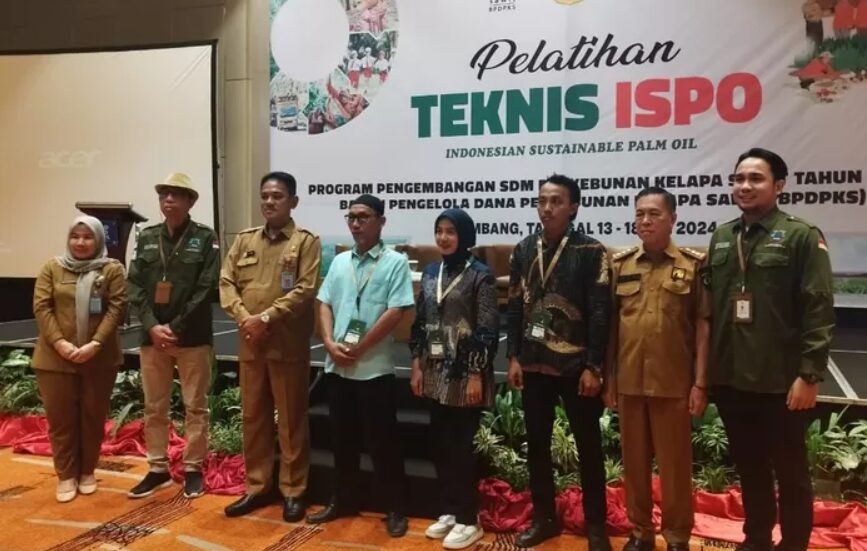
Recently, the BPDPKS and the Agriculture Ministry’s Plantation Directorate General organized a technical training on Indonesian Sustainable Palm Oil (ISPO) for the oil palm smallholders in South Sumatra (Sumsel) province. Held in Palembang, the one-week training from Monday to Saturday, 13 – 18 May 2024, is participated by 85 smallholders, consisting of 25 smallholders from Musi Banyuasin (Muba) regency and 60 smallholders from Ogan Komering Ilir (OKI) regency.
This ISPO technical training is aimed to increase the knowledge of participants on technical matters of oil palm cultivation, such as the use of fertilizer and pesticide, and the principles of sustainability in producing palm oil, including its social, economic and environmental aspects. The sustainability training subjects also include environmental conservation and how to protect biodiversity.
Concluding their training, the participants had a chance to visit the plantations operated by the village cooperative unit (KUD) Sejahtera in Sekayu district of Musi Banyuasin (MUBA) regency in South Sumatra, where the good practices were shown in the field.
At almost the same time, on 13 – 17 May 2024, BPDPKS and the agriculture ministry’s plantation directorate general organized a technical training on oil palm cultivation in Banda Aceh. During the training, which was participated by 91 smallholders from Aceh Barat and Nagan Raya, Aceh province, BPDPKS invited five academic speakers from Bogor University of Agriculture (IPB), namely Dr. Hariyadi, Dr Ir Suwardi, M.Agr, Dr Ir Supijiatno MSi, Ir Sofyan Zaman MP and Ir Sri Hermawan.
Haryadi underlined the importance of training smallholders as they play an important role in Indonesia’s palm oil industry, which has now become the main engine of growth for Indonesian economy. “Palm oil industry contributes significantly to Indonesian economy. It is one of Indonesia’s main export products. It contributes foreign exchange of Rp600 trillion per year, exceeding the foreign exchange from oil-gas sector at around Rp200 trillion per year.
“The smallholders have become our economic heroes, as they save Indonesian economy during economic crisis in 1998 and again during the outbreak of Covid-19 pandemic from 2019 to 2022. At that time, without palm oil Indonesian economy will collapse and will find it hard to revive,” he said.
Previously, BPDPKS in cooperation with the agriculture ministry’s plantation directorate general and the Yogyakarta Plantation Community Academy (AKPY – STIPER) also held a 5-day training (Tuesday – Saturday, 7 – 11 May 2024) for a total of 209 oil palm smallholders operating in Keera area of Wajo regency in South Sulawesi province.
The AKPY – STIPER Director Dr. Sri Gunawan, S.P, M.P, IPU said during the training that the smallholders were empowered with the knowledge on good agriculture practices (GAP) in oil palm plantations. “During such trainings participants are always given a chance to visit the plantations operated by companies. There they will see the theory of good agriculture practices implemented in the field,” he told reporters during the plantation visit in Wajo.
According to him, the training has shown the smallholders the best practices from the beginning of palm cultivation until harvesting. “It’s very important for them to emulate the best examples, starting from choosing quality seedlings, maintenance until harvesting,” he said. (*)
Source: sawitku.id