JAKARTA – Many people think that the imported palm oil products contribute no economic benefits to the importing countries or even possibly worse could harm their economies.
It has been the common practices in international trade that countries impose tariff policies of import/export (duty, levy, value added tax/VAT, etc), as a way to increase the government tax revenue. Such practices also apply to the imports of palm oil products in the importing countries with different rates in each country. Besides the taxes from the international trade, the state income in importing countries is also derived from a variety of taxes collected along the supply chain of palm oil from the point of importing, processing, trading, and consumption.
The study of European Economics (2014) shows that the government tax revenue enjoyed by the governments of the European Union (EU) countries as a result of the imports of palm oil and the palm oil down-streaming reached € 2.6 billion (Photo 8). The distribution of government tax revenue from import and palm oil down-streaming in every country depends on the volume of imports and the intensity of palm oil down-streaming in the respective countries. Top-5 countries receiving the government tax revenue in EU are Italy (19 percent), Spain (8 percent), Germany (7 percent), Britain (7 percent) and France (6 percent).
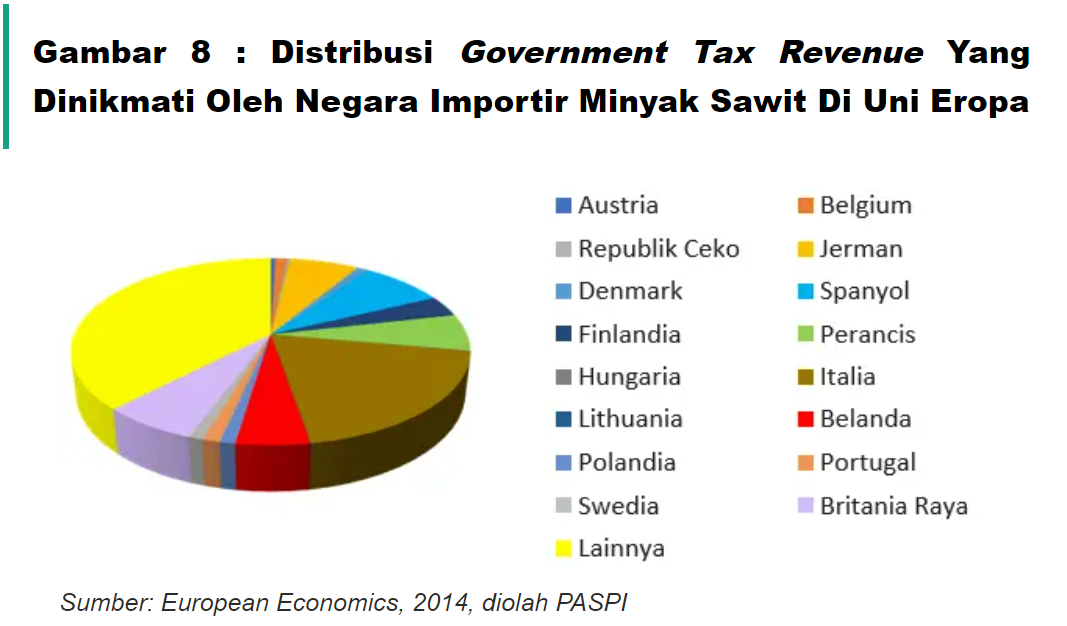
The facts show that palm oil importing countries receive government revenue. The higher their palm oil imports and palm oil down-streaming, then the higher the government revenue enjoyed by each of the EU’s importing countries. (*)
Source: Mitos 3-05 – Mitos & Fakta Kelapa Sawit – 4th Edition