JAKARTA – The palm oil industry is an exclusive industry. Apparently, it is an accusation that has been very often leveled at the palm oil ever since the inception of the industry in 1980s.
At that time, many economists opined that the palm oil industry will only benefit corporations. They reasoned that the palm oil industry needs big capital to develop oil palm plantation areas and technologies to process the palm fresh fruit bunches (FFB) (CPO-Mill). Such condition, said the economists, makes the palm oil industries unaffordable for the small-scale farmers or smallholders. (Sipayung, 2018).
But then things around the palm oil drastically changed, following the application of several regulations by the government. The regulations rule, among others, the schemes of partnerships such as the nucleus – plasma plantation scheme (PIR/NES), which created opportunities for smallholders to join the oil palm cultivation in small-scale plantations.
Such partnership scheme has driven up the ownerships of small-scale plantations by smallholders. In 2021, the smallholders owned more than 40 percent of Indonesia’s total oil palm plantation areas of 16.38 million hectares.
The partnerships had caused a wider and deeper multiplier effect, empowering the smallholders economically and creating new growth centers in regions across producing provinces of Indonesia. Such benefits of the palm oil industries can be seen from the multiplier indicator of output, income, added value and labor (Table 2).
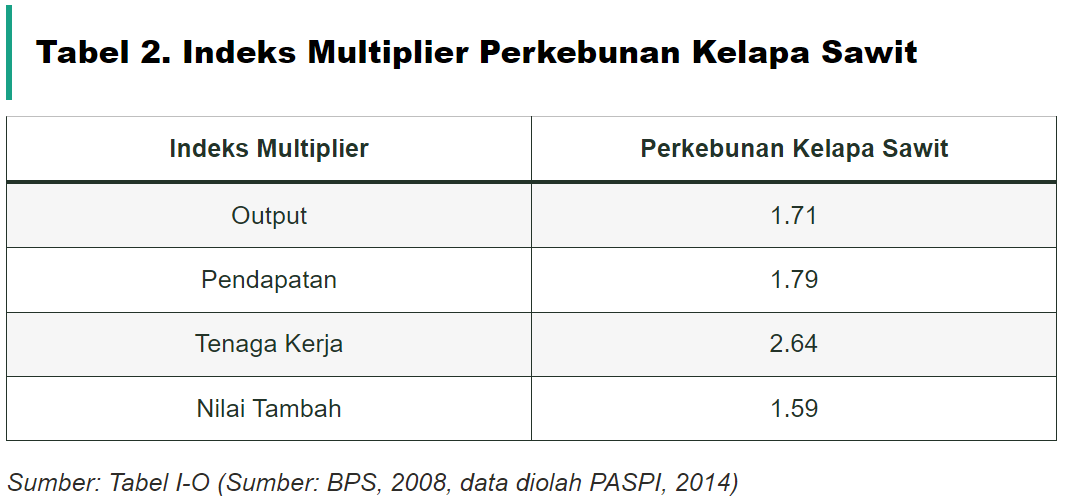
The multiplier index of output, income, labor and added value of oil palm plantations is more than one. It reflects that the benefits of oil palm plantations are also enjoyed by the general public. The increase of economic activities in the oil palm plantations has backward linkages and forward linkages. (Syahza, 2005; PASPI, 2014). The oil palm plantations have backward linkages with the input suppliers of plantation production and forward linkages with the industrial users of palm oil. (Rifin, 2011; PASPI, 2014; Edwards, 2019).
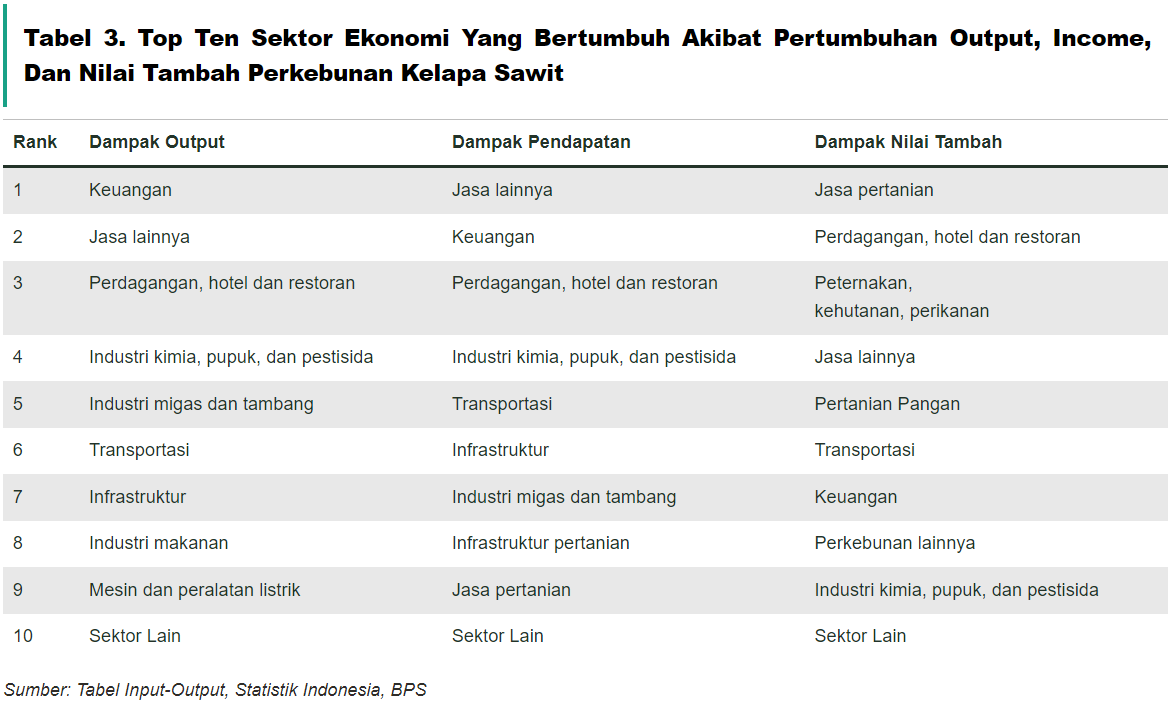
The increase of consumption, investment and exports of palm oil will create bigger benefits (through direct effect, indirect effect, and induced consumption effect), in the forms of output, income, added value, and job creation. The benefits are not only enjoyed in the palm oil industries, but also in the national economy as a whole. (Table 3).
The facts have shown that the palm oil industry is not an exclusive industry, but rather an inclusive one. The growth of Indonesia’s palm oil industries will create bigger economic pie for the national economic sectors, which are directly or indirectly linked to the palm oil industry. (*)
Source: Mitos 3-06 – Mitos & Fakta Kelapa Sawit – 4th Edition