JAKARTA: Do oil palm plantations violate human rights? Perhaps, this is a very intriguing question for many people. Internationally, protection of human rights was recognized in the Universal Declaration of Human Rights in 1948. The human rights consist of personal rights, property rights, rights of legal equality, political rights, social cultural rights, and procedural rights.
The recognition and protection of human rights is also adopted by Indonesia through its ideology contained in its constitution UUD 1945 and Pancasila, which functions as the legal basis for laws and regulations, such as UU No. 39/1999 on human rights.
There is no denying that there has been dissatisfaction in the implementation of human rights protection at regional, sectoral, and national levels. But generally, public awareness on human rights keeps rising and improving, especially since the reform era in 2000. Information openness and the development of mass media and information technology have made it easy for the public to report to authorized institutions if there is any human rights violation.
Based on data from the law and human rights ministry’s human rights directorate general shows that the number of reported cases of human rights violations in many regions across Indonesia is still relatively high, but with a tendency to continually decline. Five provinces with the highest number of reported cases of suspected human rights violations during the period of 2016-2021 (Table 3) are DKI Jakarta, West Java, North Sumatera, East Java, and Central Java.
The legal aspects reported to the national human rights commission (Komnas HAM) include right to life, rights to have family and children, rights to self-development, right to justice , freedom, safety, welfare , participation in government, woman rights, and the right not to be discriminated.
Of course, the reported cases of human rights violation are not always proven legally as legal violations. If proven as violation of human rights, in palm oil producing regions or non-producing regions, the perpetrators of rights violations will be dealt with in accordance with prevailing laws and procedures.
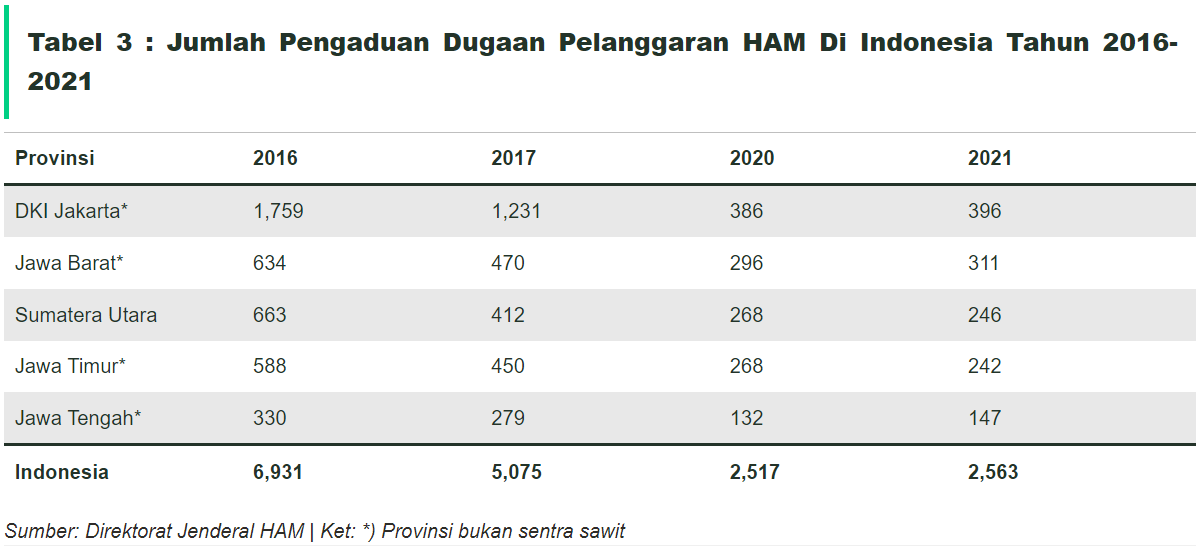
What is interesting from the above Table is that the reports of suspected violations of human rights received by the government from palm oil producing provinces and non-producing provinces. Even the provinces that reported many suspected cases of human rights violations are those of non-palm producing provinces.
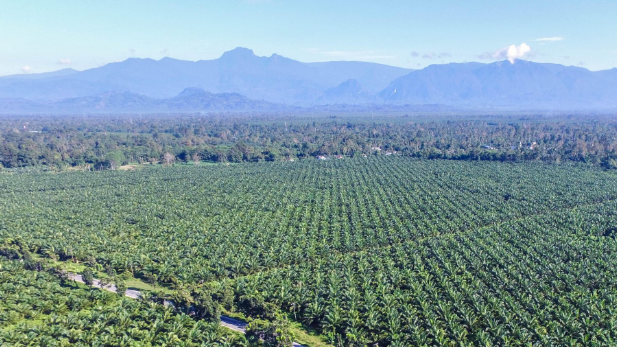
Legal issues suspectedly related to human rights violations which are often accused against the palm oil industries are concerned with exploitation of workers, child labor, gender issue, agrarian conflicts, and freedom of association. Such issues had been unfairly used by palm importing countries to block palm oil products. But are their accusations true? Or conversely, aren’t the discriminatory policies that inhibit palm oil are actually human rights violation?
The palm oil industries are part of the solution to fulfill human rights and not part of human rights problems at the local, national and global levels. The palm oil industries contribute to the fulfillment of human rights as described below:
- The fulfillment of the right to works, businesses, income at national and global levels (Sawit isu Sosial poin 4, Sawit dalam Ekonomi poin 1);
- Fulfillment of right to foods at local, national , and global levels (Sawit dalam Ekonomi Poin 1);
- Fulfillment of right to health;
- Fulfillment of right to education;
- Fulfillment of right to be free from poverty at national and global levels;
- Fulfillment of right of association and freedom of speech.
With such contribution of palm oil industries, aren’t policies and actions that hinder palm oil trading at the global market actually against the principles of human rights?
Source: Mitos dan Fakta Kelapa Sawit – 4th Edition (Mitos 4-19)