The three-day 20th Indonesian Palm oil Conference (IPOC) starting this Wednesday in Bali should be overshadowed by the Oct.23 revelation by Hashim Djojohadikusumo, the younger brother of President Prabowo Subianto, that the government had uncovered around 300 palm oil companies which operated illegally.
“We could soon collect from the rogue plantation companies Rp 300 trillion (US$20 billion) in tax payment arrears and penalties and this has been reported to President Prabowo,” Hashim, the chairman of the advisory board at the Indonesian Chamber of Commerce and Industry (Kadin), told a business conference.
The additional revenues should be a very good news for the new government which has to spend almost 44 percent of its estimated total revenues on debt interest and debt amortization alone next year.
But more detailed information is still needed on how long had those illegal companies have operated and how could 25 of the firms even did not have any taxpayer registration identification numbers and another 15 even did not own any accounts at banks in Indonesia. Without further clarification, Hashim’s statement could raise many questions about the effectiveness of the government oversight of the industry. How could the companies have so far made domestic and export transactions without taxpayer identification or even local bank accounts?
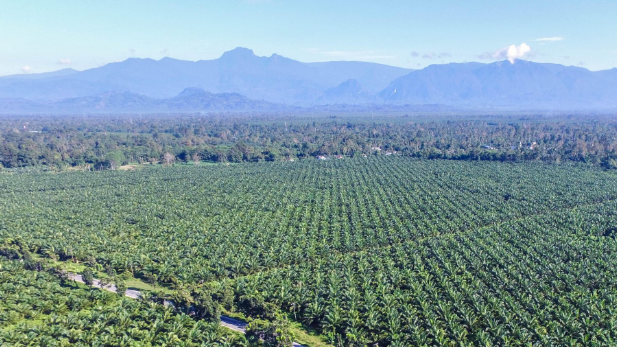
As if Hashim’s shocking remarks are not punitive enough, Minister of Agraria and Spatial Planning/ Head of the National Land Agency, Nusron Wahid told the House of Representatives on Oct. 30 that the government also had uncovered 2.5 million hectares of palm oil cultivation operated by 537 palm oil companies which have plantation business licenses but do not own the Right to Cultivate land title.
Wahid did not elaborate where those 537 companies are located or why such irregularities occurred or how long they have operated but said those illegal oil palm firms were uncovered between 2016 and 0ctober 2024. The troubling question is, how could the local administrations have been unaware of those illegal plantation companies?
“The BPKP (Development Finance Comptroller) is now calculating how much tax penalties would have to be imposed on those companies. But beware that even if those companies would pay up their tax penalties would not be entitled to obtain the Right to Cultivate,” Nusron, Golkar politician, added.
The Bali conference should be a good opportunity for government officials and members of the Indonesian Palm Oil Association (Gapki) to clarify those controversial official statements, otherwise the reputation of the whole industry, which has played a very important role in our economy, would remain tarnished and questionable internationally in terms of sustainability commitment.
Allowing such negative information to linger on could validate the perception as to just how bad has been the public sector and corporate governance of the country’s natural resources, notably the lucrative palm oil industry. Worse, inaction and failure to address this issue will prohibit the President’s efforts in attaining 8 percent annual economic growth and will likely harm efforts in achieving food security and energy self-reliance.
As the world’s largest producer, with an estimated 16.8 million ha of oil palm plantations involving around 4 million smallholder farmers, Indonesia is in a strong position to lead the industry and shape the market globally. Further, the country is richly endowed with land suitable for oil palm plantations and is still able to increase its palm oil output.
What is happening now reminds us of the time in the midst of the cooking oil debacle with skyrocketing prices in 2022. Then-coordinating maritime affairs and investment minister Luhut Pandjaitan set up a special task force for palm oil governance improvement and state revenue optimization to make a nation-wide comprehensive audit and due diligence on palm oil palm plantations.
Then in 2023, Luhut revealed that the due diligence uncovered about 3.1 million ha of oil palm plantations cultivated in forest areas. However, he stated the oil palm estates would not be closed down, but would instead be legalized and put into the tax system, as well as falling under the supervision of the relevant ministry and government agencies. The tax and administrative penalties were still calculated by BPKP.
It is still not clear whether the Rp 300 trillion additional revenues Hashim cited to be collected from 300 palm oil companies are related to the results of Luhut’s due diligence and audit task force and Nusron’s statement on the 537 palm oil fi rms, which did not own the Right to Cultivate land title.
Even now, the palm oil industry is suffering business uncertainty caused by the series of stringent antimarket policies such as export quotas, a domestic market obligation introduced in early 2022 to stabilize the cooking oil price at the government-fixed level after the prices of palm oil skyrocketed due to the massive disruption in the global supply of edible oils.
Palm oil has and will continue to play an increasingly vital role in the economy as it employs more than 17 million workers and involves around 4 million smallholders, but the government urgently needs to reform the governance of the industry. There is no other way to sustain the palm oil benefi ts for the whole economy but for the government to improve its regulatory framework and governance by reducing red tape and strengthening policy certainty and predictability.
Given the complex structure of the palm oil industry associated with formidable longstanding problems and its vital economic role to the country, it is essential for the government to seek ways to address the longstanding unresolved and recurring issues the palm oil industry has been facing.
President Prabowo himself often stated during his presidential campaign earlier this year that he would further develop palm oil not only as a major source of cooking oil and numerous other consumer goods, but also biodiesel in light of supporting Indonesia’s transition to renewable energy.
The Bali conference should be used as an effective forum for vigorous consultation on how to improve the government’s institutional capacity and the regulatory framework for the industry to provide a coherent support system.
Other priority improvement imperatives in palm oil industry include building inter-agency coordination and a clearing house to navigate policy and institutional intricacy toward the amicable settlement of longstanding palm oil problems, as well as creating a concerted intersectoral forum to develop a comprehensive road map and strategic plan for palm oil industry development. (By Edi Suhardi and Agam Fatchurrochman,