JAKARTA – The Ministry of Environment (KLH) will soon start the international carbon trading in Indonesia as part of efforts to mitigate the impacts of global climate change and open up new economic opportunities for business players.
“We invite all business players to take part in the carbon trading as a way to reduce emissions while utilizing the potential of the existing carbon economy,” Minister of Environment/Head of the Environmental Control Agency (BPLH) Hanif Faisol Nurofiq said in a press statement in Jakarta, Tuesday (14/01/2025).
He said the launch of the carbon trading system shows that Indonesia is increasingly serious about addressing the global problem of climate change. Through Presidential Regulation No. 98/2021, the government has established a carbon trading mechanism as part of the carbon economic value (NEK).
The mechanism itself will be managed by the National Registration System for Climate Change Control (SRN-PPI). SRN PPI aims to ensure that every stage of carbon trading is recorded clearly and transparently.
According to him, an emission reduction certificate will be issued through this system called the Greenhouse Gas Emission Reduction Certificate (SPE GRK). “The certificate shows that a project has succeeded in reducing greenhouse gas emissions through a verified process, namely measurement, reporting, and verification (MRV). Each certificate issued will be recorded in the SRN PPI and can be accessed by the public, creating a transparent carbon market,” he said.
As part of the initiative, the Carbon Exchange managed by the Financial Services Authority (OJK) will record carbon transactions, both in the domestic and international markets.
“In this case, every carbon transaction executed in the carbon market will be recorded and monitored by the SRN PPI. We plan to start the International carbon trading on January 20, 2025, with four major projects already registered, including natural gas and mini-hydro power plant projects owned by PT PLN Indonesia Power and Nusantara Power. These projects are expected to result in emission reductions that can be traded in the international carbon market,” he said.
“International carbon trading opens up opportunities for Indonesia to contribute more to overcoming global climate change, while also improving the economy through carbon pricing mechanisms,” said Hanif Faisol Nurofiq.
Previously, the Head of the Center for Sustainable Production Systems Research and Life Cycle Assessment (PRSPBPDH) of the National Research and Innovation Agency (BRIN), Nugroho Adi Sasongko, said that Presidential Regulation No. 98 of 2021 stipulates the Economic Value of Carbon as one of the strategies for reducing emissions, which is implemented through carbon trading.
“This step is not only a solution to support the Nationally Determined Contribution (NDC) goals, but also an economic opportunity that can encourage innovation and investment in environmentally friendly technology,” Nugroho said during the Indonesian Carbon Trading Socialization in Jakarta on Monday (13/1).
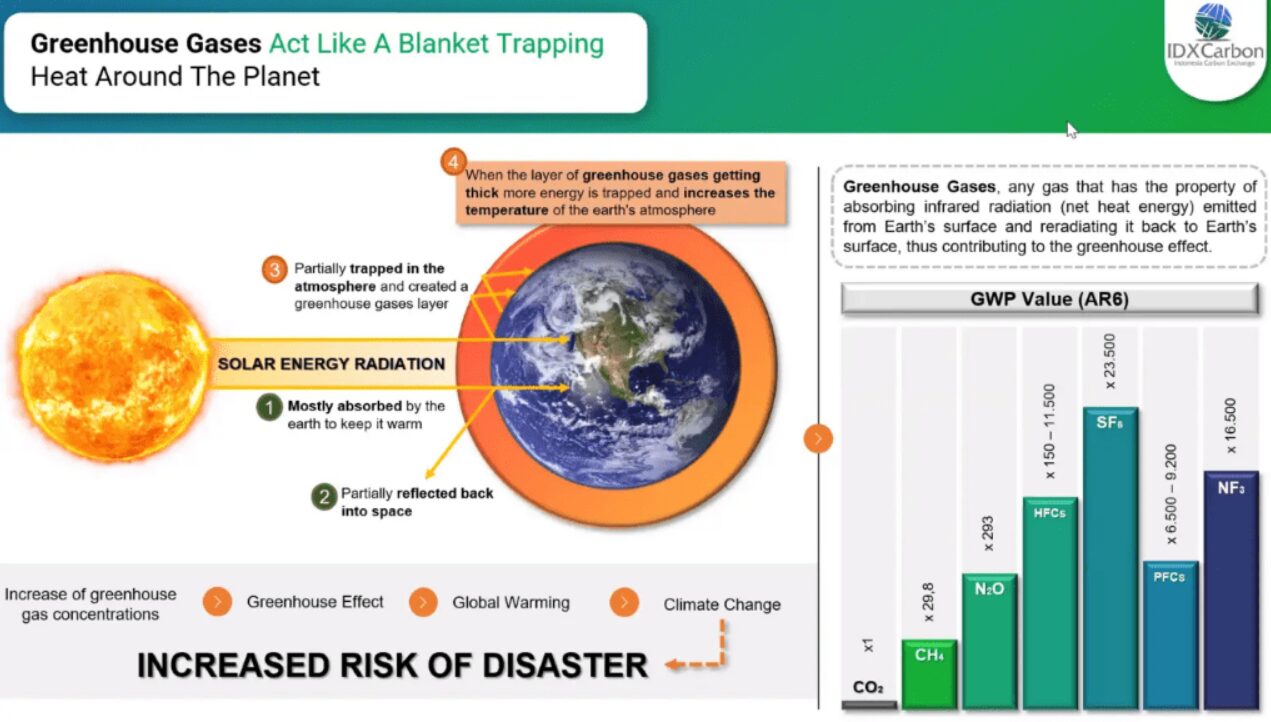
Nugroho said that climate change has become a global challenge that is urgent to address. Its impacts, such as the increase in the earth’s temperature, have been seen in various parts of the world.
Through COP 21 in Paris, the international community agreed on steps to reduce the temperature increase to 1.5 degrees Celsius, as stated in the Paris Agreement. As part of this effort, Indonesia is committed to achieving the target of reducing greenhouse gas emissions through the Enhanced Nationally Determined Contribution (ENDC).
“The target set is a reduction in emissions of 31.89 percent to 43.20 percent in 2030 compared to the business as usual scenario,” said Nugroho.
Senior Analyst for Carbon Trading Development at PT Bursa Efek Indonesia—the operator of the Indonesian Stock Exchange (IDX), Parlin Octavian Waldemar Tambunan stated that business players who are interested in joining the carbon exchange through IDXCarbon must comply with the established mechanisms.
“This aims to maintain the credibility and quality of carbon trading. PT Bursa Efek Indonesia, through the IDXCarbon platform, provides carbon trading infrastructure under the supervision of the Financial Services Authority. IDXCarbon is designed to ensure transparency, liquidity, efficiency, and ease of accessing in carbon transactions,” Parlin said.
“This platform provides high-quality carbon trading solutions with the best security and ease of international transactions,” he added. (*) Source: sawitindonesia.com