JAKARTA – The global need for vegetable oils has been continually rising along with the global economic growth and population growth. Those vegetable oils are commonly used as raw material to feed a variety of industries, such as foods, soaps, shampoos, detergents, cosmetics, personal care, pharmacy, biodiesel, etc.
Globally, there are four kinds of main vegetable oils, namely palm oil (crude palm oil and crude palm kernel oil), soybean oil, rapeseed oil, and sunflower oil.
The production of those vegetable oils have been continually increasing to mainly fulfill the rising needs of those global industries. As a result, the production increase has increased deforestation across the globe, including in other countries that produce other vegetable oils besides the palm oil in Indonesia.
Possibly, the combinatory facts of Indonesia as the world’s largest producer and exporter of palm oil and its largest share in the global market of vegetable oils at around 40% have been mistaken by a number of green NGOs. They accuse oil palm growers as the cause of massive deforestation due to their massive expansion to increase palm oil production. But actually, their accusations are completely baseless and are not supported by scientific facts.
In fact, they had misunderstood the palm oil, which actually has much higher productivity, higher efficiency and higher versatility compared to other vegetable oils. Such properties have made palm oil more preferable among industries and consumers across the globe.
Require Less Land
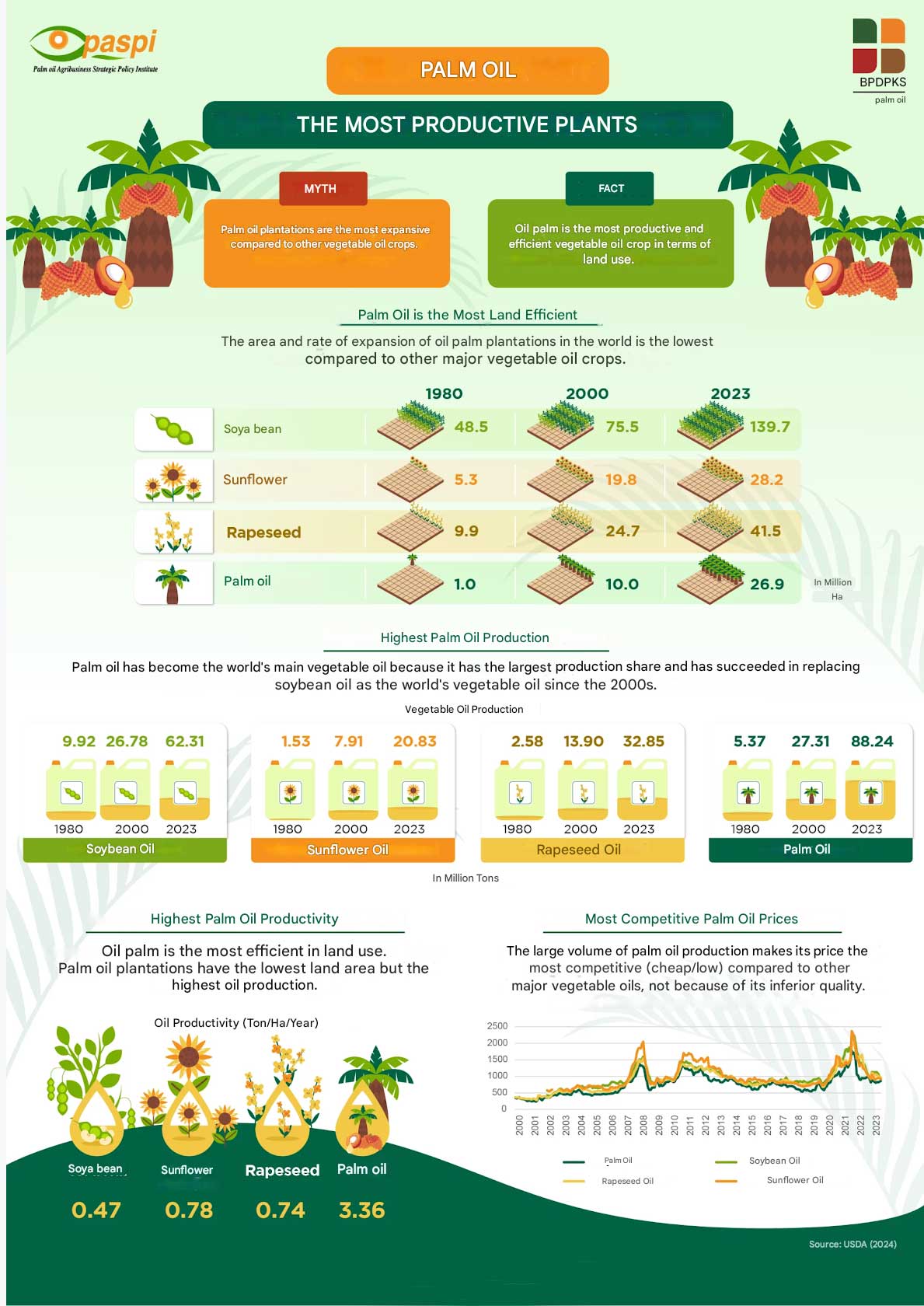
The productivity of oil palm per hectare of land per year is 8 to 10 times higher than the productivity of other vegetable oil crops. It means other vegetable oils generally require around eight to ten times more land to produce the same amount of oil, making the oil palm trees as the most land-saving vegetable oil crop compared to other vegetable oil crops in the world.
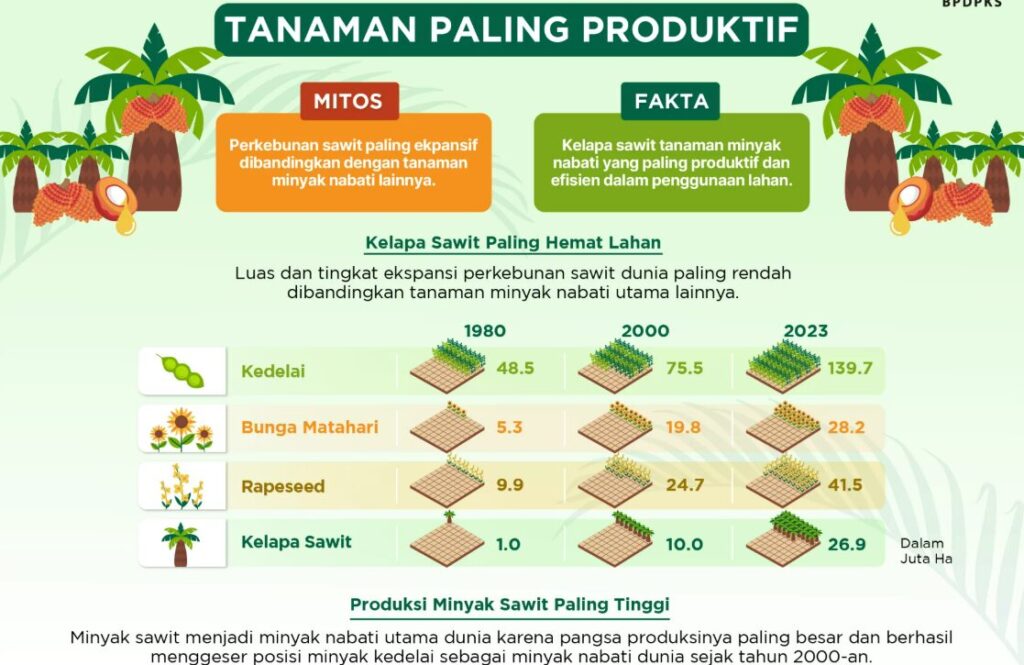
In 2023, the total area used for cultivation of soybean crops worldwide reached 139.7 million hectares, while rapeseed and sunflower plantations have a global total area of 41.5 million hectares and 28.2 million hectares respectively. But the total area of oil palm plantations worldwide only reached 26.9 million hectares. During the period of 1980 – 2023, the soybean plantations are not only the largest in the world in terms of total area, but also the highest in the world in terms of land expansion growth compared to other vegetable oils.
Much Higher Productivity
Palm oil productivity is also the highest, namely 3.36 tons per hectare per year compared to soybean oil at only 0.47 tons per hectare per year, rapeseed oil at 0.74 tons per hectare per year, and sunflower oil 0.78 tons per hectare per year. Palm oil has become the world’s main vegetable oil because of its dominant production and has succeeded in replacing soybean oil as the world’s main vegetable oil since early 2000s.
Cheap Price
The price of palm oil is also very reasonable. Not because the quality is lower, but the large production volume makes the price of palm oil very competitive compared to other main vegetable oils.
The more affordable price of palm oil provides benefits for the global community. Competitive prices, year-round availability, and various applications for palm oil have made it a preferred choice as a substitute for other vegetable oils in the global market. (*)
Palmoilina.asia. https://palmoilina.asia/berita-sawit/kelapa-sawit-tanaman-produktif/. Kelapa Sawit Tanaman Paling Produktif [Infografis 2024]. April 25, 2024