JAKARTA – The Ministry of Forestry (Kemenhut) said that oil palm plantations and forest areas should be integrated with a view to maintaining environmental sustainability and boosting the national economy.
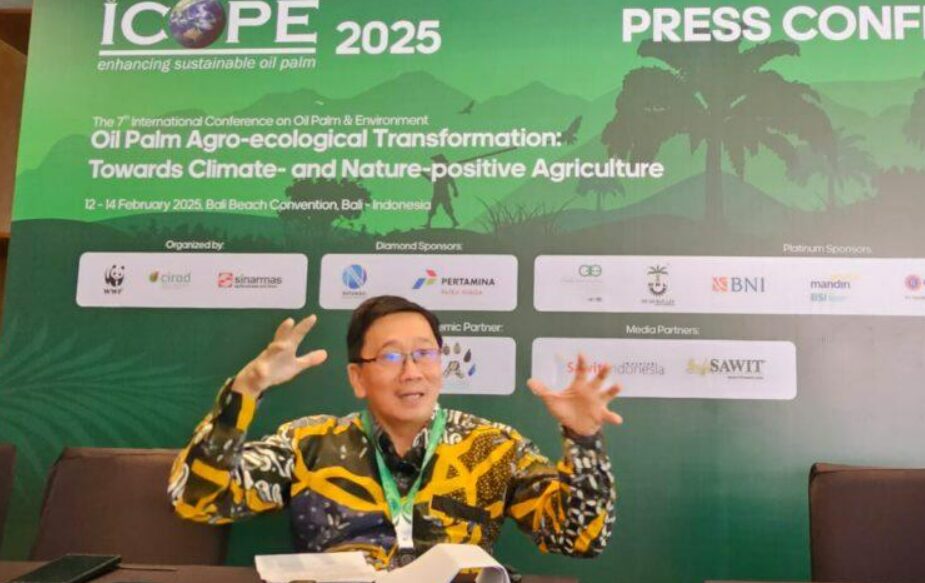
“This integration system can be achieved through a well-planned system of agroforestry,” Secretary of the Directorate General of Sustainable Forest Management of the Ministry of Forestry Muchamad Saparis Soedarjanto said on the sidelines of the 2025 international conference on palm oil and the environment (ICOPE) in Sanur, Denpasar, Bali, Thursday (13/02/2025).
According to him, the agroforestry system could be implemented through a combination of oil palm plantations with the planting of productive food crops and conservation of biodiversity through the establishment of animal corridors that are linked to forest areas in surrounding palm plantations.
He said such integration will sustainably protect the existence of animals while maintaining ecological balance.
However, he added that this integration requires careful planning and paying attention to important indicators, which include the types of soil, climate and local biodiversity.
“Continuous monitoring and evaluation are also needed to assess the effectiveness of the strategy,” he said.
This integration effort, he said, can be carried out considering that the palm oil industry has become an engine of economic growth and provides economic resources to the local communities and other Indonesian people.
“Kemenhut is waiting for a recommendation of ICOPE 2025 that can be used as a comprehensive solution to the problem of forest and environment in relation to today’s theme of integrating oil palm plantations with forest areas and nature,” said Saparis.
Saparis said that the palm plantations have become the main driver of national economic growth and the source of livelihood for the general public.
He said that the sustainability consideration is also necessary from the perspective of population growth.
The population of Indonesia during the period of 2010 – 2020 has been growing at 1.25 percent per year or higher than the projection of 1.18 percent.
“It is for the purpose of maintaining the sustainability, the palm plantation companies need to take a more holistic approach to integrate their palm plantations with the natural ecosystem. It can be achieved through the system of agroforestry which combines oil palm plantations with other kinds productive plants and conservation of biodiversity, such as developing wildlife corridors to link the fragmented forest areas around the plantations ,” he said.
“The integration of high conservation value forest (HCVF) in the oil palm plantations is a responsible step to ensure sustainable practices in balancing between the economic need and environmental and social consideration,” he said. (*) sawitindonesia.com