JAKARTA – There are 17 types of edible oils available on the global market to meet the rising global demand for various products of foods, energy and raw materials for various industries. Of the total 17 edible oils, there are 4 vegetable oils that dominate the global market.
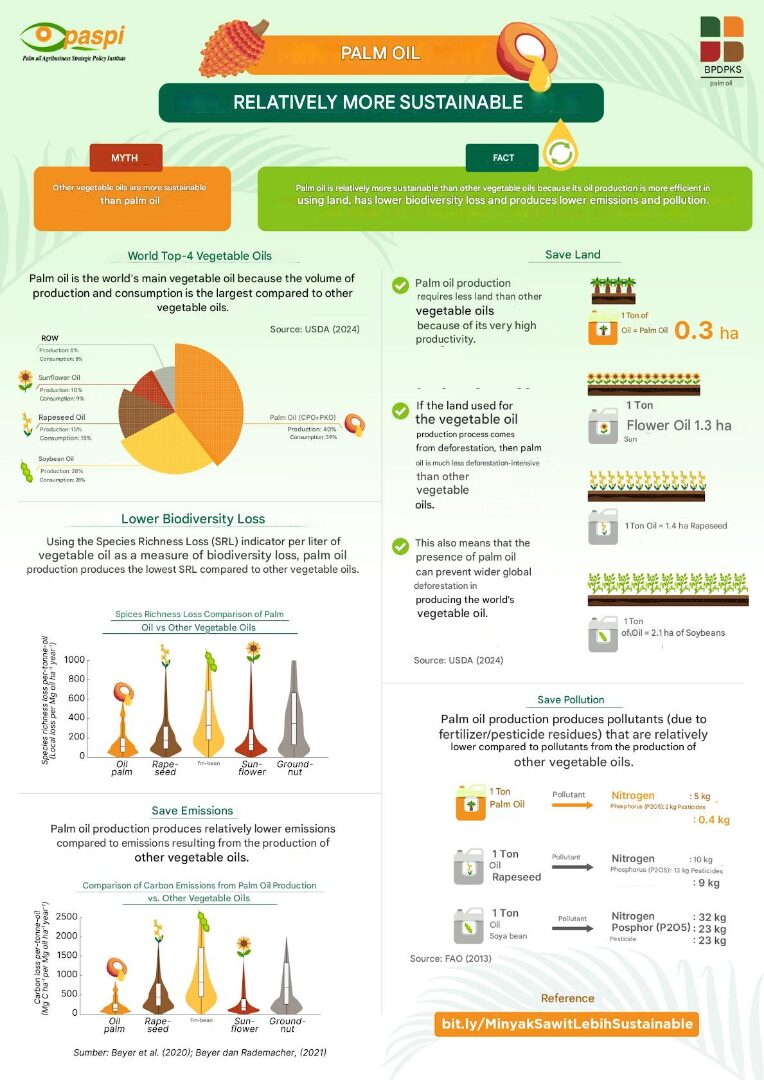
The four vegetable oils, namely palm oil, soybean oil, rapeseed, and sunflower oil, account for around 90 percent of total global production and consumption.
The Worls’s Most Favorite Edible Oil
Among the world’s Top 4 vegetable oils, palm oil is listed as the leading vegetable oil that dominates world production and consumption. Despite the oil palm plantations being only developed commercially in the 1970-1980s and achieved revolutionary production growth in the early 2000s, palm oil has managed to outcompete soybean oil which had dominated the global market of vegetable oils since a century ago.
Global Anti-Palm Oil Movement
Along with its great success, palm oil also faces greater challenges, just as a parable illustrates: “The taller the tree, the stronger the wind hits.” Its global challenges include many unfounded accusations, negative issues, black campaigns and anti-palm oil movements which have been initiated by certain groups of people, especially in western countries. Such dynamics illustrate non-price competition between palm oil versus other vegetable oils at the global market.
In the 1980s, the narratives used by competitors (other vegetable oil producers) to tackle palm oil were dominated by health issues, by presenting false information that palm oil contains cholesterol. This negative perception was campaigned by the American Soybean Association (ASA) with the aim to persuade the USA government to ban palm oil import into the American market. But the campaign was successfully defeated by researchers/scientists from palm oil producing countries with the argument that palm oil does not contain cholesterol because it is produced by plants as cholesterol is only found in animals and humans. Although many recent empirical studies have increasingly strengthened this argument, the perception that palm oil contains cholesterol is still ingrained among global community, including Indonesia.
Empirical Studies Favor Palm Oil
After being refuted with data and facts based on empirical studies, those trans-national NGOs changed their theme of black campaigns from health issues to environmental issues. They disseminate information that palm oil is not sustainable and its production and consumption will only lead to environmental destruction across the world.
On the contrary, various empirical studies show that palm oil is relatively more sustainable compared to other vegetable oils. Oil palm plants have the advantage of high productivity. Oil productivity per hectare in oil palm crops is around 8-10 times higher than the productivity of other vegetable oil crops (soybean oil, rapeseed oil and sunflower oil). The implication is that the land required to produce palm oil is less than other vegetable oils. To produce 1 ton of oil, oil palm trees only need 0.3 hectares of land, while the sunflower, rapeseed and soybean respectively need 1.3 hectares, 1.4 hectares and 2.1 hectares of land areas.
By assuming that the land used for the vegetable oil production comes from deforestation, then palm oil production only causes less deforestation if compared to other vegetable oils. This also means that the presence of palm oil can prevent higher global deforestation in producing global vegetable oils.
Other empirical studies also reveal the superiority of palm oil in relation to sustainability. For example, the study of Beyer et al. (2020) and Beyer & Rademacher (2021) found that carbon emissions from palm oil production are lower than other vegetable oils. These two studies also reveal that biodiversity loss from palm oil production is much smaller compared to other vegetable oils. The FAO study (2013) also found that palm oil production causes relatively few pollutants (pesticide and fertilizer residues) compared to rapeseed oil and soybean oil.
No Edible Oil Without Deforestation
The production process for each type of vegetable oil (including palm oil) in various producing countries is still linked to deforestation, biodiversity loss, emissions and pollutants. If you want to look for vegetable oil that is free from deforestation, biodiversity loss, emissions and pollutants, then you are an unrealistic person because you will never find it in the real world. So, the question is no longer about looking for something clean and free from the environmental issues, but about which of the vegetable oils that cause the least amount of deforestation and emissions. To such question, surely the answer is palm oil.
The superiority of palm oil, which is relatively more sustainable, will continue to rise through improvements in all chains of its production process. This commitment is reflected in the fulfillment of ISPO (Indonesian Sustainable Palm Oil) and RSPO (Roundtable Sustainable Palm Oil) sustainability certification (as well as other certifications).
In fact, through the ISPO Presidential Decree, sustainability commitments have become mandatory at the level of on-farm actors, both corporate and smallholders. This awareness has been directed at the downstream palm oil industries in Indonesia, although currently there are no regulations issued and socialized to the public regarding ISPO for finished products (downstream palm oil).
Palmoilina.asia. https://palmoilina.asia/berita-sawit/minyak-sawit-dan-minyak-nabati-dunia/. Minyak Sawit vs 3 Minyak Nabati Dunia [INFOGRAFIS 2024]. Juni 21, 2024