JAKARTA – Is it true that only oil palm plantations that cause deforestations? What are their origins, actually?
The development of oil palm plantations is part of economic activities implemented by Indonesia as part of its efforts to improve the welfare of Indonesian people. Certainly, such economic activities need land areas, which are not necessarily always originated from forests, but could be from other sources.
But if we trace the economic development in each country further into the past, we will see that cities, industrial zones, settlements, and agriculture were resulted from deforestations, which were implemented to increase their public welfare.
Indonesia has seen a very significant growth of oil palm plantations during the last 30 years, which gives rise to a prejudice that palm plantations are developed with deforestations. Certain groups of people suspected that the palm plantations are the main cause of deforestations in Indonesia.
All Countries Do Deforestation
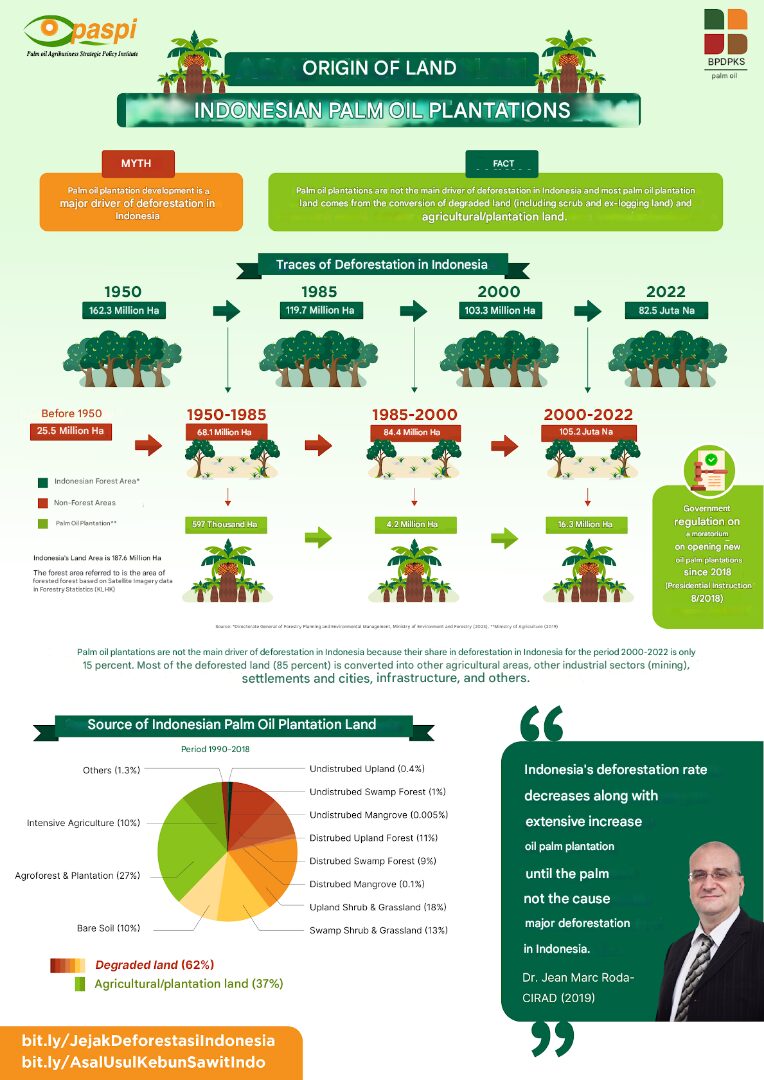
History has shown that all countries in the world, including those in Europe and the United States of America (USA), have converted forests to non-forests (deforestation) to meet their increasing needs for space, both for economic activities (industry and agriculture) and residential areas. In Indonesia, the deforestation has occurred since 1950 with an area of 25.5 million hectares and continued to increase until it reaches 105.2 million hectares in 2000-2022. On the other hand, Indonesia’s oil palm plantation areas also increased to 16.3 million hectares in 2022.
Actually, if compared proportionally, the increase of oil palm plantations is only 15 percent of the total area of deforestation in Indonesia. This means that oil palm plantations are not the main driver of deforestation in the country. And if not oil palm plantations, then who and what sectors that have been using the estimated 89 million hectares of lost or deforested land areas?
Forgotten History of Deforestation
Past historical records show that the Ministry of Forestry during the New Order era (1969-2000) granted many massive and intensive logging permits, especially on the islands of Sumatra, Kalimantan and Sulawesi. These logging activities have resulted in a lot of forest land being degraded and turned into abandoned bushes. Therefore, the New Order Government had tried to utilize the ex-logging land areas through a number of programs, which include transmigration and development of oil palm plantations.
Oil Palm Land From Ex-logging Areas
To strengthen the counter negative issue, Gunarso et al. (2019) conducted a study on the origins of oil palm plantations from 1990 to 2010, then continued by Suharto et al. (2019) for the 2010-2018 period. This study uses land use change data from satellite imagery released by the Planning Agency of the Ministry of Environment and Forestry. The results of this study show that around 62 percent of oil palm plantations come from degraded land (including scrub land, ex-logging land) and around 37 percent comes from agricultural land, plantations and agroforestry.
Various researches such as by Erniwati et al. (2017) and Santosa et al. (2020) also revealed the same case, namely that Indonesia’s oil palm plantations are not originated directly from forest conversion, but from converting forests into scrub (degraded land) or agricultural/agroforestry land, and then into oil palm plantations. Apart from Indonesian researchers, international researchers also expressed the same thing. A study by Jean-Marc Roda from the French Agricultural Development Institute (CIRAD) in 2019 revealed that the rate of deforestation in Indonesia decreased along with the increase in the area of oil palm plantations so that palm plantations are not the main cause of deforestation in Indonesia.
On the other hand, the Indonesian Government has also continued to improve palm oil governance through the implementation of Presidential Instruction No. 8 of 2018 regarding the moratorium on opening new oil palm plantations. This regulation has been in effect since 2018 and continues to be extended until now. This shows the commitment of national palm oil stakeholders to ensure sustainable palm oil development, including upholding zero-deforestation commitments. (*)
Palmoilina.asia. Asal-usul lahan sawit. palmoilina.asia/berita-sawit/asal-usul-lahan-sawit/. Desember 27, 2023