JAKARTA – The old palm trees at the age of between 25-30 years old are usually considered unproductive and no longer have economic values. Those old palm trees must be cut down so that the palm plantations can be replanted.
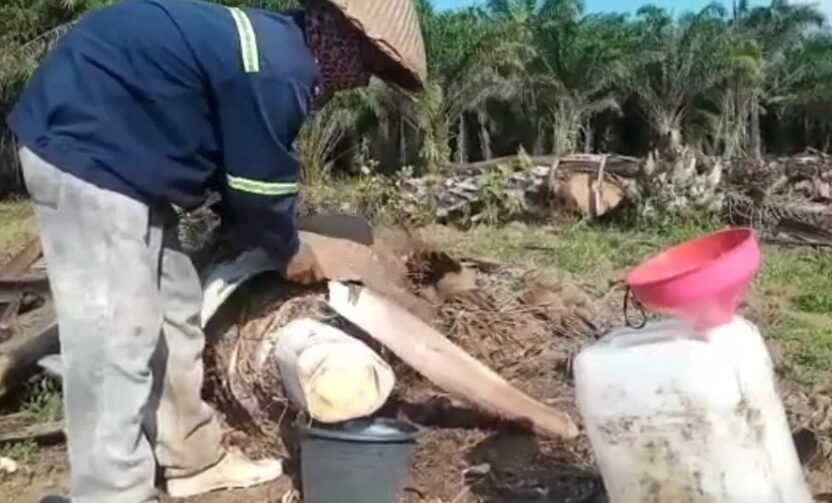
However, it turns out that based on a study, the old oil palm trees can have high potential economic value. Apparently, these trees contain sap which can be processed into liquid sugar, among other things.
Dr. Siti Nurdjanah, the researcher of the old palm trunks and professor of agriculture at the Faculty of Agriculture, University of Lampung (Unila), said recently that the potential of sap in old oil palm trees could become a financial solution for oil palm smallholders who will be undergoing a replanting of their plantations. So far, many farmers have been reluctant to replant because they are afraid of losing income during the replanting period before their oil palm trees can start producing.
She said that the research on old oil palm trunks was funded by the Plantation Fund Management Board (BPDP) and published in the book “Grant Riset Sawit 2024” entitled “Development of Technology of Liquid Sugar Production from Old Oil Palm Trees to Support the National Program of Oil Palm Replanting”. The finding had been also presented by Dr. Siti Nurdjanah as a scientific oration in her inauguration as a professor at the Faculty of Agriculture, University of Lampung at the end of last year (2024).
“The potential of sap from old oil palm trees can be a financial solution for smallholders. One old oil palm tree produces 100 liters of sap. In one hectare, there is a potential of 10,000 liters of sap that can be used as raw material for liquid sugar,” she said.
The process of producing liquid sugar from old oil palm trunks begins with the cutting of trunks into smaller parts. Then the cut trunks are stored in a storage room at a temperature of 25±5 °C, relative humidity of 75±5% for 4 days. After that, the trunks are peeled and chopped into small particles and then pressed using a screw press to extract the sap. The resulting sap is filtered with a two-layer 200 mesh filter cloth and then evaporated until the total dissolved solids reach ≥70° brix. This treatment produces a liquid sugar yield of 24% with a heating time of 135 minutes. This liquid sugar has the characteristics of pH 5.5, 72°brix, ash content of 3.17%, total reducing sugar of 87.82 g/100 g, total phenolic compounds of 872.7 mg/100 g, total flavonoids of 28.42 mg/100 mg, DPPH antioxidant activity of 80.394% and ABTS antioxidant activity of 89.300%.
Based on several trials and their results, the business of making liquid sugar from old oil palm trunks is feasible. The resulting liquid sugar does not have heavy metal contents, tastes sweet, has no bitter aftertaste, a calorific value of 232.86 k calories/100 g and a shelf life of 2 years. The conclusion will of course still be tested again by utilizing old oil palm trunks from different regions because the variation in the content of oil palm trunks can be different.
According to Dr. Siti Nurdjanah, this research still needs to be further improved in production scale from laboratory scale to mini plant scale with a capacity of 150-200 L of liquid sugar per day. “The method of obtaining sap can be by tapping or pressing,” she said.
Dr. Siti Nurdjanah said that with the number of oil palm plantations ready to be rejuvenated around 600 thousand hectares, there are 60 million old oil palm trunks that can be used to produce sap with the assumption that 1 hectare has 100 oil palm plants. Each oil palm trunk produces 6 liters of sap for 30 days. With 60 million oil palm trunks available, there are 10.8 billion liters of sap each year that have the potential to be used as raw material for liquid sugar.
As Indonesia has a total area of oil palm plantations at 16.38 million hectares, the country is potential to produce the liquid sugar at much higher volume. “The potential production of liquid sugar is huge because the total sugar content of old oil palm sap reaches 17.6%. This potential can be utilized by the smallholders in implementing the replanting program,” she said. (*) Source: sawitkita.id