JAKARTA – The ministry of energy and mineral resources (KESDM), through its directorate general of renewable energy and energy conservation (EBTKE), is preparing a new regulation on the implementation of mandatory bioavtur (Sustainable Aviation Fuel – SAF) 3% in the near future.
“I’ve been sounding it out anywhere I can to allow the implementation of bioavtur mandatory program stipulated in a ministerial regulation. We’d like to have it in a blending of 3% bioavtur, instead of just 1%,” EBTKE Director General Eniya Listiani Dewi said at Senayan Park, Jakarta, on Friday (16/05/2025).
According to Eniya, if Indonesia can realize the bioavtur 3%, then it will outperform Singapore which will start its bioavtur 1% in 2026. “Singapore will only implement its mandatory bioavtur with only 1% blending in 2026. We in Indonesia will make it higher at 3%, but we have to be ready,” she said.
She noted that the target of three percent blending is the maximum one as it has to be adjusted to technological capacity of blending owned by PT Pertamina’s refineries.
“Why it is only up to three percent maximum? It’s because the refineries of KPI (PT Kilang Pertamina Internasional) are still based on coprocessing system. So, the bioavtur blending can only be made at the maximum of three percent,” said Eniya.
According to her, if there are more companies able to do the blending, then the target can be raised up to five percent. “Pak Menteri (Minister Bahlil) has asked for one more company. If there is one more with production capacity of 300,000 kilolitres, for example, it can possibly be realized at five percent,” added Eniya.
Production cost
Despite the ambitious target of bioavtur, the increase of its blending will affect its production cost and then also the increase of plane ticket prices. “But if we follow Singapore’s steps, the cost of mandatory bioavtur program can be fully charged to airline passengers. And on the part of passengers, they can claim carbon credits because they have used bioavtur-powered airplanes.
“If Singapore implements its bioavtur mandatory program, then the increase of ticket prices will be charged to passengers. But in that case, passengers can claim their own carbon credits,” she said.
Currently, the development of bioavtur in Indonesia has achieved significant progress. The state-owned energy company PT Pertamina has managed to produce bioavtur in its Cilacap refinery with a blending of 2.4%, and had successfully conducted flight test of using bioavtur with the aircraft of CN235 owned by PT Dirgantara Indonesia. Later on 27 October 2023, the Pertamina’s bioavtur was used for commercial flight test using airplane of the type Boeing 737-800 NG on the route of Jakarta – Solo round trip.
The company is also developing a bioavtur refinery in Banyuasin, South Sumatera, which will produce bioavtur by using non-standard coconuts.
Carbon reductions
Bioavtur is believed to reduce carbon emissions up to 80% as compared to the conventional fossil avtur. It is expected to reduce carbon emissions from aviation industry, which is one of the largest contributors of greenhouse gas emissions.
The International Air Transport Association (IATA) said that the SAF is projected to be able to contribute around 65% or 718 megaton of CO2 reduction in 2050.
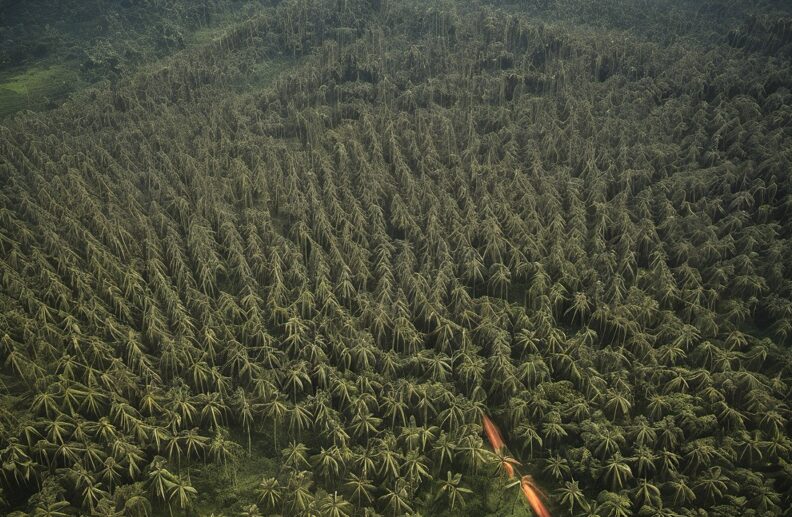
For Indonesia as the world’s largest producer of palm oil, the use of bioavtur is seen more profitable as the raw material for SAF can be locally derived. With huge abundance of raw materials, such as crude palm oil (CPO) and used cooking oil (UCO), Indonesia has the right position to develop a strong industry of bioavtur or SAF. (*)