Are you really sure you know everything about palm oil? How about its land use compared to other vegetable oils?
Do you think that since almost half of the world’s vegetable oils is derived from oil palm, then its land use must be at least half of the world’s total land areas needed to produce the total vegetable oils? If you think so, your are certainly wrong.
The real facts show that palm oil is the most efficient vegetable oil in the world, especially in its land use for cultivation. Due to its high productivity, the oil palm only needs much less land areas to produce much more oil as compared to other vegetable oils.
Palm efficiency: Undeniable Facts
Based on global data, the global oil palm plantations only use land area of around 18.8 million hectares or around 6% of the world’s total land areas needed for the cultivation of all of the global vegetable oils. But the palm plantations can produce 82.4 million tons, which account for 40% of the world’s total production of vegetable oils.
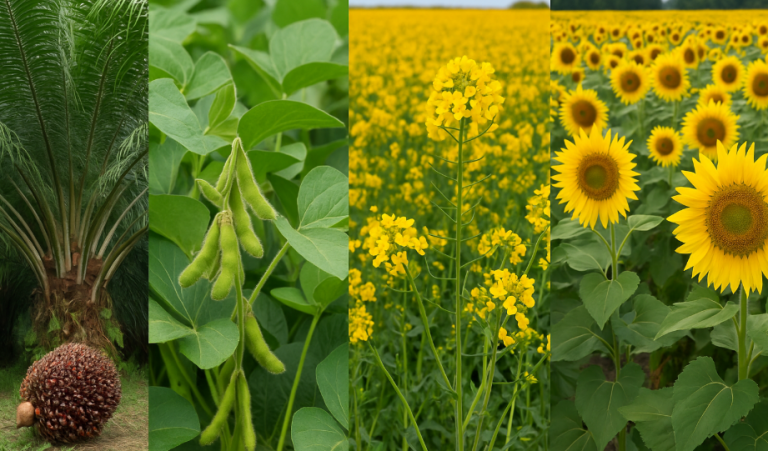
Based on 2017 data from USDA, the land areas used by the world’s top four oil crops (palm oil, soybean, sunflower and rapeseed) reached around 200.5 million hectares. The total areas comprise 61 percent (121 million hectares) for soybean plantations, around 29% for sunflower and rapeseed, and around 10% for oil palm.
In terms of oil production, with 121 million hectares, soybean plantations produce only 53 million tons of oil or only 33 percent of the world’s top four vegetable oil production. On the contrary, oil palm plantations with an area of less than 20 million hectares, can produce 65 million tons of oil or 40 percent of the world’s top four vegetable oils. This is due to the high productivity of palm oil plantation, which is far higher than the productivity of other vegetable oil producing plants
The data shows that from every hectare of land, oil palm plantations can produce 4.0 tons of palm oil per year. It is much higher than other vegetable oils, such as:
- Soybean: Soybean needs 125 million hectares (40% of total land areas) to produce only 55.6 million tons of oil (27.3%), with productivity of 0.4 ton/ha/year.
- Rapeseed: Rapeseed needs 37.7 million hectares (12%) tom produce 27.9 million tons (13.7%), with productivity of 0.7 ton/ha/year.
- Sunflower: Sunflower needs 26.7 million hectares (8,5%) to produce 19.4 million tons (9.5%), with productivity of 0.7 ton/ha/year.
What does it mean for us?
The more land areas used for cultivation, the bigger the impacts caused to the environment due to forest clearing, water consumption, and carbon emission. Here comes the advantages of palm oil: Less land, but more productivity. If all of the global vegetable oils are produced from soybean or sunflower, we will need much more land areas, creating big risk of accelerating global deforestation.
Why palm oil often misunderstood?
The palm oil has often got negative image due to environmental issues, which are often not compatible with its real facts, especially in terms of efficiency, productivity and sustainability. In fact, from the perspective of productivity and sustainable use of land, the palm oil is the best solution to meet the global needs of vegetable oils in a responsible manner with sustainable cultivation and certification of ISPO and RSPO.
If the world wants to fulfil the global needs for foods, energy and cosmetic and hygiene products based on vegetable oils while keeping the environmental conservation, then the palm oil is the solution. The efficiency of palm oil is not a myth. It is its real facts and data that should become a consideration in all debates about palm oil and sustainability. (*)
Bpdp.or.id. Sawit Sumber Minyak Nabati Dunia yang Paling Efisien. https://www.bpdp.or.id/sawit-sumber-minyak-nabati-paling-efisien-palmoil. Feb 28, 2021